







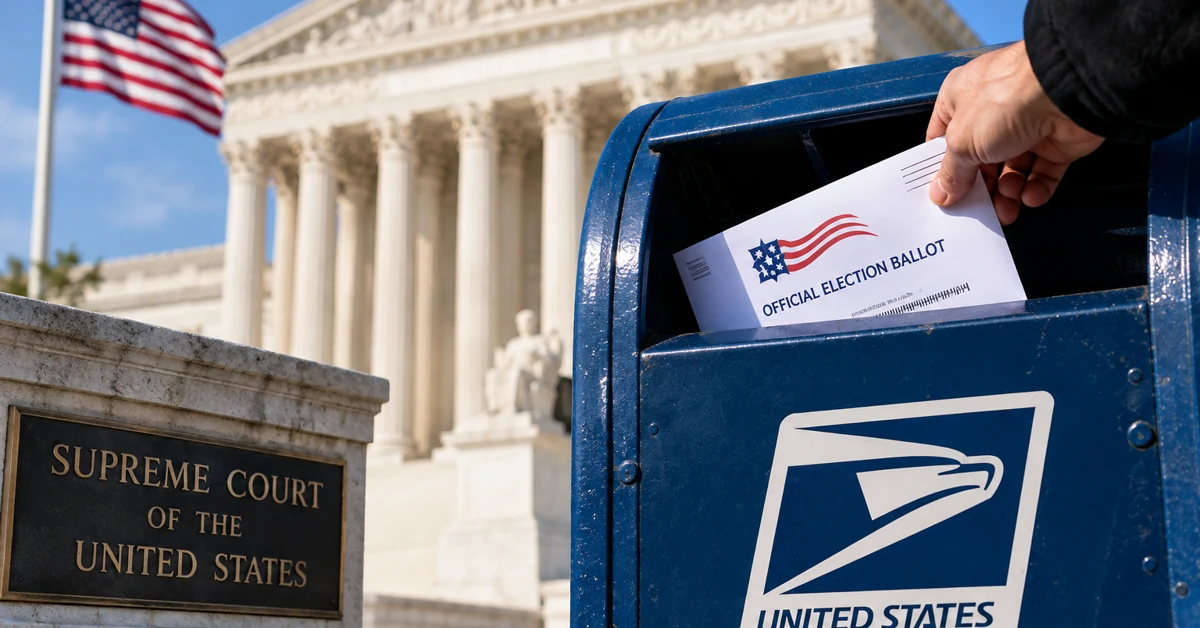
A second federal judge has blocked new Trump administration rules governing mail ballots, warning that introducing the requirements after the election process has already begun could result in otherwise valid votes not being counted.
The latest ruling is particularly notable because U.S. District Judge Carl J. Nichols was appointed by President Donald Trump.
Nichols temporarily blocked the U.S. Postal Service from implementing rules introduced following Trump’s executive order on mail voting.
The changes would require the Postal Service to pre-approve ballot-envelope designs used by state and local election authorities.
States would also have to upload information identifying mail-ballot recipients to an online portal.
According to the Associated Press, that portal is not yet operational.
The timing is already becoming critical.
Mail ballots are being sent to voters in Alabama, North Carolina and Wisconsin ahead of November’s midterm elections.
Nichols concluded that allowing the rules to take effect now would increase the risk that otherwise valid absentee and mail ballots would not be counted.
Election integrity cuts both ways
The ruling does not settle the wider argument over mail voting.
States have legitimate reasons to ensure ballots are secure, properly issued and legally counted.
The question is whether major procedural changes can safely be imposed once election machinery is already running.
This is also no longer a dispute confined to one courtroom.
Another federal judge in Boston has issued a similar injunction, and the Trump administration has asked the Supreme Court to intervene.
That puts the country’s highest court in a potentially consequential position just weeks before the midterms.
Stricter safeguards can strengthen confidence in an election when they are workable and introduced in time.
Rules that risk preventing legitimate ballots from being counted because election authorities cannot implement them quickly enough create the opposite problem.
A secure election should reject invalid votes.
It should also make sure valid votes are counted.
The question now heading towards the Supreme Court is whether an election-integrity measure can undermine election integrity when it is introduced too late to implement safely.
Sources
Join the Dissenting Citizen Newsletter
Independent news and commentary delivered directly to your inbox.
Breaking stories, analysis and commentary throughout the day.
Follow @VoxDissent →