








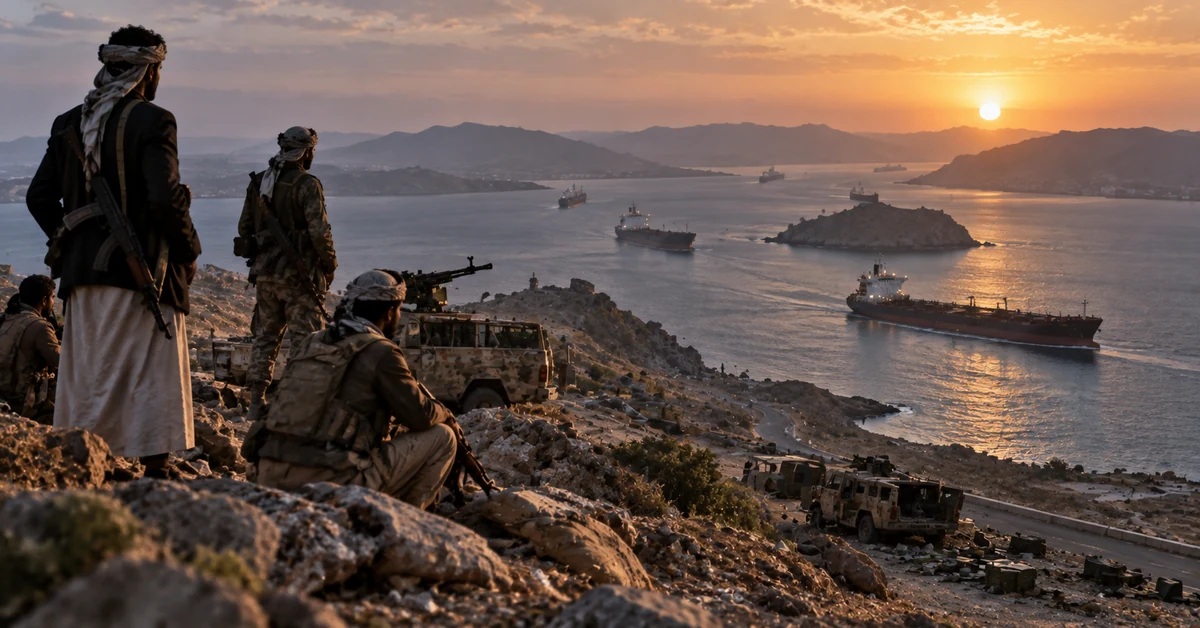
A rapid Houthi offensive along Yemen’s Red Sea coast has delivered Saudi Arabia its most serious setback in the country for years, exposing intelligence failures and leaving the Iran-aligned movement controlling strategically important territory around one of the world’s major shipping routes.
The Houthis quietly assembled an estimated 100,000 fighters ahead of the offensive, according to a diplomatic source cited by Reuters.
Saudi-backed forces then collapsed rapidly as the attack unfolded, abandoning territory and a substantial quantity of advanced US- and Saudi-supplied weaponry.
The scale of the build-up appears to have caught Saudi Arabia and its allies off guard.
The result has strengthened the Houthis’ position around the Bab el-Mandeb Strait, the narrow passage connecting the Red Sea with the Gulf of Aden.
Two strategic chokepoints
The Houthis now control additional territory and islands around Bab el-Mandeb, increasing their potential leverage over commercial shipping through the Red Sea and Saudi oil exports using western routes.
That has wider significance because of Iran’s position at the other end of the Arabian Peninsula.
Tehran already has considerable leverage around the Strait of Hormuz, through which a large share of global oil and gas supplies normally passes.
Iran and its regional allies therefore now possess potential pressure points around both Hormuz and Bab el-Mandeb – two of the most important maritime chokepoints in the global energy system.
The Houthi movement is rooted in Yemen’s Zaydi Shia community and has received support from Iran. It has developed increasingly sophisticated missile and drone capabilities during years of conflict with the Saudi-led coalition.
Riyadh looks for help
Saudi Crown Prince Mohammed bin Salman has sought Egyptian assistance following the Houthi advance, according to Reuters.
Washington and European governments have so far been unwilling to provide direct military backing for a Saudi counteroffensive.
The United States declined to intervene directly, leaving Riyadh looking elsewhere for support as it attempts to stabilise the situation.
The setback comes after years in which Saudi Arabia sought to contain the Houthis and reduce its direct involvement in Yemen’s war.
Instead, the movement has emerged from its latest offensive with additional territory, captured weapons and greater strategic leverage around the Red Sea.
The most striking question may be how it was able to prepare an offensive involving an estimated 100,000 fighters without Saudi Arabia and its allies detecting the scale of the threat in time.
The consequences now extend beyond Yemen.
With the Houthis strengthening their position around Bab el-Mandeb while Iran retains leverage around Hormuz, two of the world’s critical energy and shipping routes are increasingly exposed to pressure from Tehran and an allied armed movement.
Source
Join the Dissenting Citizen Newsletter
Independent news and commentary delivered directly to your inbox.
Breaking stories, analysis and commentary throughout the day.
Follow @VoxDissent →