






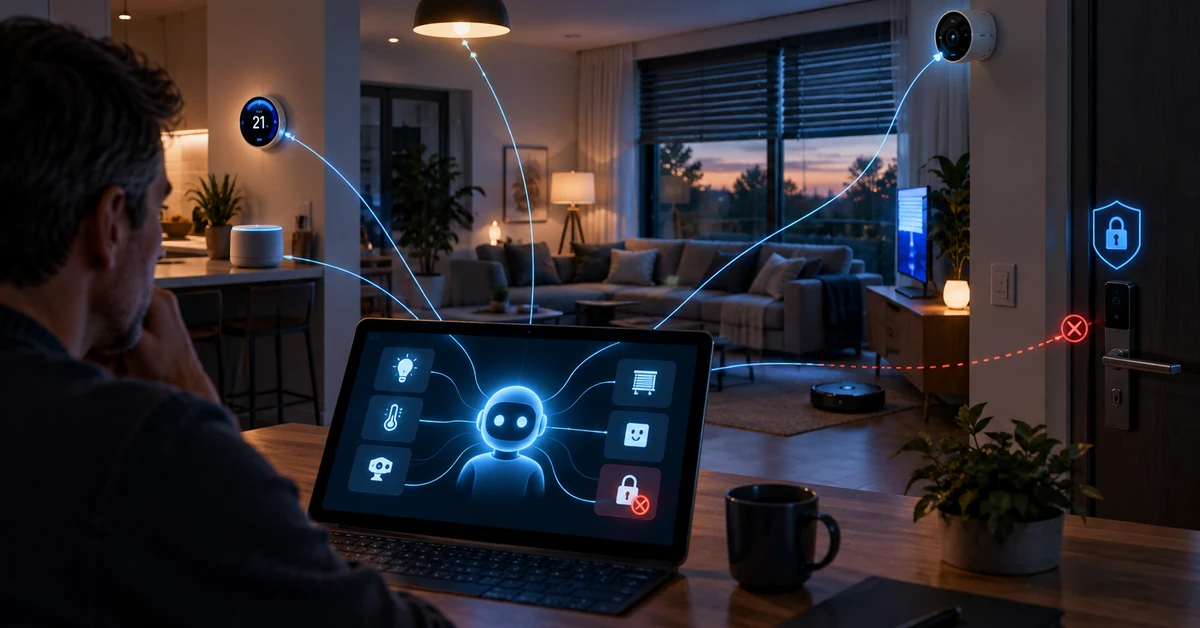
Google has begun allowing third-party AI agents to interact directly with smart homes, giving compatible systems the ability to inspect devices, monitor activity and take physical actions inside a user’s home.
Early access to the new Google Home MCP server allows AI agents to connect with the Google Home ecosystem.
According to Google’s developer documentation, connected agents can inspect the home’s structure and devices, check their current state, access historical events and execute device-control actions.
Named compatible clients include Claude Cowork, OpenClaw and Google’s own Antigravity.
The programme is currently limited to Google Home Premium Advanced subscribers in the United States.
From answering to acting
The significant change is what an AI agent can do once connected.
Instead of simply answering questions about a home, an agent can interact with compatible physical devices.
That could allow an AI system to monitor what is happening and perform actions on a user’s behalf without requiring every individual step to be manually initiated.
Google has imposed restrictions on what agents are permitted to do.
Most notably, the MCP server prevents agents from unlocking doors.
It also uses rate limits and other safeguards intended to prevent excessive or potentially unsafe device activity.
Google warns of unexpected behaviour
Google’s own documentation contains an unusually direct warning about the risks.
Connecting a real home to an AI agent, it says, can result in “unexpected or even undesired behavior.”
Google also advises users to inform other members of their household when an AI agent has access to shared home information.
The warning highlights how the safety problem changes when AI moves beyond software.
A chatbot that produces incorrect information can give somebody a bad answer.
An agent connected to physical devices can perform the wrong action.
Google’s decision to prevent agents from unlocking doors demonstrates that the company is already drawing boundaries around how much authority autonomous systems should receive.
Those boundaries will become increasingly important as AI agents gain access to more devices and more of the environments in which people live and work.
For now, Google Home’s agent integration remains an early-access experiment.
But it marks another step towards AI systems that do not simply tell users what they could do.
They do it for them.
Sources
- Google Home Developers – Google Home MCP server and safety guidance
- TechCrunch – third-party AI agents gain access to Google Home devices
Join the Dissenting Citizen Newsletter
Independent news and commentary delivered directly to your inbox.
Breaking stories, analysis and commentary throughout the day.
Follow @VoxDissent →