









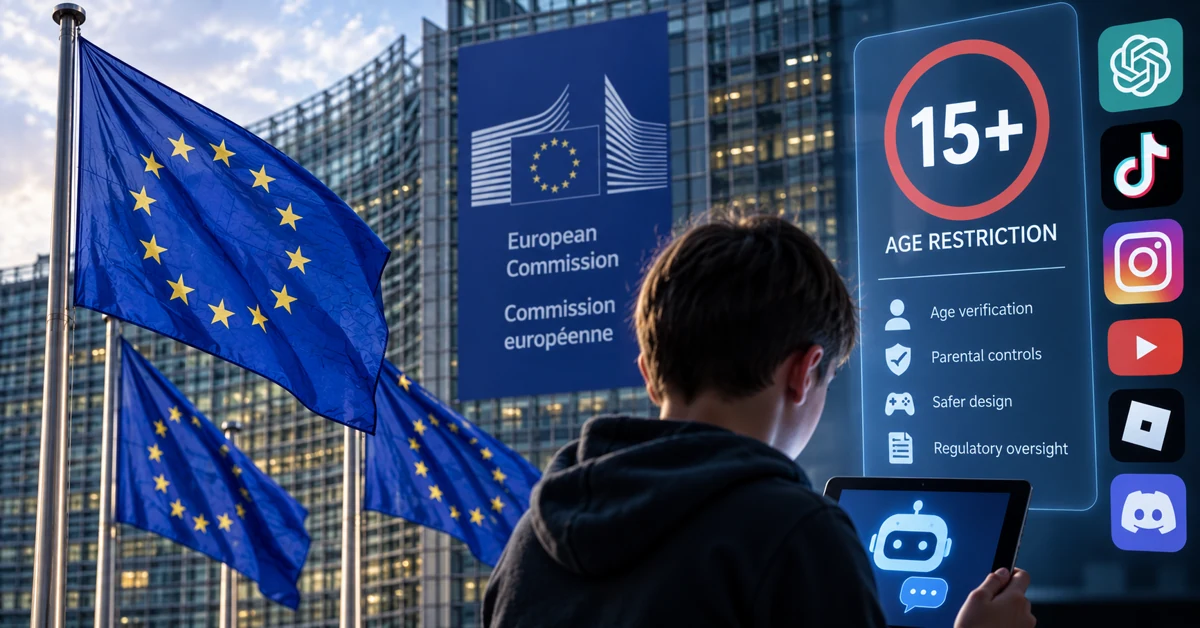
The European Commission is preparing an EU Kids Act that would impose age restrictions across social media, online gaming, video platforms and AI chatbots.
A draft seen by Reuters would allow users aged 15 and over to open independent accounts.
Younger teenagers would face restricted access controlled by parents, with tighter protections for younger children.
Platforms could also face age-verification requirements, mandatory parental controls, measures designed to limit addictive features and a supervisory fee.
The proposal has not yet been formally unveiled and could still change.
It would also require approval through the EU legislative process.
Including AI chatbots marks a significant expansion of the child-safety debate.
Conversational AI is increasingly being used for companionship, advice and extended personal interactions, placing it closer to social media in the eyes of regulators than conventional software.
Protecting children means identifying them
Age restrictions create an obvious enforcement problem.
A platform cannot reliably apply different rules to a 13-year-old and a 30-year-old unless it has some way of determining which is which.
Depending on how the eventual system is designed, that could mean asking adults to demonstrate their age too.
The objective is legitimate.
Children should not have unrestricted access to services capable of exposing them to harmful content, addictive design or inappropriate AI interactions.
But an internet where every adult routinely proves their age before accessing ordinary services would create its own problems for privacy and anonymity.
Europe’s challenge is not simply keeping children safe online.
It is doing so without turning age verification into an identity check at the entrance to the internet.
Sources
Join the Dissenting Citizen Newsletter
Independent news and commentary delivered directly to your inbox.
Breaking stories, analysis and commentary throughout the day.
Follow @VoxDissent →