







Saudi Arabia had a way around the crisis in the Strait of Hormuz.
Send the oil the other way.
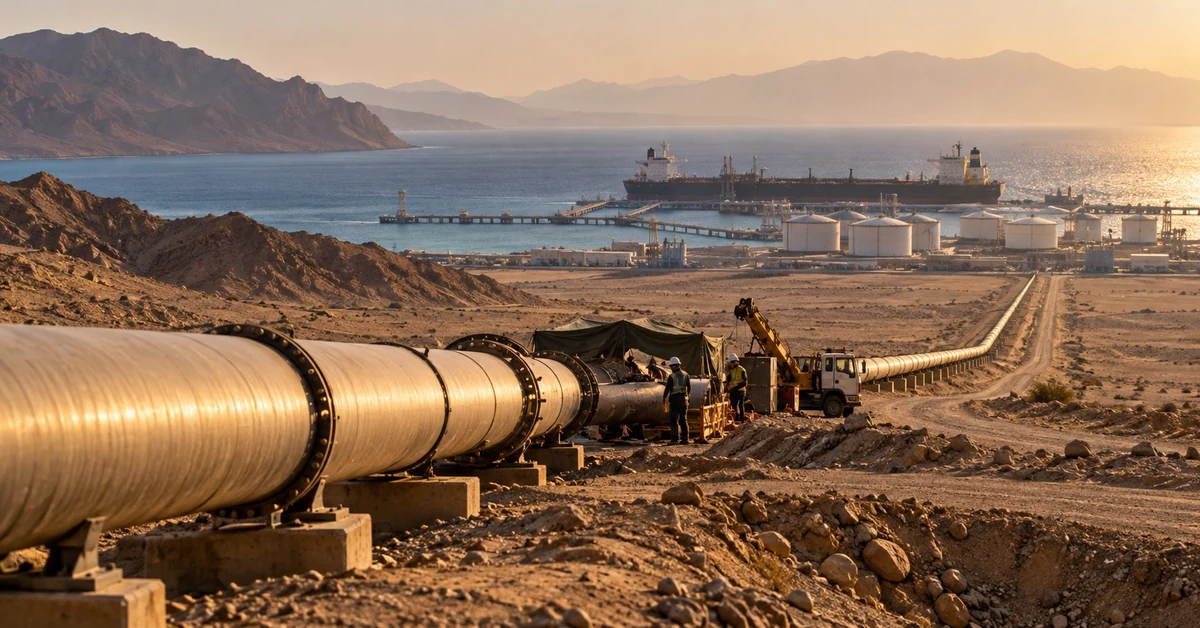
Crude could be pumped west across the kingdom to Yanbu on the Red Sea, avoiding Hormuz altogether.
Then the pipeline was attacked and shut.
Saudi Arabia’s East-West pipeline had become one of the most important alternative routes in the global oil system.
Now its closure has started a clock.
Reuters reported on September 13 that traders and Saudi crude buyers estimated Yanbu held just five to seven days of export-ready crude without the pipeline replenishing it. Reuters
Two days later, US Energy Secretary Chris Wright said the pipeline could return within days. One source told Reuters repairs could take five to six weeks, while another said partial operations could resume sooner. Reuters
Can repairs and replacement supplies arrive before those stocks run low?
THE FIRST CHOKEPOINT
The Strait of Hormuz has always been one of the great vulnerabilities in the global energy system.
Roughly 20% of global crude oil and LNG supply depended upon the strait before the current war. Recent ship-tracking data show how dramatically traffic has been disrupted.
Over the weekend, four tracked commodity vessels exited the Gulf while ten entered. Reuters reported that traffic remained far below normal. The tracking figures exclude vessels travelling with their identification transponders switched off. Reuters
Saudi Arabia’s East-West pipeline provided an alternative.
Built during the Iran-Iraq War, it allows Saudi crude to reach the Red Sea without entering Hormuz. During the current disruption it had been carrying around four million barrels a day, approximately 4% of global oil supply. Reuters
Its closure does not mean those four million barrels simply disappear. Saudi Arabia can draw on stored crude and reroute some exports, including attempting to move more oil through Hormuz.
The five-to-seven-day estimate concerns Yanbu’s ability to maintain exports from local stocks. Sustaining deliveries beyond that period would require replenishment or supplies from elsewhere.
PRESSURE AT THE OTHER END
Houthi forces have meanwhile advanced along Yemen’s western coastline and reached Perim Island, which sits in the Bab el-Mandeb Strait at the southern entrance to the Red Sea.
This does not close Yanbu. Tankers loaded there can sail north towards Egypt and the Suez Canal, while Saudi crude can also use Egypt’s SUMED pipeline to reach the Mediterranean.
And despite the Houthi advance, shipping through Bab el-Mandeb remained broadly stable over the weekend, according to vessel-tracking data reported by Reuters. Reuters
The Red Sea is not another Hormuz. But the Houthi advance adds another security risk around the wider Red Sea system at precisely the moment Saudi Arabia has become more dependent upon western export routes.
European buyers are already responding to reduced Saudi deliveries.
Poland’s Orlen was expected to receive 2.1 million barrels from Egypt’s Sidi Kerir terminal in September, down from 6.6 million in August. Tankers carrying replacement crude from the United States, Algeria and Norway were heading towards Gdansk, while Orlen said its refineries continued operating normally. Reuters
Orlen’s replacement cargoes show that an individual buyer can adapt. They do not, by themselves, show that the global supply gap has closed.
Behind those commercial responses sits another layer of protection.
THE RESERVE BUILT AFTER 1973
In October 1973, Arab producers imposed an oil embargo against the United States and introduced production cuts.
The world oil price rose from $2.90 a barrel before the embargo to $11.65 by January 1974 — nearly quadrupling. Federal Reserve History
Congress subsequently established the Strategic Petroleum Reserve in 1975 to provide emergency protection against severe oil-supply interruptions. US Department of Energy
The current Middle Eastern disruption has already drawn heavily on that reserve.
US Energy Information Administration data show the SPR held 413.3 million barrels on April 3.
By September 4, it held 285.4 million.
The reserve therefore recorded a net decline of almost 128 million barrels in five months, taking it to its lowest level since 1982. US Energy Information Administration
America today is very different from America in 1973. It is one of the world’s largest oil producers and held another 424 million barrels of commercial crude on September 4. EIA
The SPR is therefore not a measure of how close America is to running out of oil. It is an emergency buffer designed to provide additional supply when normal commercial flows are seriously disrupted.
And the response extends far beyond the United States.
THE EMERGENCY RESPONSE HAS BEGUN
In March, the 32 members of the International Energy Agency agreed to make 400 million barrels of emergency oil available in response to the Middle East disruption — the largest coordinated stock release in the organisation’s history. International Energy Agency
On March 19, the IEA confirmed that initial volumes from emergency reserves had already started to be made available. The releases consist of both crude and refined products, with countries contributing through government stocks, industry obligations and other measures. IEA implementation update
That is the emergency system doing what it was designed to do: cushioning disruption while infrastructure is repaired and alternative supplies arrive.
At Yanbu, the outcome now depends partly on which repair estimate proves closer to reality.
A restart within days would ease the pressure on local stocks. A disruption lasting several weeks would require stored crude and replacement supplies to cover a much longer gap.
Saudi Arabia also holds crude elsewhere. European buyers are finding alternative suppliers. Other producers can respond. The global oil market still has options.
The warning would be continued inventory depletion without enough recovery in exports or replacement supply to slow it.
So watch the pipeline repairs.
Watch actual Saudi exports.
Watch traffic through Hormuz.
And watch the inventories.
None of this guarantees another 1970s-style oil shock.
The test is whether restored routes and replacement supplies can close the gap before the stocks covering it run too low.
Join the Dissenting Citizen Newsletter
Independent news and commentary delivered directly to your inbox.
Breaking stories, analysis and commentary throughout the day.
Follow @VoxDissent →