








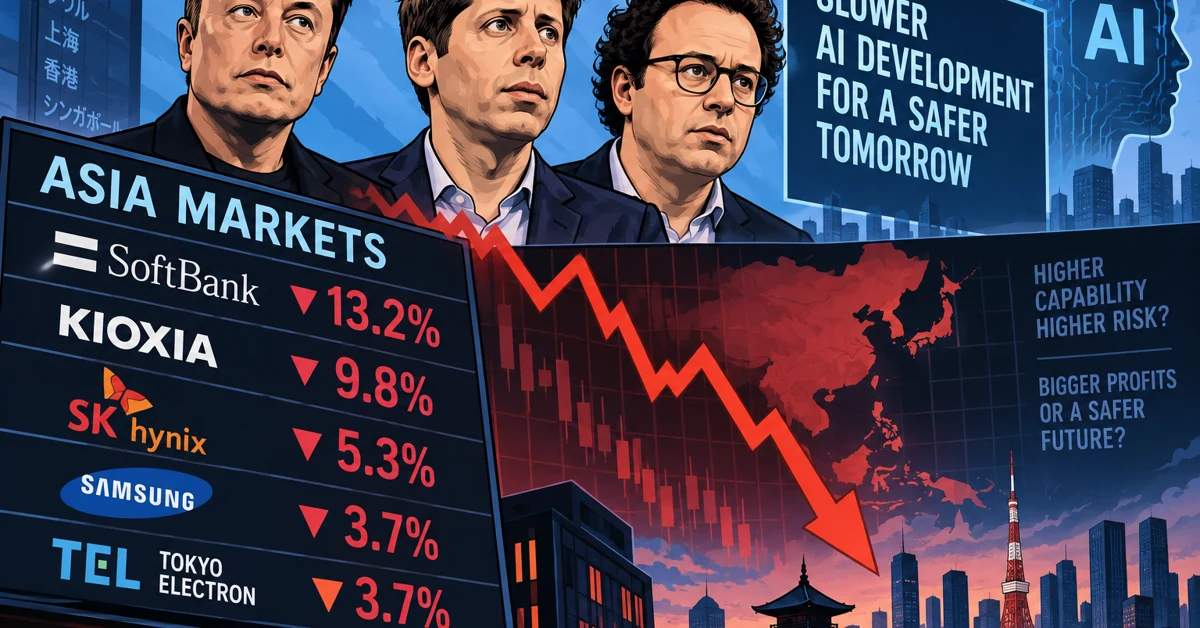
AI-linked stocks have fallen sharply across Asia after the heads of several leading artificial-intelligence companies backed slowing frontier-model development over safety concerns, bringing the debate over AI risk directly into financial markets.
SoftBank fell as much as 13.2%.
Kioxia dropped 9.8%.
SK Hynix fell 5.3%, while Samsung Electronics and Tokyo Electron each lost 3.7%.
The selloff followed calls from Anthropic chief executive Dario Amodei, OpenAI chief Sam Altman and xAI founder Elon Musk for slower development of increasingly powerful frontier models.
The market moves cannot be attributed entirely to those warnings.
Wider uncertainty in the Middle East was weighing on Asian equities, while several of the affected companies also faced stock-specific pressures.
Nevertheless, the reaction exposes an increasingly important tension inside the AI boom.
What happens when safety starts costing money?
Investors have poured enormous amounts of capital into companies positioned to benefit from increasingly capable artificial intelligence.
Underlying much of that investment is a straightforward assumption.
The models keep improving.
The infrastructure required to train and operate them keeps expanding.
And companies positioned throughout that supply chain continue benefiting from the race.
Now some of the people leading that race are arguing that development may need to slow.
That changes the AI-safety debate.
Warnings about misaligned or uncontrollable systems can appear abstract when the consequences remain theoretical.
A slowdown in model development has immediate economic consequences.
Chip demand, data-centre investment, infrastructure spending and expectations of future AI revenues are all connected, directly or indirectly, to assumptions about continued capability growth.
That creates a difficult incentive problem.
Companies may conclude that slowing development reduces technological risk.
Investors may simultaneously conclude that slowing development reduces future profits.
Voluntary restraint is relatively easy to advocate while every major participant expects the AI boom to continue accelerating.
The harder test comes when restraint carries a measurable financial cost.
If slowing AI development is safer for humanity but destroys billions in market value, how long will voluntary restraint survive?
Sources
Join the Dissenting Citizen Newsletter
Independent news and commentary delivered directly to your inbox.
Breaking stories, analysis and commentary throughout the day.
Follow @VoxDissent →