









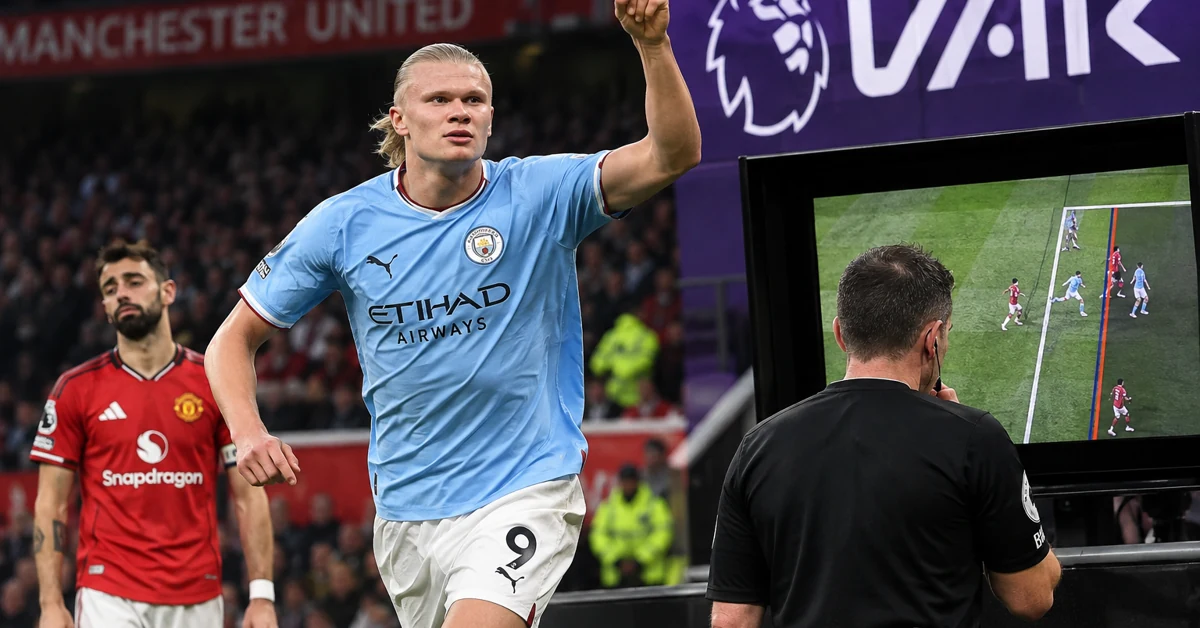
The refereeing body responsible for Premier League officials has admitted VAR made an “error of judgement” when it intervened to award Manchester City the only goal of Sunday’s Manchester derby.
Erling Haaland’s 60th-minute winner at Old Trafford was initially ruled out for offside.
VAR intervened.
Haaland was found to be onside and the decision was overturned, handing Manchester City a 1-0 victory over Manchester United.
The problem was that Haaland wasn’t the only player involved.
City midfielder Enzo Fernández was in an offside position and attempted to reach Josko Gvardiol’s cross before it arrived at Haaland.
He did not touch the ball, but United defender Lisandro Martínez moved towards Fernández, potentially affecting his ability to deal with the cross and leaving Haaland free behind him.
Pro Ref, the refereeing body formerly known as PGMOL, has now acknowledged that VAR failed to properly consider that interference.
It said the VAR “did not recognise the likely impact” of Fernández’s position and should have recommended that referee Michael Oliver conduct an on-field review.
Pro Ref has contacted Manchester United to acknowledge what it called an “error of judgement” and says the incident will now be reviewed.
VAR didn’t just fail to correct a mistake
That distinction matters.
This wasn’t simply an incident that VAR failed to spot.
The assistant referee had already given an on-field decision of offside.
VAR intervened to overturn it.
The technology correctly established that Haaland himself was onside, but failed to properly deal with Fernández’s involvement in the same attack.
The intervention therefore replaced the original decision with one the refereeing body now accepts should have been reviewed differently.
And it decided the match.
Manchester City won 1-0.
United manager Michael Carrick questioned how a system involving multiple officials, screens and additional layers of review could still fail to reach the right decision.
That gets to the heart of the problem.
VAR was introduced to reduce decisive refereeing errors.
In one of English football’s biggest fixtures, it intervened in the decisive moment, overturned the on-field decision and helped produce an outcome its own refereeing body now accepts resulted from an error of judgement.
If VAR can turn the correct outcome into the wrong one, what exactly is the technology achieving?
Sources
Join the Dissenting Citizen Newsletter
Independent news and commentary delivered directly to your inbox.
Breaking stories, analysis and commentary throughout the day.
Follow @VoxDissent →