









Britain’s latest attempt to disrupt illegal migration before people reach the border has produced its first charge.
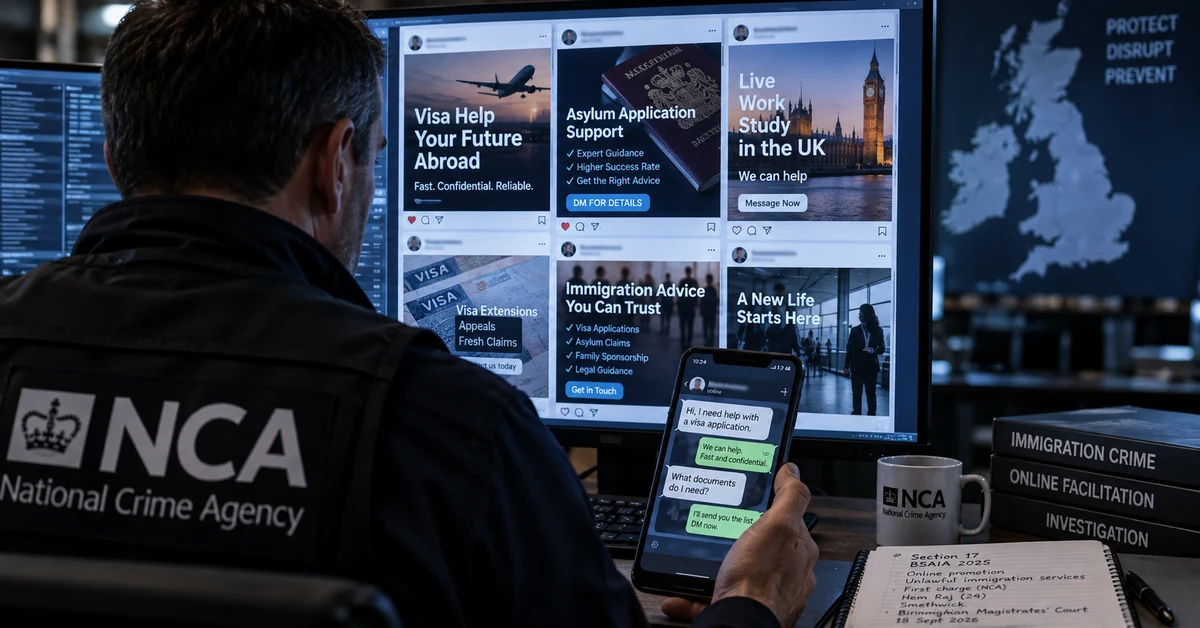
The National Crime Agency has charged a 24-year-old man under a new offence specifically targeting online advertisements for services that allegedly facilitate immigration crime.
Hem Raj, an Indian national living in Smethwick, was charged on Thursday after NCA investigators discovered social-media posts allegedly offering advice on fraudulent visa and asylum applications.
Raj has not been convicted.
The allegations will now have to be proved in court.
What makes the case significant is the law being used against him.
The NCA says this is its first charge under Section 17 of the Border Security, Asylum and Immigration Act 2025.
The provision was created to attack a different part of the illegal-migration system.
Much of Britain’s border enforcement necessarily happens after something has already occurred.
A small boat reaches the Channel.
A person arrives using fraudulent documentation.
Someone is discovered working illegally.
Authorities then investigate the journey and attempt to identify whoever organised or facilitated it.
Online advertising potentially allows intervention earlier.
Smugglers and other facilitators increasingly use social media to advertise routes, documents, transport and immigration services to potential customers.
The new offence is intended to make promoting certain unlawful immigration services a crime in itself.
That matters because proving facilitation under older offences can require investigators to establish a connection with an actual or intended immigration offence.
An advertisement exists further upstream.
The service can be promoted before a particular journey has happened.
That changes where authorities can potentially intervene.
Instead of concentrating exclusively on the boat, vehicle, fraudulent document or person arriving at the border, investigators can target the commercial infrastructure used to attract customers in the first place.
Raj’s case will provide an early test of how that works in practice.
The NCA alleges that social-media posts connected to him offered advice relating to fraudulent visa and asylum applications.
He has also been charged with providing immigration advice or services while not qualified to do so.
Neither allegation has yet been established in court.
That distinction is particularly important in the first prosecution under a new offence.
A law can look powerful when Parliament passes it.
Its real boundaries emerge when prosecutors have to prove individual cases.
Courts will determine what conduct falls within the legislation, what evidence establishes the necessary elements and whether the offence works as lawmakers intended.
If prosecutions prove successful, the enforcement logic could extend considerably beyond one defendant in Smethwick.
The internet has reduced the importance of geography to organised immigration crime.
A facilitator does not necessarily need to stand on a beach in northern France or physically accompany somebody across a border.
Advertising, recruitment, payment and advice can take place through a phone.
That gives border authorities another potential point of intervention.
Britain has spent years trying to stop unlawful migration at the end of the journey.
The first Section 17 prosecution begins testing whether some of it can be disrupted closer to the beginning.
Sources
Join the Dissenting Citizen Newsletter
Independent news and commentary delivered directly to your inbox.
Breaking stories, analysis and commentary throughout the day.
Follow @VoxDissent →