





Morocco and Israel are taking another step towards treating their relationship as something that does not have to wait for the Israeli-Palestinian conflict to be resolved.
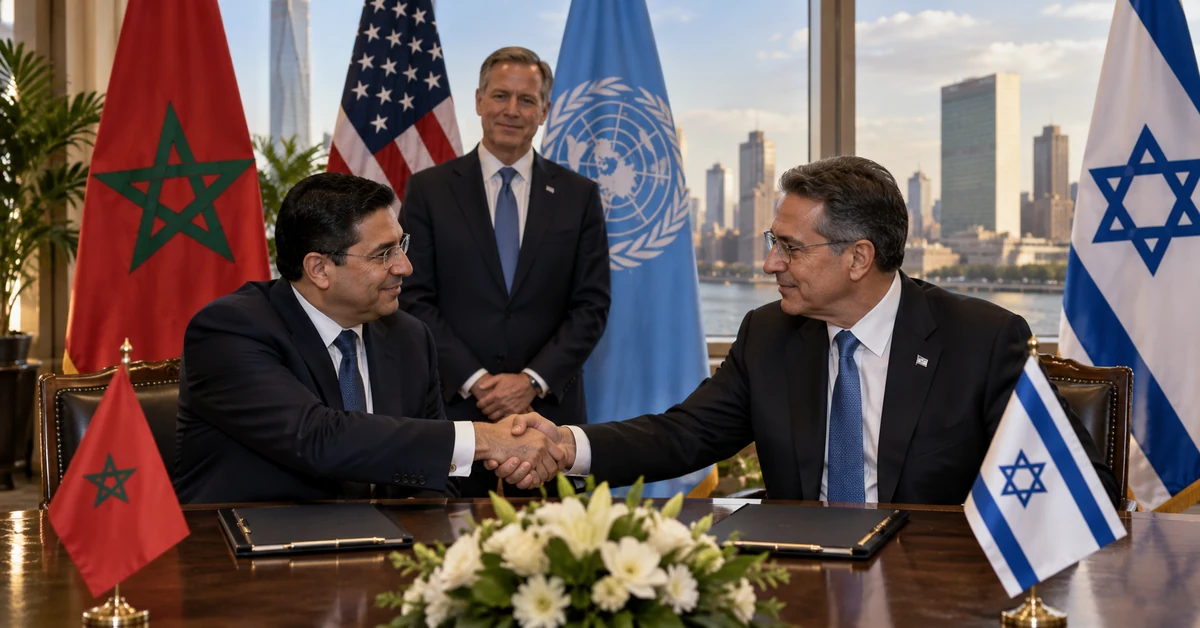
The two countries have agreed to open full embassies and exchange ambassadors following talks involving their foreign ministers and the US ambassador to the United Nations.
They also agreed to expand direct flights and pursue further trade and investment agreements.
The diplomatic upgrade matters because of what has not happened.
There is still no Palestinian state.
There is still no final Israeli-Palestinian settlement.
Yet Morocco is moving its relationship with Israel further towards conventional state-to-state diplomacy.
That reverses the sequence that shaped much of the Arab world’s approach to Israel for decades.
The 2002 Arab Peace Initiative offered Israel normal relations with Arab states in return for withdrawal from occupied territories and the establishment of an independent Palestinian state.
Normalisation was the reward at the end of the process.
The Abraham Accords began separating those two questions.
Morocco was one of four Arab countries – alongside the United Arab Emirates, Bahrain and Sudan – that moved towards normalising relations with Israel in 2020 under US-brokered agreements.
Morocco and Israel subsequently established liaison offices rather than full embassies.
The latest agreement moves beyond that arrangement.
Ambassadors and embassies would make the relationship considerably more conventional – not merely an opening created in 2020, but diplomatic infrastructure intended to endure.
That does not mean Morocco has abandoned support for Palestinian statehood.
Nor does a government decision establish what Moroccan citizens think about Israel, Gaza or the Palestinians.
It demonstrates something narrower but strategically important.
Rabat is increasingly treating its relationship with Israel as a bilateral question governed by Moroccan interests rather than something that must remain frozen until Israelis and Palestinians reach a final agreement.
Those interests are substantial.
Morocco and Israel have developed cooperation in trade, tourism, technology and security since restoring ties.
The United States simultaneously recognised Moroccan sovereignty over Western Sahara as part of the 2020 agreement – an issue of enormous strategic importance to Rabat.
Normalisation therefore created benefits that Morocco could pursue independently of progress between Israel and the Palestinians.
That logic challenges the older idea of a unified Arab diplomatic front.
If individual governments can obtain security cooperation, investment, technology, diplomatic recognition or other national advantages by dealing directly with Israel, waiting collectively for a Palestinian settlement carries an opportunity cost.
The Abraham Accords offered another model:
pursue the bilateral relationship now, while continuing to address the Palestinian question separately.
Morocco’s decision to exchange ambassadors pushes that model further.
It does not resolve the Israeli-Palestinian conflict.
It demonstrates that, for at least some Arab governments, resolving that conflict is no longer a prerequisite for building deeper relations with Israel.
Sources
Join the Dissenting Citizen Newsletter
Independent news and commentary delivered directly to your inbox.
Breaking stories, analysis and commentary throughout the day.
Follow @VoxDissent →