






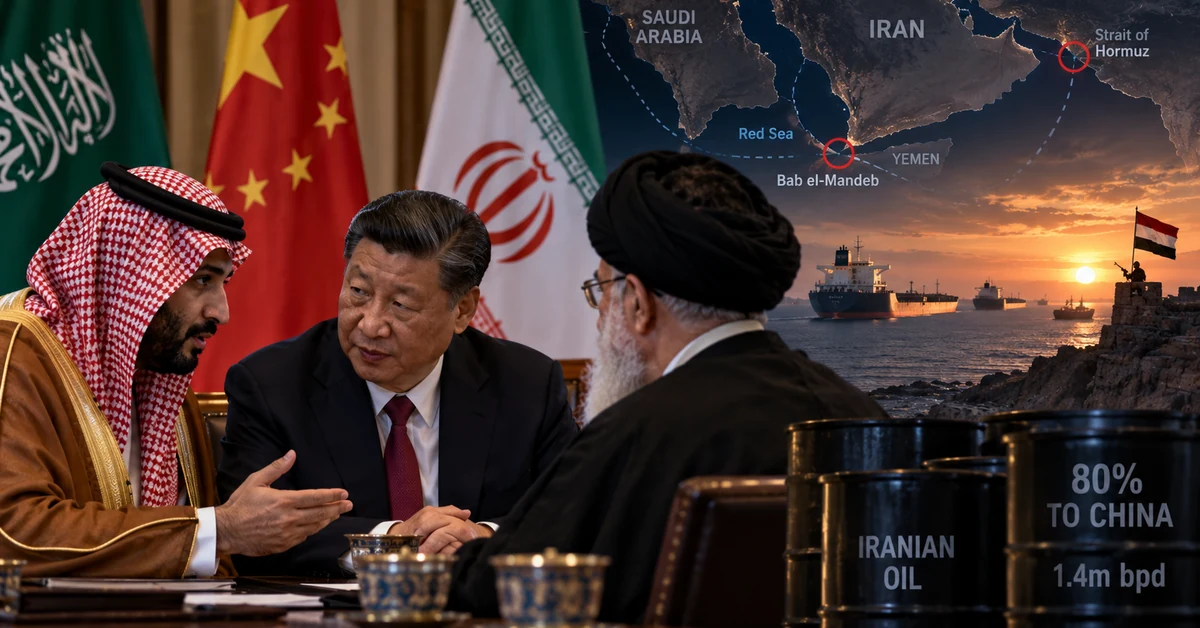
Saudi Arabia has turned to an unusual intermediary to try to restrain Yemen’s Houthis.
China.
After Houthi forces advanced along Yemen’s Red Sea coast and around the Bab el-Mandeb Strait, Riyadh asked Beijing for help.
China then privately asked Tehran to use its influence over the Iran-aligned movement to prevent the conflict spreading further across the shipping routes on which the Chinese economy depends.
The diplomatic chain is revealing.
Saudi Arabia wants the Houthis restrained.
Iran has influence over the Houthis.
And China has influence over Iran.
That last relationship carries considerable economic weight.
China has been Iran’s largest trading partner for more than a decade and remains overwhelmingly the biggest buyer of its oil. Chinese purchases accounted for more than 80% of Iran’s seaborne oil exports in 2025, averaging around 1.4 million barrels a day.
Iran’s regional strategy is therefore beginning to encounter a problem of its own making.
The Houthis provide Tehran with leverage far beyond Yemen.
Their missiles, drones and territorial gains allow an Iran-aligned movement to threaten Saudi infrastructure and shipping through the Red Sea without Iran itself having to control the territory.
Their latest advances have put Houthi forces along the Red Sea coastline and around Bab el-Mandeb, one of the world’s most important maritime chokepoints.
Normally, that increases Iranian leverage.
This time it also threatens Chinese interests.
The Strait of Hormuz is already effectively shut to normal commercial traffic as the wider conflict involving Iran continues. Preliminary shipping data showed only three commercial vessels transiting Hormuz on Wednesday, compared with a recent 10-day average of about 17.
Bab el-Mandeb sits at the other end of the region’s critical maritime energy network.
Sustained disruption there would threaten both of the Middle East’s principal oil-export routes simultaneously.
China depends heavily on both.
That creates an unusual collision between Iran’s geopolitical strategy and the interests of the country on which Tehran increasingly depends economically.
Beijing has publicly called for restraint, dialogue and safe navigation.
According to three Iranian sources briefed on the discussions, its private message to Tehran went further: China wants Iran to use its influence with the Houthis to prevent the conflict spreading across vital energy routes.
There is an important limit.
Reuters reports that China made no explicit threat and gave no indication that it would punish Iran economically if Tehran failed to act.
Iran’s response was also revealing. Tehran told Beijing that regional peace depended upon ending what it described as the US-Israeli war against Iran.
Whether Iran will actually attempt to restrain the Houthis remains unclear.
Nor should Iranian influence be confused with complete control. The Houthis have developed into a formidable political and military force in their own right, with domestic interests and capabilities alongside Iranian support.
Yet the episode exposes a constraint inherent in proxy warfare.
An armed ally is useful partly because it gives its patron influence without requiring direct action.
But the proxy has interests of its own.
And when its actions begin damaging the interests of a great power the patron relies upon, the relationship becomes considerably more complicated.
China now finds itself in the middle.
It wants stable energy supplies from Iran.
It has rapidly expanding economic relationships with Saudi Arabia and the wider Gulf.
And roughly half of China’s oil imports come from the Middle East.
Beijing also has some diplomatic capital invested in the relationship: in 2023, it brokered the agreement restoring diplomatic ties between Saudi Arabia and Iran.
Saudi Arabia is now effectively asking China to cash some of that influence in.
The Houthis have given Tehran another way to exert pressure over Saudi Arabia and the world’s energy routes.
The question is how valuable that leverage remains when it starts threatening the interests of the country buying most of Iran’s exported oil.
Sources
Join the Dissenting Citizen Newsletter
Independent news and commentary delivered directly to your inbox.
Breaking stories, analysis and commentary throughout the day.
Follow @VoxDissent →