






Europe’s response to Chinese competition may be moving beyond tariffs.
It may start deciding how much of the market China should be allowed to capture.
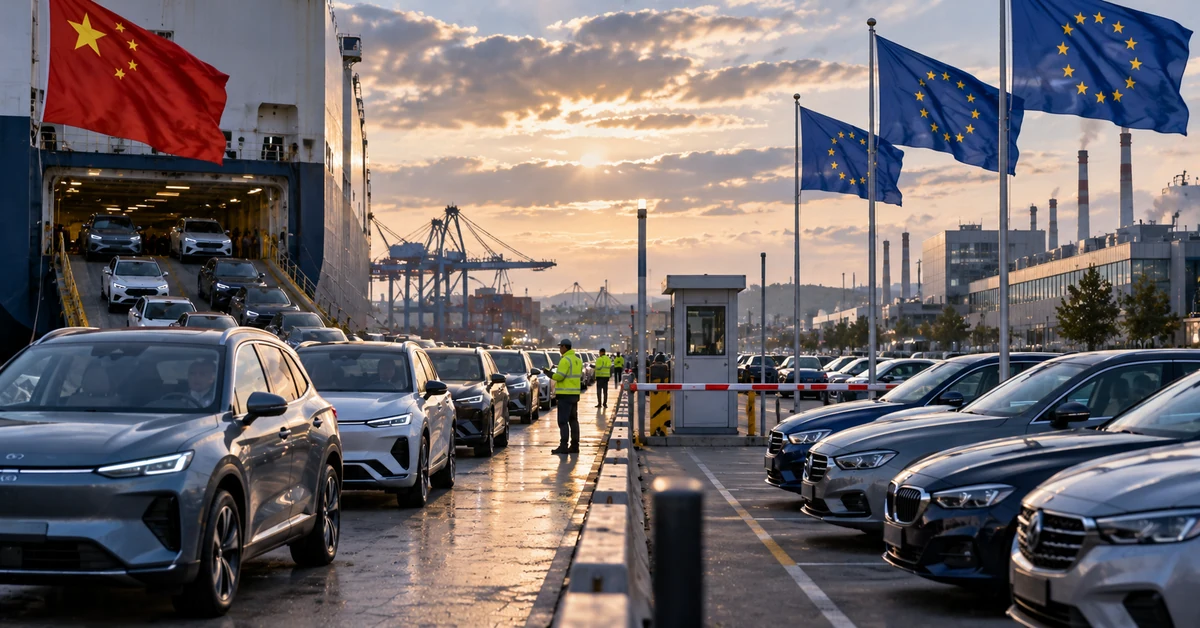
Brussels has asked Beijing to voluntarily restrict Chinese hybrid-car sales to around 15% of the EU market, according to a Financial Times report cited by Reuters.
The proposal has not been confirmed by the European Commission, and Reuters says it could not independently verify it.
But the language attributed to an EU official makes the underlying argument unusually clear.
“If they will not limit their exports to our market then we will,” the official told the FT.
“This is about stopping deindustrialisation. We have to act. It’s about managed trade.”
That would represent something more fundamental than another dispute over import duties.
Tariffs alter the price of foreign competition.
A market-share ceiling attempts to influence how much competition is allowed through the door.
The reported proposal comes as Chinese manufacturers rapidly expand in Europe’s car market.
The EU already imposes additional anti-subsidy duties on battery-electric vehicles imported from China.
Hybrids have largely escaped those measures.
Chinese manufacturers have responded accordingly, expanding sales of hybrid vehicles that can compete in Europe without facing the same additional tariffs.
Germany’s finance minister Lars Klingbeil called on Thursday for the EU to close that gap by imposing tariffs on Chinese plug-in hybrids as well.
The pressure comes from an uncomfortable economic reality.
European consumers have increasingly been offered Chinese cars that compete aggressively on price, technology and equipment.
European manufacturers face the consequences.
Volkswagen, Renault, Stellantis and others are attempting major restructurings while Chinese groups such as BYD, Geely and Chery expand internationally.
Chinese-branded vehicles reached about 9% of EU car sales during the first half of 2026.
Consultancy AlixPartners expects Chinese brands to reach 16% of the wider European market by 2030.
If the reported 15% hybrid ceiling is genuine, Brussels would therefore be contemplating intervention around roughly the level Chinese manufacturers might otherwise approach naturally across the broader market.
The European argument is that the competition is not occurring on neutral ground.
EU officials say Chinese industrial overcapacity, state support and enormous manufacturing scale are pushing excess production into foreign markets and threatening Europe’s industrial base.
Beijing rejects that characterisation.
China argues that European complaints about overcapacity are protectionist and intended to constrain competitive Chinese industries.
Behind that dispute sits a larger question about what Europe actually wants its trade policy to achieve.
European Commission President Ursula von der Leyen says the bloc’s goods deficit with China reached €360.6 billion in 2025 – almost €1 billion a day – and widened another 9% during the first half of this year.
She describes the resulting pressure on European industry as a second “China shock”.
If policymakers accept that diagnosis, simply allowing consumers to buy whichever vehicle offers the best combination of price and technology becomes politically difficult.
Cheap imports create winners.
Consumers get more choice and potentially lower prices.
But imports can also create losers if domestic factories shrink, suppliers disappear and industrial knowledge migrates elsewhere.
Cars make that trade-off particularly difficult because automotive manufacturing is not a marginal European industry.
It supports large supply chains, skilled employment and strategically important engineering capacity across Germany, France, Italy, Spain, Central Europe and beyond.
The choice therefore isn’t neatly between free trade and protectionism.
It is between competing interests.
European consumers benefit from competition.
European manufacturers need to become competitive enough to survive it.
Workers depend upon industries that policymakers may consider strategically important.
And governments have to decide how much economic dependence they are prepared to tolerate when the strongest competitor is also a geopolitical rival.
Chinese manufacturers are already adapting.
Several are looking for factories inside Europe, partly in anticipation of rules requiring greater local production.
That suggests another possible outcome: Chinese brands continue gaining European customers, but increasingly manufacture the cars inside Europe.
A 15% import ceiling would push the relationship further towards that kind of managed system.
Chinese companies could still compete.
European consumers could still buy their cars.
But governments would increasingly determine the conditions, location and potentially the scale of that competition.
For decades, Europe’s basic trade proposition was that competition would determine who won market share, subject to rules against unfair practices.
The reported negotiations with China suggest something different.
If competition produces an outcome Europe considers strategically unacceptable, Europe may increasingly try to manage the outcome itself.
Sources
- Reuters – EU reportedly seeks Chinese hybrid export curbs
- Reuters – Germany urges tougher measures on Chinese hybrid imports
- Reuters – Chinese automakers seek European factories
Join the Dissenting Citizen Newsletter
Independent news and commentary delivered directly to your inbox.
Breaking stories, analysis and commentary throughout the day.
Follow @VoxDissent →