




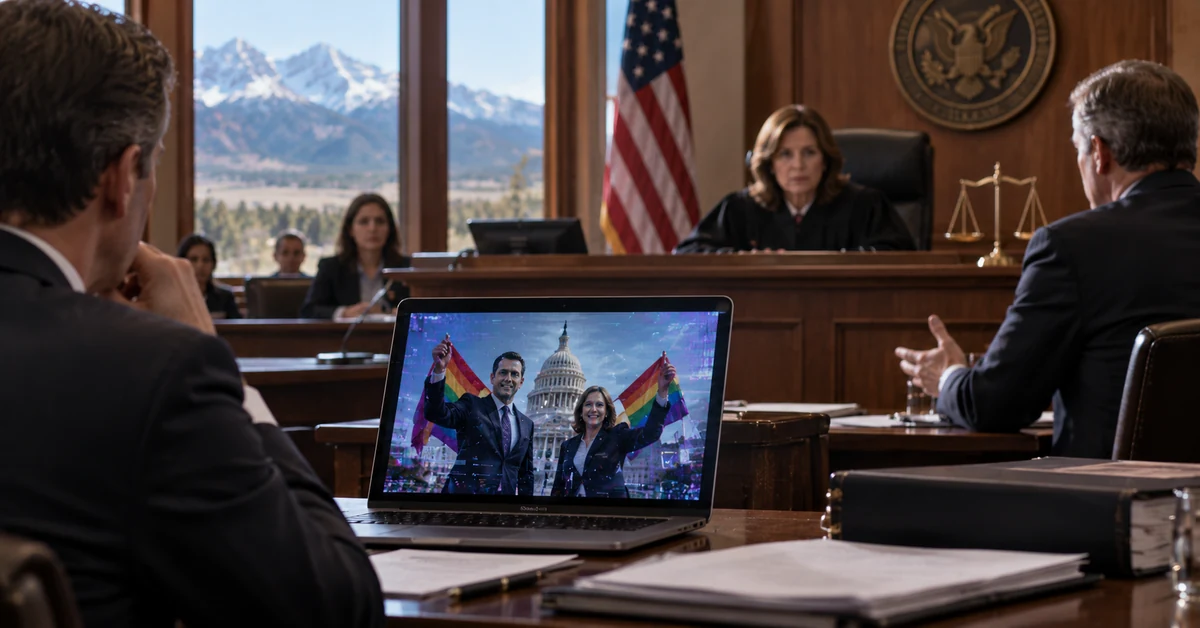
Artificial intelligence can create convincing political images that never happened.
Montana tried to regulate them.
Now a federal judge says the state may have created a First Amendment problem in the process.
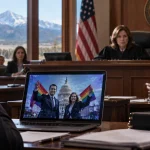
US District Judge Susan Watters has temporarily blocked Montana from enforcing its election-deepfake law against a conservative political action committee that distributed AI-generated images depicting political candidates holding pride flags.
The ruling does not establish that election deepfakes are constitutionally protected from regulation.
Nor does it strike down every law attempting to control deceptive AI-generated election material.
It raises a narrower question.
Can government regulate synthetic political speech differently depending upon what that speech says about a candidate?
Watters concluded that Accountability in State Government is likely to succeed in arguing that Montana’s law violates the First Amendment because of the way it distinguishes between political messages.
The group had distributed synthetic images depicting candidates in ways intended to criticise their political positions.
The images were generated using artificial intelligence.
Montana’s law regulates certain synthetic media distributed close to an election when it depicts candidates or political parties in falsely authentic-looking ways.
But the statute contains exceptions and distinctions.
According to Watters, the law treats identically deceptive media differently depending on whether its message damages or elevates a candidate.
That distinction is constitutionally significant because political speech sits near the centre of First Amendment protection.
Government can regulate conduct surrounding elections.
It can impose disclosure requirements.
It can address fraud and other legally defined forms of deception.
But laws that discriminate according to the viewpoint expressed face much more demanding constitutional scrutiny.
That creates a difficult problem as AI-generated political material becomes easier to produce.
The underlying threat is real.
A synthetic video can make a candidate appear to say something they never said.
An artificial recording can imitate a politician’s voice.
A fabricated image can place somebody at an event they never attended.
Released at the right moment, such material could spread to millions of voters before journalists, campaigns or election officials establish that it is false.
More than 30 states have responded with laws addressing AI-generated election content.
Those laws take different approaches.
Some emphasise disclosure, requiring synthetic material to be clearly identified.
Others restrict distribution during particular periods before elections or create remedies for candidates depicted in manipulated content.
Montana chose its own approach.
The First Amendment challenge demonstrates why drafting those laws is difficult.
Not every synthetic political image is intended to deceive somebody into believing it documents a real event.
Political communication has always used exaggeration, caricature, satire, parody and visual manipulation.
AI makes those techniques vastly easier and potentially much more realistic.
But realism alone does not necessarily establish deception.
That distinction matters because a law broad enough to capture every artificial depiction of a politician could also capture political satire and advocacy.
The Montana case introduces another complication.
Even if government can regulate some deceptive synthetic media, it cannot easily make the legality of that speech depend upon whether the political message is favourable or hostile.
That risks transforming an anti-deception law into a viewpoint-based speech restriction.
The state has arguments of its own.
Montana enacted the law against a rapidly developing technology capable of generating political misinformation at unprecedented scale and realism.
Protecting voters from deliberately fabricated representations of candidates is a legitimate governmental concern.
The preliminary injunction does not decide that concern is unconstitutional.
It means the judge believes this particular plaintiff has shown sufficient likelihood of success on its First Amendment claim to prevent enforcement against it while the litigation continues.
That limitation matters.
The injunction applies to Accountability in State Government.
The litigation continues.
And Watters has not issued a final ruling that Montana’s entire regulatory approach is unconstitutional.
But the case provides an early indication of where the legal battle over AI and elections may concentrate.
The hardest question may not be whether governments can respond to deepfakes.
It may be how they define the thing being regulated.
Target deliberate deception too narrowly and sophisticated synthetic misinformation may escape regulation.
Define prohibited synthetic political content too broadly and government begins policing protected political expression.
Write exceptions that depend upon whether the message supports or opposes somebody and an anti-deepfake law can become a viewpoint-discrimination problem.
Artificial intelligence has made political fabrication easier.
The First Amendment has not disappeared because the fabrication became technologically sophisticated.
The challenge for lawmakers is therefore more precise than simply stopping deepfakes.
They have to target the deception without giving government authority to decide which political messages are acceptable.
Sources
- Reuters – Federal judge blocks Montana deepfake law against plaintiff PAC
- NCSL – State AI election legislation overview
Join the Dissenting Citizen Newsletter
Independent news and commentary delivered directly to your inbox.
Breaking stories, analysis and commentary throughout the day.
Follow @VoxDissent →