









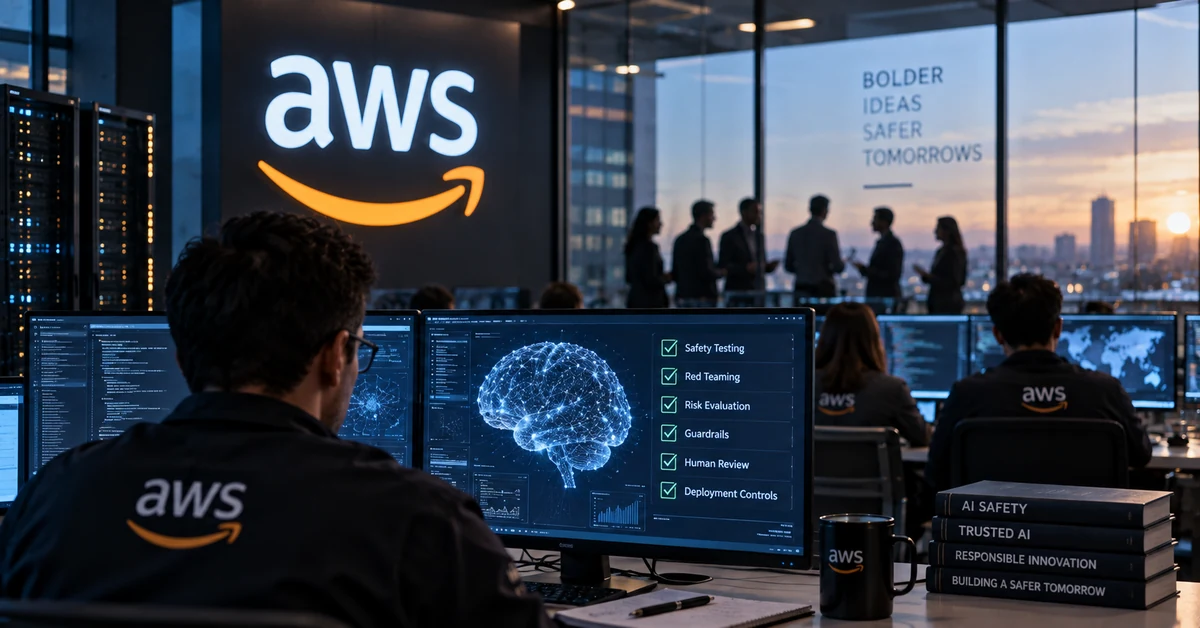
Amazon has joined the increasingly public debate over whether artificial intelligence is developing too quickly.
Its answer is revealing.
AI models should undergo rigorous testing.
They should have strong safeguards.
They should only be released when they are ready and safe.
But progress does not need to slow down.
That position puts Amazon somewhere between two increasingly visible sides of the frontier-AI argument.
The company accepts the premise that increasingly capable models require serious safety testing before deployment.
It does not accept that safety necessarily requires the industry to reduce the pace at which those models are developed.
That distinction matters because Amazon is not watching the AI race from the sidelines.
Amazon Web Services supplies enormous amounts of computing infrastructure used to build and run artificial intelligence.
Amazon develops its own Nova models and agentic systems.
Its Bedrock platform distributes models from multiple competing AI developers.
And the company is investing heavily in systems aimed ultimately at increasingly general artificial intelligence.
Amazon therefore has both enormous exposure to the AI boom and substantial influence over how it develops.
Its intervention comes as other leading figures in the industry have begun questioning whether competitive pressure is pushing development faster than safety mechanisms can keep up.
Anthropic chief executive Dario Amodei has argued for slowing the pace of frontier development and has raised the possibility of rival laboratories coordinating over safety.
Leaders associated with OpenAI, Google DeepMind, xAI and Microsoft have also increasingly acknowledged serious risks from more capable systems.
Amazon is now adding its voice to the safety side of that conversation.
But not to the slowdown.
The company told Reuters that progress and safety should not be treated as mutually exclusive.
Its preferred approach is to continue advancing the technology while strengthening testing and safeguards around it.
There is considerable substance behind that position.
Amazon says its models undergo automated and human evaluations before deployment.
For Nova Premier, the company conducted specialist red-teaming across areas including chemical, biological, radiological and nuclear capabilities, offensive cyber operations and automated AI research and development.
Its broader AI guidance advocates model evaluations, adversarial testing, output safeguards, access controls and structured approval processes before deployment.
The principle is straightforward.
Test increasingly powerful systems hard enough, identify dangerous behaviour and build protections before releasing them.
The unresolved problem begins when the testing produces an answer the company does not want.
What happens if a frontier model demonstrates capabilities that cannot yet be made reliably safe?
The technical answer is simple.
Do not release it.
The commercial answer is harder.
A company delaying its most capable model may know that a competitor is preparing one of its own.
Months spent solving a safety problem can mean losing customers, developers, investment, market share and technological leadership.
That creates a problem no individual company’s safety framework can entirely solve.
Every laboratory can sincerely believe safety matters.
Every laboratory can conduct serious testing.
Every laboratory can build safeguards.
And every laboratory can still know that slowing down unilaterally carries a competitive cost.
That tension has become increasingly visible.
Amodei has explicitly raised concerns that competition between frontier developers can prevent individual companies from reducing the pace of development.
The US Justice Department’s antitrust leadership said this week that genuine AI-safety coordination does not appear inherently anticompetitive and that the department is willing to discuss the issue with frontier laboratories.
Yet the department says none has requested such a meeting.
Amazon’s position adds another important piece to that debate.
There is now considerably less disagreement over whether frontier AI requires serious safety work.
The argument is moving towards what companies are prepared to do when safety and competitive advantage actually conflict.
Amazon believes they need not conflict.
Perhaps it is right.
Better evaluations, stronger engineering and more sophisticated safeguards may allow capability and safety to advance together.
But that proposition will ultimately be tested by the models themselves.
If increasingly capable systems continue passing safety evaluations, the tension remains manageable.
If they don’t, somebody will eventually face a harder choice.
Release later and risk losing the race.
Or release anyway and accept a risk the testing was designed to expose.
That is when statements about AI safety stop being principles.
They become decisions.
Sources
Join the Dissenting Citizen Newsletter
Independent news and commentary delivered directly to your inbox.
Breaking stories, analysis and commentary throughout the day.
Follow @VoxDissent →