








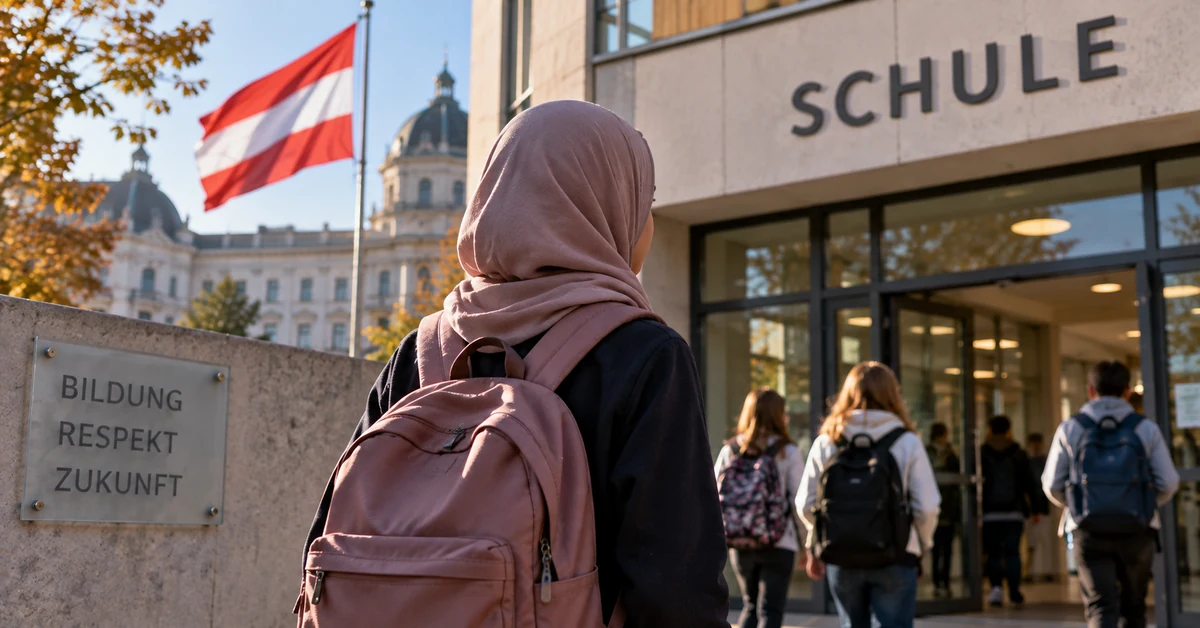
Austria has begun enforcing a nationwide ban on Islamic headscarves for girls under 14, with repeated breaches potentially resulting in fines of up to €800 for parents.
The law is now operating across state and private schools as the 2026-27 academic year gets under way.
It specifically prohibits girls under 14 from wearing clothing that covers the head “according to Islamic traditions”.
The first weeks of enforcement have already resulted in girls and parents being called into meetings with headteachers after pupils refused to remove their hijabs.
From warning to €800 fine
Schools are required to follow a staged process when the rule is breached.
A pupil wearing a hijab is initially asked to remove it.
If she continues to wear one, the school can hold discussions with the girl and her parents before referring the case to education authorities.
Child-welfare services can also become involved, and repeated violations can ultimately result in parents receiving fines ranging from €150 to €800.
Austrian reporting indicates that numerous cases have already arisen in Vienna. Roughly half were resolved at school level, while others were referred to education authorities.
Teachers’ representatives say implementation elsewhere has generally been calm, although some confrontations have occurred.
Government says ban protects girls
The Austrian government argues that the measure protects children from family and community pressure and gives girls greater freedom to develop without being required to display a religious identity.
Ministers have also raised concerns about informal “morality guardians” pressuring Muslim girls over how they dress.
Austria’s principal Muslim organisation, IGGÖ, opposes the law and argues that it discriminates against Muslim children.
The wording of the legislation is particularly significant because it does not establish a general prohibition on all religious head coverings.
It specifically defines the prohibited clothing by reference to Islamic tradition.
Austria has tried this before
That distinction has already caused constitutional problems.
Austria’s Constitutional Court struck down an earlier school headscarf ban in 2020.
The court found that specifically targeting Islamic head coverings violated principles of equality and religious neutrality.
The government subsequently redesigned the legislation and increased the age threshold.
But the new statute still explicitly targets head coverings worn according to Islamic traditions.
That question is now heading back towards the Constitutional Court.
Two sisters and their mother have applied to have the new law overturned following its entry into force.
An earlier challenge was rejected in July because the legislation was not yet operational, meaning the court did not decide whether the law itself was constitutional.
Austria is therefore enforcing a national restriction on Islamic dress while its legality remains contested.
The government says the state is protecting young girls from religious and social pressure.
Opponents argue that the state is itself determining what Muslim girls are permitted to wear.
Austria’s highest court rejected the country’s first attempt.
It will now be asked whether the second one survives.
Sources
- Reuters – Austria’s hijab ban enters its first classroom test
- Austrian Parliament – legislation taking effect from September 2026
- ORF – Constitutional Court and challenge to the new law
Join the Dissenting Citizen Newsletter
Independent news and commentary delivered directly to your inbox.
Breaking stories, analysis and commentary throughout the day.
Follow @VoxDissent →