









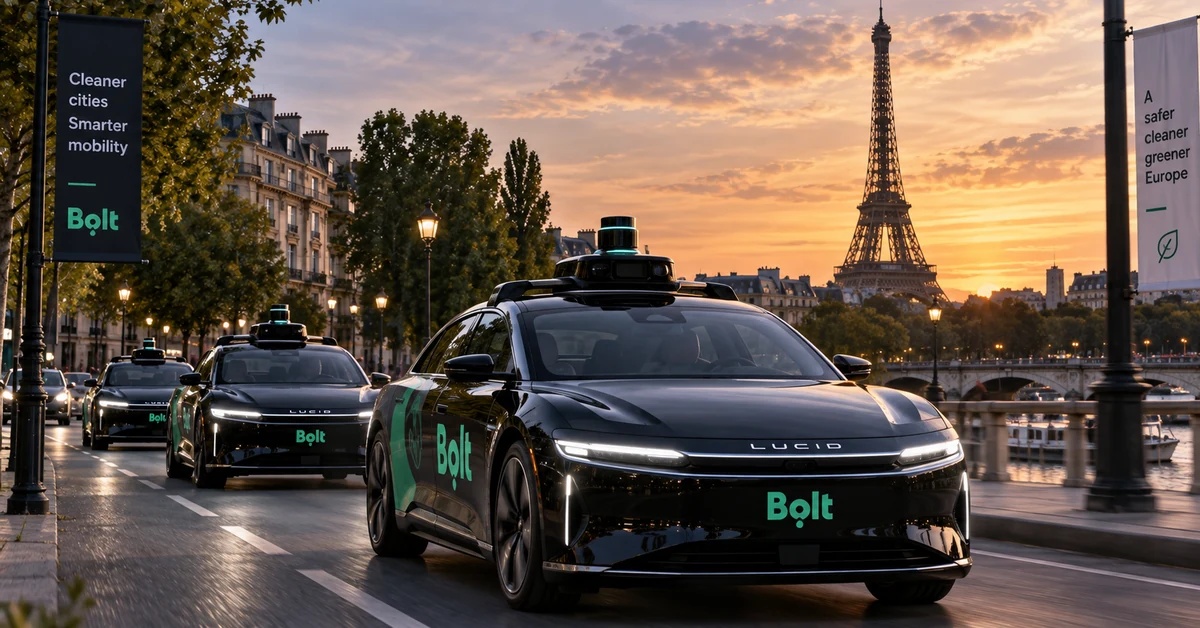
Bolt’s next major European fleet could have something conspicuously absent.
Drivers.
The ride-hailing company has joined Lucid in a plan to deploy at least 25,000 fully autonomous vehicles across Europe, with a longer-term ambition of putting 100,000 autonomous vehicles into operation by 2035.
There is no timetable yet for reaching 25,000.
Regulators still need to permit the vehicles to operate, the technology has to satisfy European safety requirements and large-scale deployment remains some distance away.
But the proposed scale changes the question.
Robotaxis have spent years being treated as an experiment: small fleets operating in restricted areas while engineers and regulators determine whether autonomous driving can work safely enough for widespread use.
Twenty-five thousand vehicles is a different proposition.
Bolt intends to own and operate the fleet itself, using Lucid vehicles equipped with Nvidia’s Hyperion autonomous-driving platform.
The vehicles are expected to be manufactured at Lucid’s new factory in Saudi Arabia.
Bolt chief executive Markus Villig believes Europe could eventually support millions of robotaxis, although he says stricter European safety regulation currently makes expansion more difficult than in the United States or China.
For Europe’s taxi and private-hire drivers, the important development is not whether millions arrive.
It is what happens when autonomous fleets begin scaling by the thousand.
A human-driven taxi creates a straightforward labour requirement. Put another 1,000 cars on the road and somebody has to drive them.
An autonomous fleet breaks that relationship.
Another 1,000 robotaxis can potentially add another 1,000 vehicles of passenger capacity without creating another 1,000 driving jobs.
That does not mean 1,000 existing drivers immediately become unemployed.
Demand can grow. Regulation can slow deployment. Autonomous vehicles may remain unsuitable for some journeys or locations. Operating them also creates different jobs in maintenance, fleet management, cleaning, remote assistance and technology.
The labour effect can arrive without mass redundancies.
If a platform can satisfy a growing share of additional passenger demand using vehicles without drivers, fewer new drivers may be required.
If autonomous operation eventually becomes cheaper, human drivers may also find themselves competing against vehicles whose economics contain no driver’s wage.
That is where the employment question becomes considerably larger than whether a robotaxi can successfully navigate a European city.
The relevant technology does not have to eliminate taxi driving to change taxi driving.
It only has to become sufficiently reliable, sufficiently legal and sufficiently cheap that platforms prefer adding autonomous cars when they need more capacity.
Bolt and Lucid have not demonstrated that Europe has reached that point.
Their proposed 25,000-vehicle fleet is a sizeable bet that it eventually will.
And if they are right, the next generation of competition facing Europe’s taxi drivers may not be another driver willing to work for less.
It may be a car that does not need paying at all.
Sources
Join the Dissenting Citizen Newsletter
Independent news and commentary delivered directly to your inbox.
Breaking stories, analysis and commentary throughout the day.
Follow @VoxDissent →