









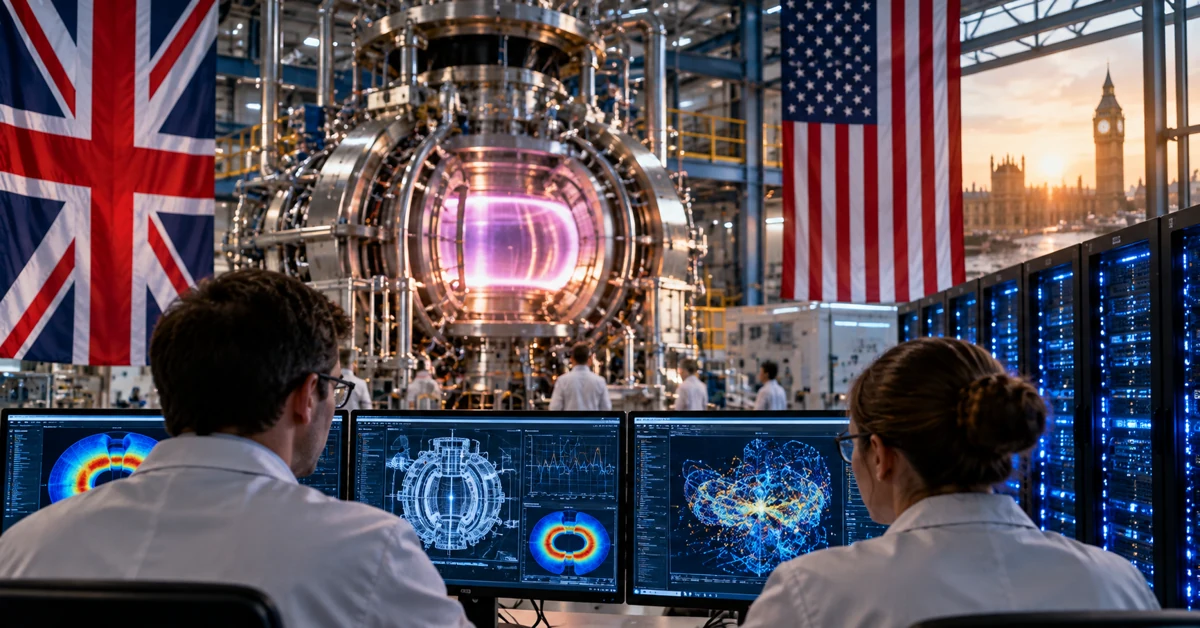
Britain and the United States are signing two new fusion agreements combining artificial intelligence, supercomputing and nuclear research as the UK commits more than £2.5 billion to building a domestic fusion industry.
The agreements are being signed at the Global Fusion Policy Summit in London.
The first links the UK Atomic Energy Authority with Princeton Plasma Physics Laboratory through a new supercomputing partnership.
AI and advanced computing will be used alongside fusion research to accelerate modelling and development.
A second agreement will deepen UK-US cooperation on fusion regulation, an area that will become increasingly important if experimental systems progress towards commercial deployment.
Britain plans to spend more than £2.5 billion over five years on fusion.
That includes £45 million for Sunrise, a supercomputer dedicated to fusion research.
The government is targeting more than 10,000 UK fusion jobs by 2030 and estimates the eventual global market could be worth between £3 trillion and £12 trillion.
The science is British. Will the industry be?
Britain’s flagship STEP programme is intended to demonstrate a prototype fusion power plant at West Burton in Nottinghamshire.
Commercial fusion, however, does not yet exist.
STEP remains a long-term project, with its demonstration plant targeted around the 2040 horizon. Today’s agreements are about research capability, computing and regulation, not electricity entering the grid.
Britain has considerable scientific expertise in fusion. The harder part comes if the technology works.
The country has repeatedly demonstrated an ability to produce world-class science without capturing the full industrial value that follows.
Fusion offers another chance to get that sequence right: research, intellectual property, supply chains, skilled employment and eventually energy production.
More than £2.5 billion is a substantial bet on technology that may take decades to mature.
If fusion succeeds, the prize is considerably larger.
Sources
- UK Government: UK and US fusion partnership to accelerate clean energy
- UKAEA: Global Fusion Policy Summit
Join the Dissenting Citizen Newsletter
Independent news and commentary delivered directly to your inbox.
Breaking stories, analysis and commentary throughout the day.
Follow @VoxDissent →