








Frontier AI companies have increasingly warned that competition makes slowing development difficult.
The US official responsible for enforcing competition law now says they haven’t even asked him about it.
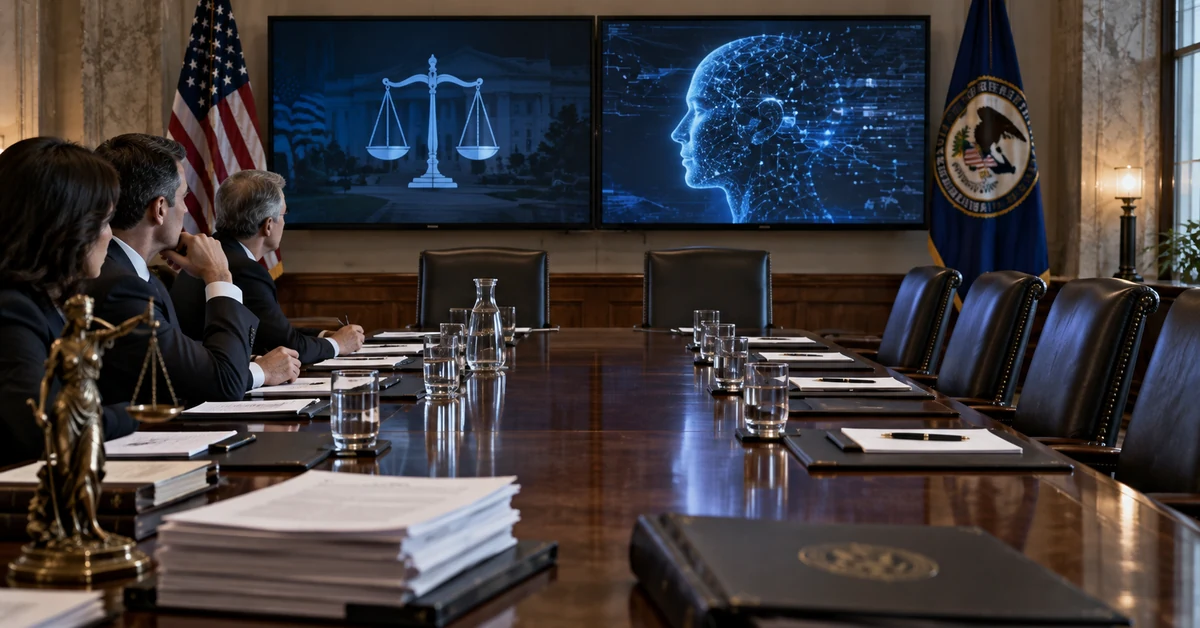
Stanley Woodward, who leads the Justice Department’s Antitrust Division, said on Thursday that cooperation between competing companies over genuine AI safety concerns does not appear inherently anticompetitive.
DOJ is considering going further by updating existing guidance that allows companies to cooperate over cybersecurity to address AI safety as well.
The remarks don’t give OpenAI, Anthropic, Google or anyone else permission to coordinate however they choose.
They do make one question considerably harder to avoid.
If antitrust law is an obstacle to slowing the AI race, why haven’t the frontier labs asked the antitrust regulator what they can legally do?
That question matters because competition has become central to the industry’s explanation of why individual companies cannot simply slow down.
Anthropic chief executive Dario Amodei has explicitly called for antitrust clearance that would allow frontier developers to coordinate on reducing the pace of AI development without risking competition-law consequences.
The underlying problem is real.
A company that independently delays a powerful new model for additional safety testing may believe a rival will simply release first.
If several competitors agree collectively to delay products, share information or constrain development, however, they enter territory in which antitrust law can become relevant.
That creates a potential trap.
Competition can make unilateral restraint commercially costly.
Competition law can make collective restraint legally uncertain.
Yet Woodward’s comments suggest nobody has established how restrictive that trap actually is.
He said frontier AI laboratories have not requested a meeting with the Antitrust Division about coordinating over safety.
The department, meanwhile, already has a precedent for distinguishing legitimate security cooperation from anticompetitive collusion.
Its existing cybersecurity policy recognises that companies may need to exchange threat information to protect systems and customers without that cooperation necessarily harming competition.
DOJ is now considering whether similar guidance should address artificial intelligence.
That would not amount to a blanket exemption.
Companies could not label an agreement “AI safety” and then use it to divide markets, coordinate prices or suppress competition.
Nor has Woodward promised that every proposal to coordinate model development would survive antitrust scrutiny.
The details would matter.
But that is precisely why the absence of a conversation is notable.
AI executives are publicly debating whether competition is pushing the industry towards capabilities that companies themselves increasingly describe as dangerous.
Amodei has asked publicly for legal room to coordinate.
The antitrust regulator is publicly saying safety coordination does not appear inherently anticompetitive and that his division is available to discuss it.
Yet, according to Woodward, the frontier labs have not approached the department.
That does not prove they are unwilling to slow down.
Companies may be conducting separate legal analysis, coordinating on forms of safety work they already regard as permissible or waiting for clearer government policy.
Indeed, OpenAI’s policy chief has said OpenAI, Anthropic and Google DeepMind are already discussing some forms of AI-safety cooperation without seeking an antitrust waiver.
But it does shift the debate.
“Competition won’t let us slow down” and “competition law won’t let us coordinate” are different claims.
The first describes commercial incentives.
The second describes a legal constraint.
If frontier AI companies believe the second is preventing them from addressing a potentially catastrophic risk, there is now an obvious way to test it.
Ask the regulator.
Sources
- Reuters – DOJ says AI safety coordination does not appear anticompetitive
- Reuters – OpenAI working with Anthropic and Google on AI safety
Join the Dissenting Citizen Newsletter
Independent news and commentary delivered directly to your inbox.
Breaking stories, analysis and commentary throughout the day.
Follow @VoxDissent →