






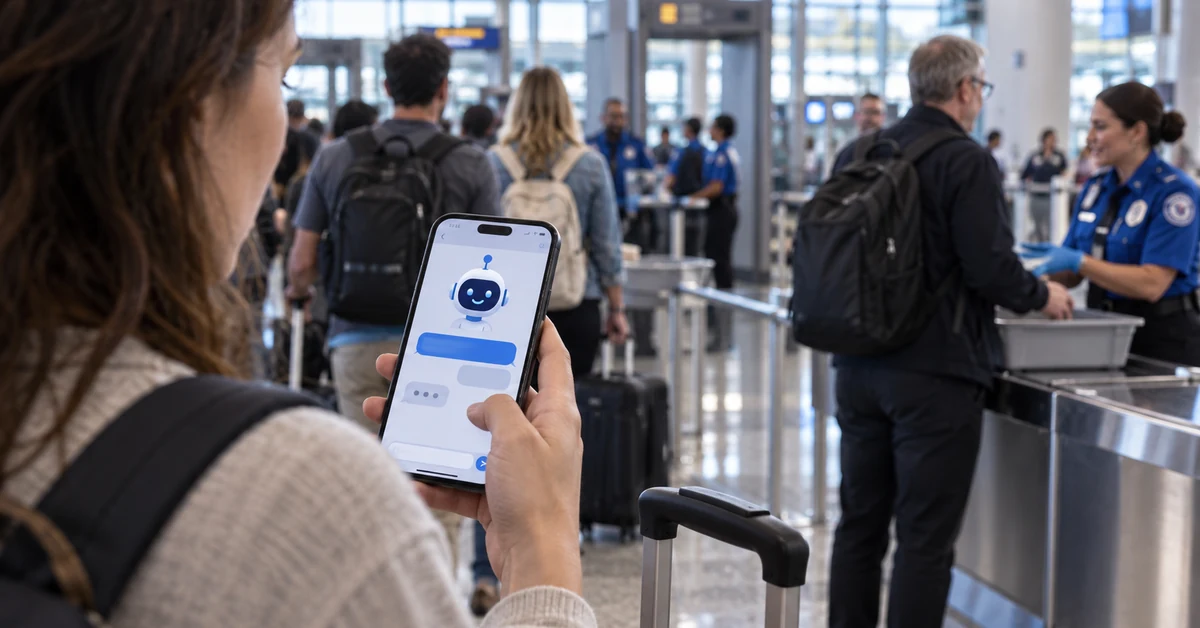
An AI agent answering questions for the US Transportation Security Administration is handling around 100,000 traveller conversations every month, with 96% of routine inquiries resolved without being transferred to a human.
The agent, called Ace, answers common questions about airport security requirements, including how passengers should pack liquids and what they need to do when travelling with medical devices.
When a question falls outside what Ace can handle, the conversation is escalated to TSA staff.
The operating figures were reported by Salesforce, whose technology powers the system.
96% of routine inquiries resolved by AI
The 96% figure applies to routine inquiries within Ace’s supported domain, rather than every contact received by the TSA.
Ace also does not make airport security-screening decisions or replace Transportation Security Officers working at checkpoints.
Its job is narrower: dealing with large volumes of repetitive questions that would otherwise require some degree of human attention.
At 100,000 conversations a month, that amounts to roughly 1.2 million traveller interactions a year at the current rate.
If the reported resolution rate holds, only about 4,000 of every 100,000 routine conversations require human escalation.
Work disappears before jobs do
The numbers illustrate one way AI could change employment without entire professions suddenly being automated.
Ace has not replaced the TSA.
It has automated a specific recurring workflow within it.
The same pattern can apply across customer service, administration, finance, healthcare and other sectors containing large volumes of repetitive interactions.
A job composed of ten different activities does not require AI to perform all ten before staffing requirements can change.
Automating three or four activities may simply reduce the number of people required to perform the remaining ones.
That makes workload displacement harder to see than a straightforward announcement that a particular occupation has been automated.
There need not be a moment when somebody declares that a job has disappeared.
The routine work can disappear first.
At the TSA, one AI agent is already handling around 100,000 traveller conversations every month.
For the routine questions it supports, humans are needed for about 4% of them.
Source
Join the Dissenting Citizen Newsletter
Independent news and commentary delivered directly to your inbox.
Breaking stories, analysis and commentary throughout the day.
Follow @VoxDissent →