







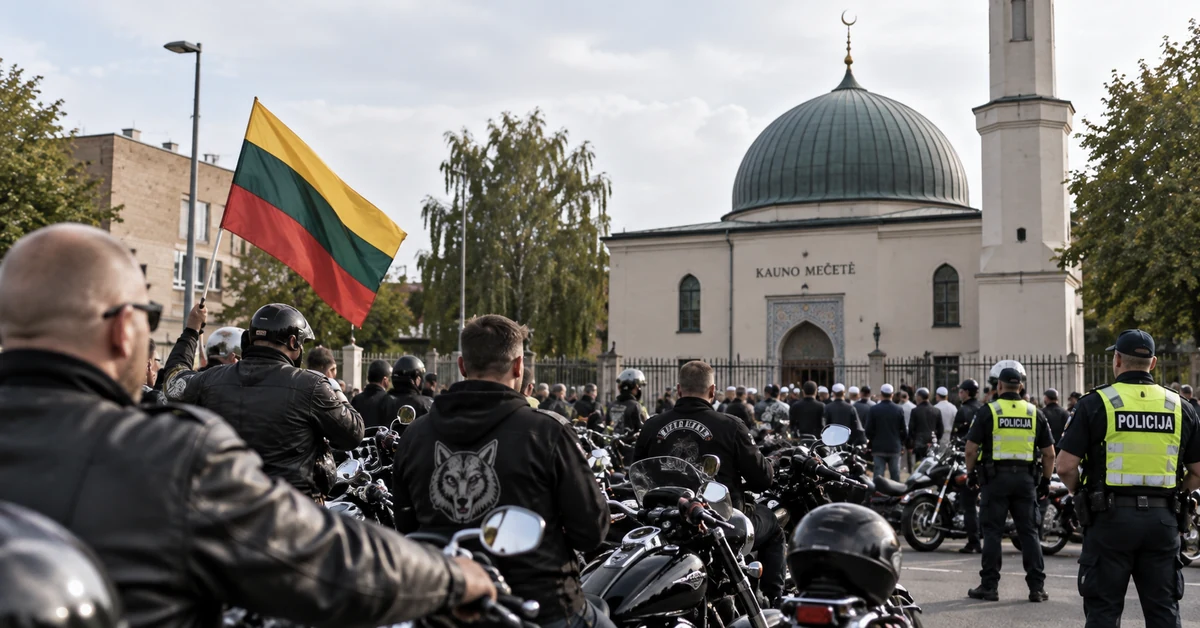
Lithuania’s interior minister has asked the country’s security service to assess growing tensions over migration after around 100 bikers disrupted Friday prayers outside a mosque in Kaunas.
The confrontation was deliberately provocative.
Motorcyclists gathered around the mosque on September 11, revved their engines, played loud music and chanted “Lithuania” while Muslims were worshipping. A pig’s head was displayed towards the congregation.
Police have since opened a criminal investigation into possible incitement against a religious group and interference with religious rites.
Yet Interior Minister Martynas Katelynas has framed the incident as something larger than an isolated anti-Muslim protest.
“What we saw at the Kaunas mosque on Friday is a consequence of growing tensions in society over migration,” he said.
Katelynas has now asked Lithuania’s State Security Department to assess the situation and potential risks.
His distinction between Lithuania’s established Muslim population and more recent arrivals is particularly revealing.
The minister said Lithuania’s Tatars – a Muslim community with centuries of history in the country – were not the problem. Instead, he pointed to what he called a “new migration reality” and argued that authorities need to understand who is arriving and what security risks may accompany new communities.
The bikers themselves say their grievance was more specific.
One representative told Lithuanian broadcaster LRT that Muslims attending the mosque had been obstructing streets with cars and praying outside. The protest, he claimed, was motivated by disorder rather than opposition to Islam itself.
Those complaints can be examined on their own merits.
If roads are being obstructed, parking regulations can be enforced. If large gatherings are creating problems in public spaces, authorities can address them. Lithuania can debate immigration levels and integration just as any democratic country can.
None of those questions requires preventing Muslims from praying.
That is the distinction now confronting Lithuanian authorities.
The bikers were not protesting outside parliament or presenting demands to immigration officials. They gathered during a religious service, generated enough noise to interfere with it and displayed an object chosen for its obvious capacity to offend Muslims.
Police are now investigating whether that crossed the legal boundary from protest into religious incitement and interference with worship.
The incident has continued to spread politically.
Prime Minister Inga Ruginienė has urged both sides to avoid escalation while affirming Muslims’ right to practise their religion without interference. The Kaunas archbishop has condemned the confrontation, and Lithuania’s mufti has asked the government for additional protection.
On Wednesday, 60 Lithuanian academics, journalists, cultural figures and politicians published an open letter demanding a firm official response.
Migration can create genuine pressures over housing, integration, public space, culture and security.
Pretending those tensions do not exist does not resolve them.
Neither does directing them at people while they pray.
A democratic society ought to be capable of doing both things at once: arguing openly about who enters the country and protecting the religious freedom of those already there.
Sources
- LRT – Interior Minister links Kaunas mosque confrontation to migration tensions
- LRT – Criminal investigation and competing accounts of the dispute
- LRT – Open letter and latest reaction
Join the Dissenting Citizen Newsletter
Independent news and commentary delivered directly to your inbox.
Breaking stories, analysis and commentary throughout the day.
Follow @VoxDissent →