









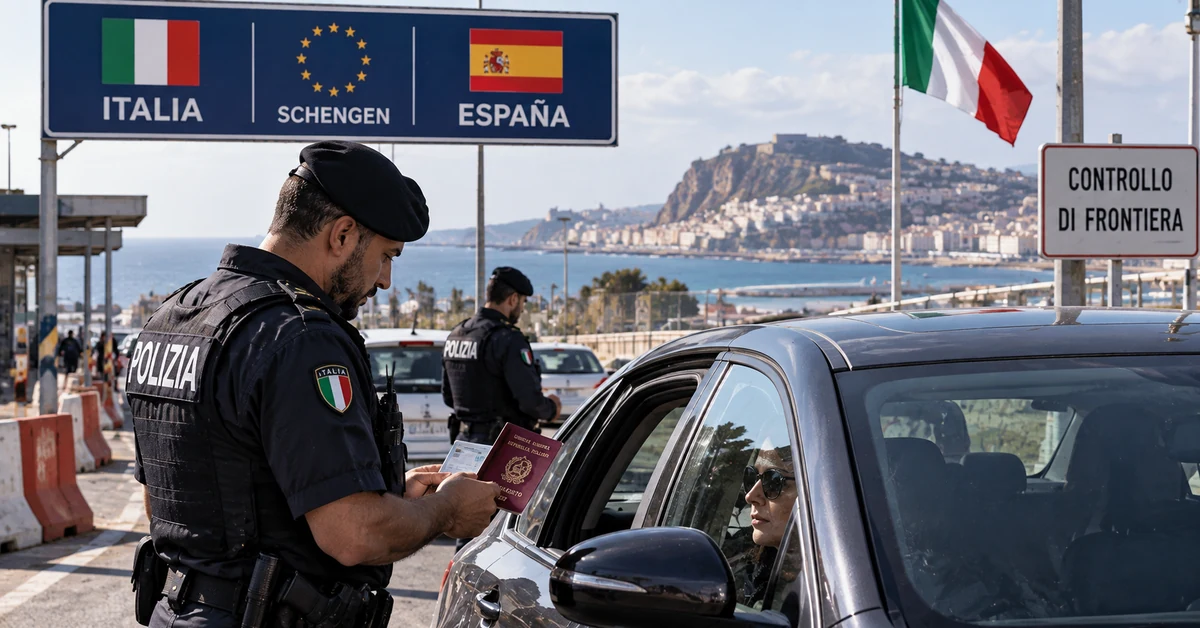
Italy has extended border controls on travellers arriving from Spain as its foreign minister explicitly links the restrictions to fears of jihadist infiltration following the mass migration into Ceuta.
Antonio Tajani said on Thursday that there are “many cells of Islamic jihad” around the Spanish enclave and argued that Italy cannot risk potentially dangerous individuals moving from Ceuta into mainland Spain and then elsewhere in Europe.
The controls will remain in place for another 15 days.
Italy first introduced them after tens of thousands of migrants crossed from Morocco into Ceuta during the extraordinary border crisis at the end of July.
Rome initially cited internal security and the possibility of terrorist infiltration.
Tajani has now made the government’s reasoning considerably more explicit.
“The problem is security,” he said.
His concern is not simply that migrants could travel onwards from Spain.
It is that jihadist networks operating around Ceuta could exploit that movement.
That assessment has consequences well beyond Italy’s immigration policy.
Spain and Italy are both members of the Schengen area, where internal border controls are supposed to be exceptional.
A migration crisis on Europe’s external frontier is therefore now disrupting free movement between two EU states because one government believes it carries a potential terrorism risk.
Spain strongly disputes the justification.
Madrid regards the Italian restrictions as unnecessary and politically motivated and has imposed controls of its own on travellers arriving from Italy.
There is also an important limit to what has been established publicly.
ANSA reports that no migrant from the July Ceuta influx has so far reached Italy.
Tajani’s claim about jihadist cells around Ceuta is the Italian government’s assessment. Public reporting has not established that members of those cells entered Ceuta during the July crossings or subsequently travelled towards Italy.
That does not make preventative action inherently unreasonable.
Counter-terrorism cannot operate on the principle that authorities wait until a suspected jihadist reaches his intended destination before responding.
If Italian intelligence indicates a credible threat, temporary border controls are one of the tools available to government.
But the episode demonstrates how quickly failures at Europe’s external borders can create consequences elsewhere.
Ceuta is Spanish territory on the North African coast.
Once somebody reaches mainland Spain, movement across much of continental Europe becomes considerably easier.
That is one of Schengen’s central advantages for legitimate travellers.
It is also why control of the external border matters to every country inside it.
Italy’s response effectively treats the Ceuta crisis not merely as Spain’s migration problem but as a potential Italian security problem.
That distinction matters.
Irregular migration and jihadism are not interchangeable.
The overwhelming majority of people crossing borders illegally are not terrorists, and the existence of jihadist organisations around a migration route does not establish that migrants using that route belong to them.
But governments also cannot assume that extremist networks will never exploit weaknesses in border control.
Europe has experienced that problem before.
The security question is whether intelligence indicates that it is happening again.
Italy evidently considers the risk serious enough to restrict normal Schengen movement.
Spain disagrees.
For now, the practical result is already visible.
A mass migration event on Europe’s southern frontier has produced border controls between two countries hundreds of miles away from where the crossings occurred.
That is the vulnerability Schengen has always contained.
Free movement inside Europe depends upon confidence in the borders around it.
When that confidence breaks down, internal borders start returning.
Sources
- Reuters – Italy extends Schengen controls involving Spain
- LaPresse – Tajani cites jihadist cells around Ceuta
- ANSA – Italy says controls are security-related
Join the Dissenting Citizen Newsletter
Independent news and commentary delivered directly to your inbox.
Breaking stories, analysis and commentary throughout the day.
Follow @VoxDissent →