








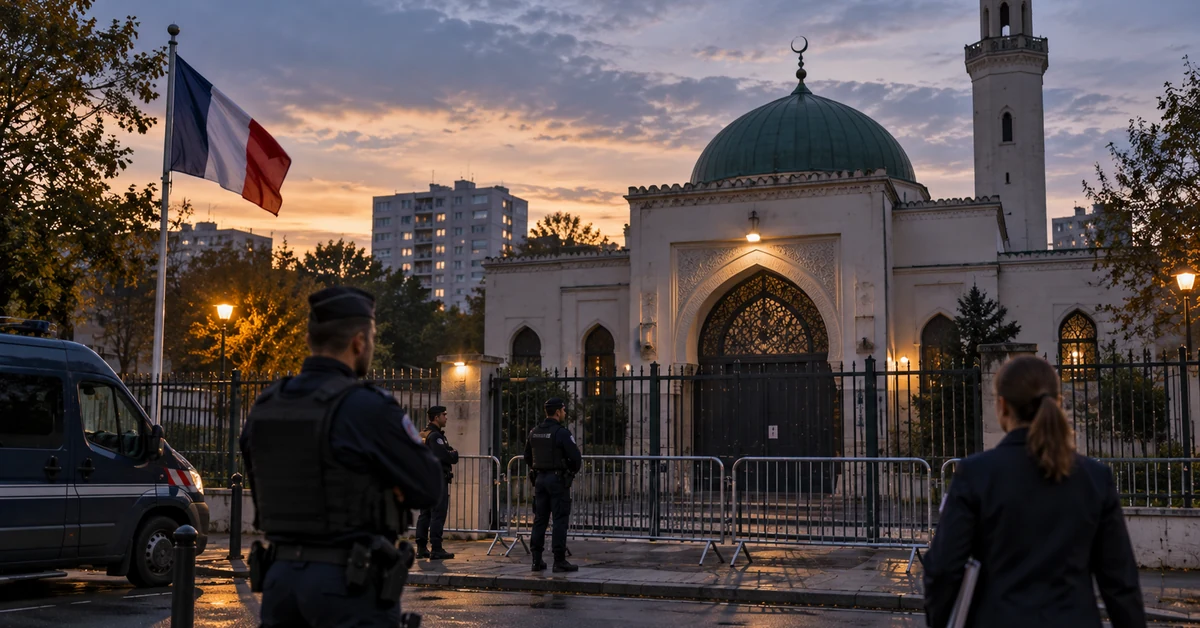
France has dissolved the organisation that ran the Attaqwa mosque near Paris after authorities accused its preachers of legitimising armed jihad, glorifying martyrdom and repeating terrorist rhetoric.
The decision marks the latest stage in an escalating series of measures against the Association culturelle d’Aulnay Sud.
Its assets were frozen in July.
The Attaqwa mosque, also known as the Chanteloup mosque, was then ordered closed for six months.
The association challenged that closure and lost its first court battle.
Now the French government has dissolved the organisation itself.
From closing the mosque to eliminating the organisation
The mosque is in Aulnay-sous-Bois, in the Seine-Saint-Denis department north-east of Paris.
French authorities say sermons delivered by regular imams and visiting speakers promoted what they describe as a “radical Islamist ideology”.
The prefecture accused speakers associated with the mosque of inciting hatred or violence, legitimising jihad and disseminating material amounting in some instances to advocacy or encouragement of terrorism.
According to reporting by Le Monde, one regular preacher was accused of repeatedly legitimising jihad and describing Shia Muslims as more impure than pigs and dogs.
Another imam was accused of rhetoric calling for the destruction of unbelievers.
Authorities also cited appearances by a Kuwaiti Salafist preacher who visited the mosque five times and was subsequently barred from France.
Among the material attributed to him was a social-media post following the October 7 Hamas attack saying the massacre had made Muslims happy.
Authorities also said the mosque had attracted people already known for radicalisation and individuals connected to terrorism cases.
Court rejected challenge to closure
The allegations have already undergone an initial test in France’s administrative courts.
On August 7, the Montreuil Administrative Court rejected an emergency application seeking to suspend the mosque’s six-month closure.
At that stage of proceedings, the court found that statements attributable to religious officials at the mosque constituted incitement to hatred or violence connected with terrorism, or advocacy of terrorist acts.
It also concluded that the temporary closure did not constitute a manifestly unlawful interference with freedom of religion.
That ruling was not a final determination of every allegation against the association.
But it meant the government’s action survived its first legal challenge.
Association disputes the allegations
The association has denied promoting terrorism or unlawful extremism.
It argues that sermons cited by the authorities were selectively quoted and removed from their proper religious context.
Its lawyer has argued that the measures interfere with freedom of religion and expression.
The association also removed two imams after authorities intervened and maintains that it operated within French law.
Those arguments did not prevent the government from escalating its response.
France targets the organisation behind the mosque
The sequence is revealing.
French authorities first monitored the activity.
They froze the association’s assets.
They closed its mosque.
The association challenged the closure and failed to have it suspended.
The government has now dissolved the organisation that operated it.
That moves the intervention beyond preventing particular sermons from being delivered in a particular building.
France is targeting the institution it says sustained the activity.
It reflects a broader question running through French counter-Islamism policy: whether the state should intervene only when extremist ideology produces a prosecutable violent act, or whether it should dismantle organisations it believes are helping create an ideological environment in which violence is legitimised.
At Aulnay-sous-Bois, the government has chosen the second approach.
Sources
- Seine-Saint-Denis Prefecture – official grounds for closing the Attaqwa mosque
- Montreuil Administrative Court – August 7 ruling on mosque closure
- Le Monde – allegations and background to the Attaqwa mosque case
Join the Dissenting Citizen Newsletter
Independent news and commentary delivered directly to your inbox.
Breaking stories, analysis and commentary throughout the day.
Follow @VoxDissent →