





Three seats have brought down Sweden’s government.
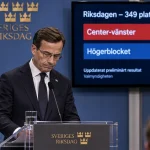
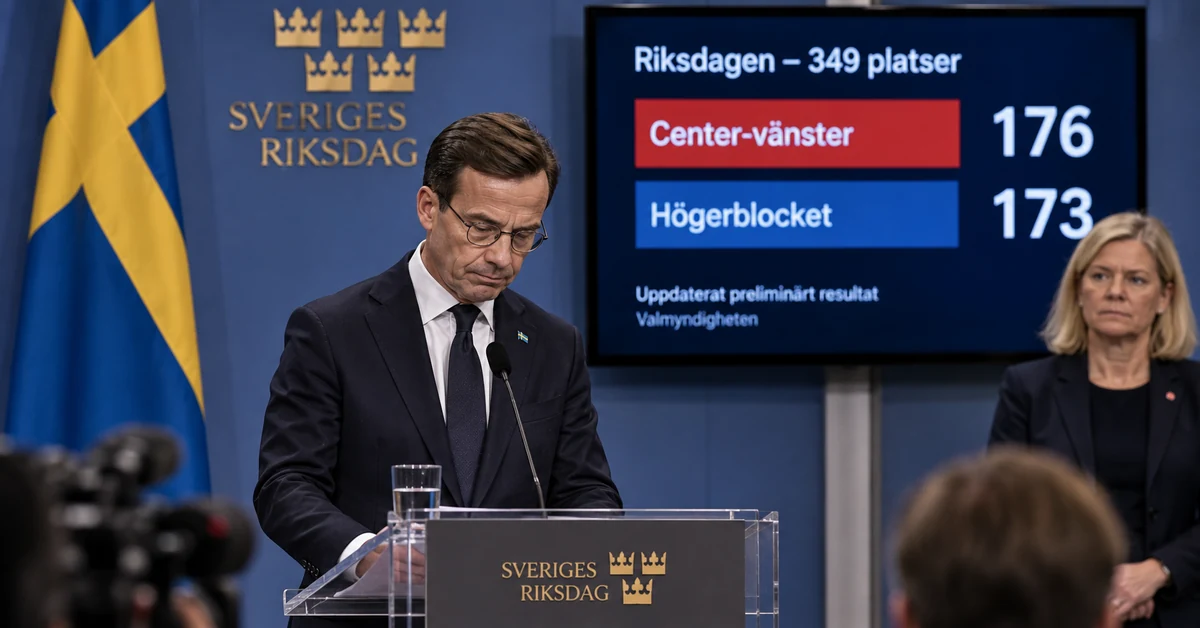
Prime Minister Ulf Kristersson submitted his resignation on Thursday after the updated election count gave Sweden’s centre-left opposition a 176-173 advantage in the country’s 349-seat parliament.
The resignation formally ends the government formed after Sweden’s previous election and begins negotiations over what replaces it.
That may prove considerably more complicated than the numbers suggest.
Sweden’s Social Democrats, Centre Party, Greens and Left Party collectively hold the parliamentary edge.
But defeating Kristersson’s right-wing bloc does not mean those four parties automatically agree on how Sweden should now be governed.
The first qualification is that even the electoral arithmetic is not formally complete.
Sweden’s Election Authority describes Thursday’s seat allocation as an updated preliminary result while the final count continues.
On the current figures, however, the balance is extraordinarily narrow.
Centre-left parties: 176.
Outgoing government bloc: 173.
Kristersson has accepted the result and submitted his resignation to Speaker Andreas Norlén.
The Speaker has now begun the constitutional process of identifying a candidate capable of forming a government tolerated by the Riksdag.
Former prime minister Magdalena Andersson is the central figure in those negotiations.
Her Social Democrats remain Sweden’s largest party and lead the group of parties that collectively defeated Kristersson’s bloc.
But Sweden does not elect its prime minister directly.
Nor does the largest party automatically govern.
A prospective prime minister must assemble enough parliamentary support – or at least enough tolerance – to survive Sweden’s system of negative parliamentarism.
That is where a three-seat electoral victory becomes a much more complicated political problem.
The Social Democrats, Centre Party, Greens and Left Party agree that Kristersson’s government should be replaced.
They do not agree on everything that should replace it.
The Centre Party and Left Party have substantial differences over economic policy.
Questions involving taxation, welfare, climate policy, labour markets and the shape of any governing arrangement will have to be negotiated.
There is also the question of whether all four parties would participate directly in government or whether some would support an administration from outside it.
Sweden has considerable experience with precisely these arrangements.
Minority governments are common.
What matters is not necessarily constructing a coalition containing a majority of MPs.
Under Sweden’s constitutional system, a proposed prime minister can take office provided that no absolute majority of the Riksdag – 175 members – votes against them.
That creates room for abstentions, confidence arrangements and negotiated parliamentary support.
It also means the 176-173 divide does not automatically translate into a four-party coalition government.
The election nevertheless represents a clear political change.
Kristersson came to power after the 2022 election through an arrangement involving the Moderates, Christian Democrats and Liberals, supported in parliament by the Sweden Democrats.
That agreement reflected one of the largest transformations in modern Swedish politics.
The Sweden Democrats had moved from political isolation into a position of substantial influence over government policy.
Immigration became significantly tighter.
Crime and gang violence became central political issues.
Questions of integration, citizenship and national identity moved towards the centre of Swedish political debate.
Those issues have not disappeared because the parliamentary balance has shifted.
Any new government will inherit them.
The Social Democrats themselves have moved towards tougher positions on several immigration and crime questions compared with where the party stood a decade ago.
That makes the election result more complicated than a simple reversal of Sweden’s recent political direction.
Voters have changed the parliamentary majority.
They have not necessarily returned Swedish politics to where it was before the rise of the Sweden Democrats.
The outgoing bloc also remains formidable.
A 173-seat opposition would sit only three seats behind the parties currently capable of supporting an alternative government.
That leaves little room for defections, internal rebellions or failed negotiations.
The immediate task now belongs to Speaker Norlén.
He will hold talks with party leaders and determine who has the best prospect of surviving a parliamentary vote.
What emerges from it will depend on what the parties are prepared to negotiate.
That is the distinction Thursday’s resignation makes clear.
Swedish voters have produced enough parliamentary arithmetic to remove one government.
Now Sweden has to discover whether that arithmetic can produce another.
Sources
- Reuters – Kristersson resigns after updated election count
- Swedish Riksdag – Speaker begins government-formation process
Join the Dissenting Citizen Newsletter
Independent news and commentary delivered directly to your inbox.
Breaking stories, analysis and commentary throughout the day.
Follow @VoxDissent →