









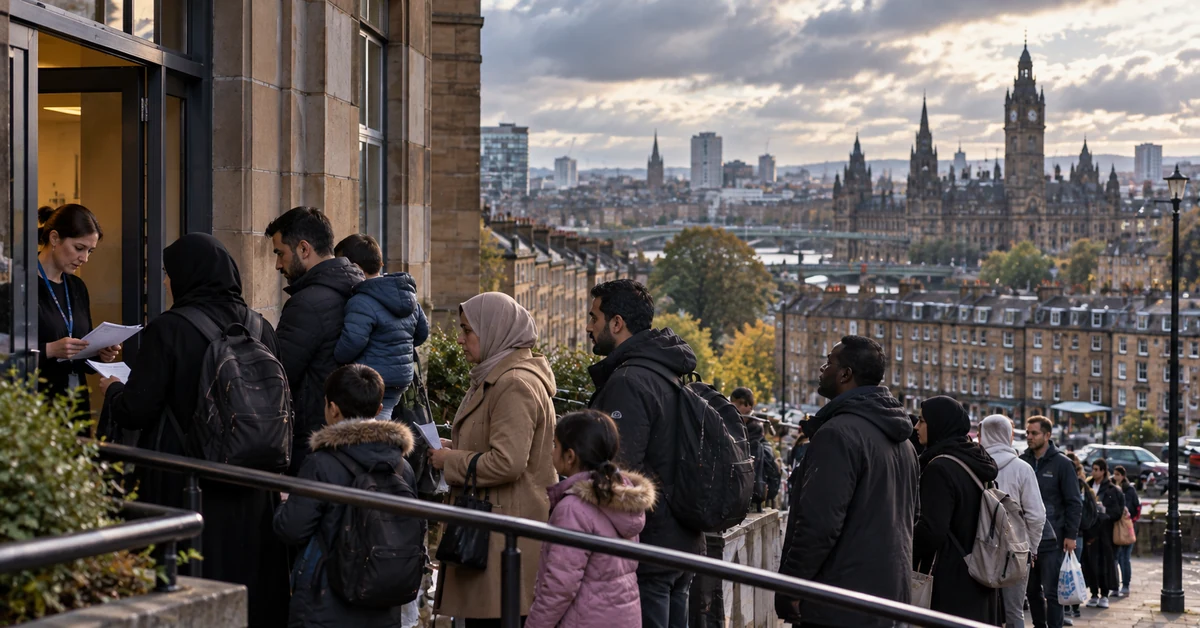
Glasgow’s council leader wants the government to stop sending more asylum seekers to the city.
Temporarily, at least.
Ricky Bell has backed calls for a pause on further asylum placements as Glasgow struggles with pressure on housing and local services.
The numbers explain why the argument has moved beyond immigration policy itself.
Glasgow currently accommodates 3,938 asylum seekers receiving Home Office support.
Birmingham has 2,136.
Liverpool has 1,961.
No other UK local authority has more than Glasgow.
That comparison is particularly striking because Glasgow is not Britain’s largest city.
Birmingham’s population is roughly twice as large.
Yet Glasgow is accommodating almost twice as many Home Office-supported asylum seekers.
That turns a national immigration question into a local distribution question.
Britain decides nationally who enters the asylum system.
The Home Office manages asylum accommodation.
But the practical consequences arrive somewhere specific.
People need housing.
Children may need school places.
Patients use local health services.
Councils deal with homelessness and social support.
Community organisations provide assistance.
And those demands become much more noticeable when placements are concentrated heavily in particular places.
Glasgow has carried an unusually large share for years.
The city was Britain’s first local authority to participate in the asylum dispersal programme introduced in 2000 and has remained one of its largest destinations.
That history reflects something positive as well as difficult.
Glasgow has developed substantial experience, organisations and services capable of supporting refugees and asylum seekers.
But capacity can itself create a cycle.
Places with established infrastructure become easier locations in which to place more people.
Those additional placements increase the infrastructure and experience.
And the same communities continue carrying a larger share.
The city now says that cannot continue indefinitely.
Bell has backed calls for a temporary pause while pressure on Glasgow’s housing system is addressed.
The demand does not mean asylum seekers already living in Glasgow would be removed.
Nor would it end Britain’s responsibility to accommodate people awaiting asylum decisions.
It would shift the question elsewhere.
If Glasgow receives fewer placements, where should those people go instead?
That is the unavoidable consequence of treating asylum as a national responsibility.
Somebody has to provide the accommodation.
The argument therefore cannot stop at whether Glasgow has too many.
It has to ask how the burden should be distributed across Britain.
There are important arguments against blaming asylum placements for Glasgow’s housing crisis.
Scotland’s shortage of affordable housing predates the current pressure on the asylum system.
Housing organisations and refugee groups argue that decades of insufficient housebuilding and wider structural problems have created shortages affecting asylum seekers and existing residents alike.
That distinction matters.
Removing every asylum seeker from Glasgow tomorrow would not suddenly create a healthy housing market.
But it does not follow that additional demand has no effect when supply is already constrained.
Both things can be true.
Glasgow can have a longstanding structural housing shortage.
And placing thousands of additional people who require accommodation in the city can intensify pressure on that shortage.
The useful question is therefore not whether asylum seekers “caused” Glasgow’s housing problems.
It is whether national government should continue concentrating asylum accommodation in places already saying they have reached capacity.
The dispersal system was originally intended to prevent precisely that kind of concentration.
Yet the current figures show enormous differences between local authorities.
Glasgow has 3,938 supported asylum seekers.
Birmingham has 2,136.
Liverpool has 1,961.
Many other councils accommodate considerably fewer.
There may be legitimate reasons for some variation.
Housing availability differs.
Costs differ.
Support networks differ.
Some areas have more suitable accommodation than others.
And simply allocating people according to population would ignore those practical differences.
But disparities this large deserve an explanation.
National asylum policy should not become somebody else’s responsibility simply because particular councils have historically been willing or able to participate.
If Britain decides that people awaiting asylum decisions must be housed, Britain collectively owns the consequences of that decision.
The argument in Glasgow is therefore bigger than Glasgow.
It is about who absorbs the local consequences of national policy.
Ricky Bell is asking for his city to receive a temporary pause.
If the government agrees, the asylum seekers will still need somewhere to live.
Which brings the argument back to the question the current numbers make difficult to avoid.
If asylum is a national responsibility, why is so much of it being concentrated in particular communities?
Sources
- STV – Glasgow council leader calls for pause in housing asylum seekers
- UK Parliament – Evidence on asylum accommodation and Glasgow pressures
Join the Dissenting Citizen Newsletter
Independent news and commentary delivered directly to your inbox.
Breaking stories, analysis and commentary throughout the day.
Follow @VoxDissent →