








Syria’s first verdicts over the sectarian violence that followed the fall of Bashar al-Assad contain an important test of the country’s new order.
The court did not punish only the losing side.
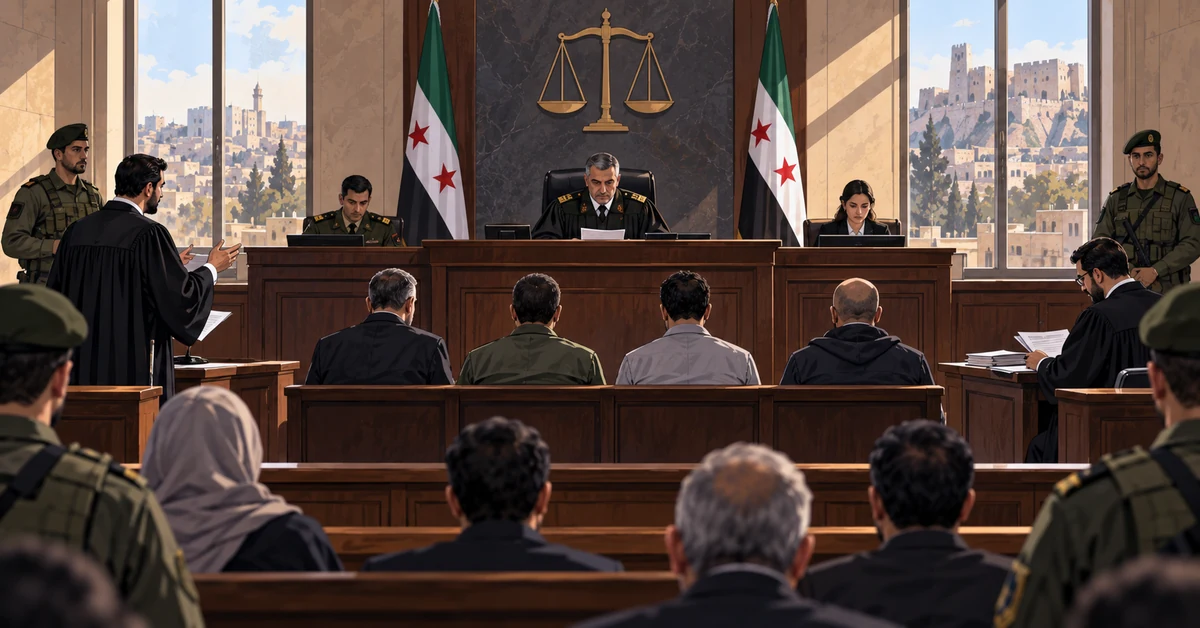
A military court in Aleppo has sentenced defendants linked to Assad’s former regime while also imposing a 20-year prison sentence on a former member of the forces aligned with the government that replaced him.
Another defendant was acquitted.
The four judgments are the first arising from the deadly violence that swept Syria’s Mediterranean coast in March 2025.
One defendant linked to the former regime was sentenced to death, while another received life imprisonment.
But the court also convicted a former member of the transitional government’s forces.
He was sentenced to 20 years in prison.
A fourth defendant was acquitted because the court found insufficient evidence against him.
Those outcomes matter because of what happened on Syria’s coast.
The violence began in March 2025 after forces loyal to the former Assad government attacked members of Syria’s new security forces.
The response rapidly escalated.
Government-aligned forces, armed groups and individual fighters were accused of retaliatory killings in predominantly Alawite communities.
Hundreds of civilians died.
The sectarian dimension made the violence particularly dangerous for a country emerging from more than a decade of civil war.
Assad came from Syria’s Alawite minority.
The armed movement that overthrew him emerged largely from the country’s Sunni opposition.
That did not make every Alawite an Assad supporter or every Sunni a supporter of the new authorities.
But once civilians began being identified through sectarian affiliation, the distinction became deadly.
Investigations subsequently produced competing assessments of responsibility.
Syria’s National Independent Commission for Investigation and Fact-Finding concluded that serious violations had occurred but said it found no evidence that the transitional authorities had centrally ordered attacks on Alawite civilians.
It characterised many abuses as individual actions.
A United Nations investigation painted a more troubling picture.
The UN Commission of Inquiry said violence against civilians by forces aligned with the transitional government had been widespread and systematic in affected areas.
Investigators documented killings, torture, looting and destruction of property.
They also described incidents in which armed men allegedly asked civilians whether they were Sunni or Alawite before deciding what happened to them.
Those findings make the prosecutions politically difficult.
Punishing Assad loyalists for violence against the new state is comparatively straightforward for authorities that overthrew Assad.
Prosecuting crimes committed by people who fought on the victorious side is a different test.
Revolutions naturally divide history into perpetrators and liberators.
Courts cannot work that way.
If somebody intentionally kills a civilian, the victim does not become less dead because the perpetrator belonged to the faction that won the war.
That is why the 20-year sentence imposed on a former member of the new government’s forces matters beyond one defendant.
It does not prove Syria’s transitional justice system is independent.
One conviction cannot establish that thousands of allegations will be investigated impartially.
Nor do these first four judgments resolve disagreements between Syrian and international investigators over whether abuses were isolated acts or reflected something more systematic.
There are many more cases to come.
Future prosecutions will show whether accountability reaches commanders as well as individual fighters, whether defendants receive fair trials and whether crimes committed by government-aligned forces are pursued with the same determination as crimes committed by Assad loyalists.
The death sentence will also attract separate scrutiny from governments and organisations opposed to capital punishment.
But the first verdicts establish an important principle.
An Assad loyalist has been convicted.
A fighter from the other side has been convicted.
And a defendant against whom the court considered the evidence insufficient has been acquitted.
For a country attempting to replace revolutionary victory with functioning state institutions, that distinction matters.
Justice cannot mean punishing yesterday’s enemy.
It has to mean applying the law to today’s ally too.
Sources
- SANA – Aleppo Military Criminal Court first coastal-violence verdicts
- Al Jazeera / AFP – First verdicts and sectarian context
Join the Dissenting Citizen Newsletter
Independent news and commentary delivered directly to your inbox.
Breaking stories, analysis and commentary throughout the day.
Follow @VoxDissent →