






The political conflict over Channel crossings has now helped take a Portsmouth lifeboat station temporarily out of service.
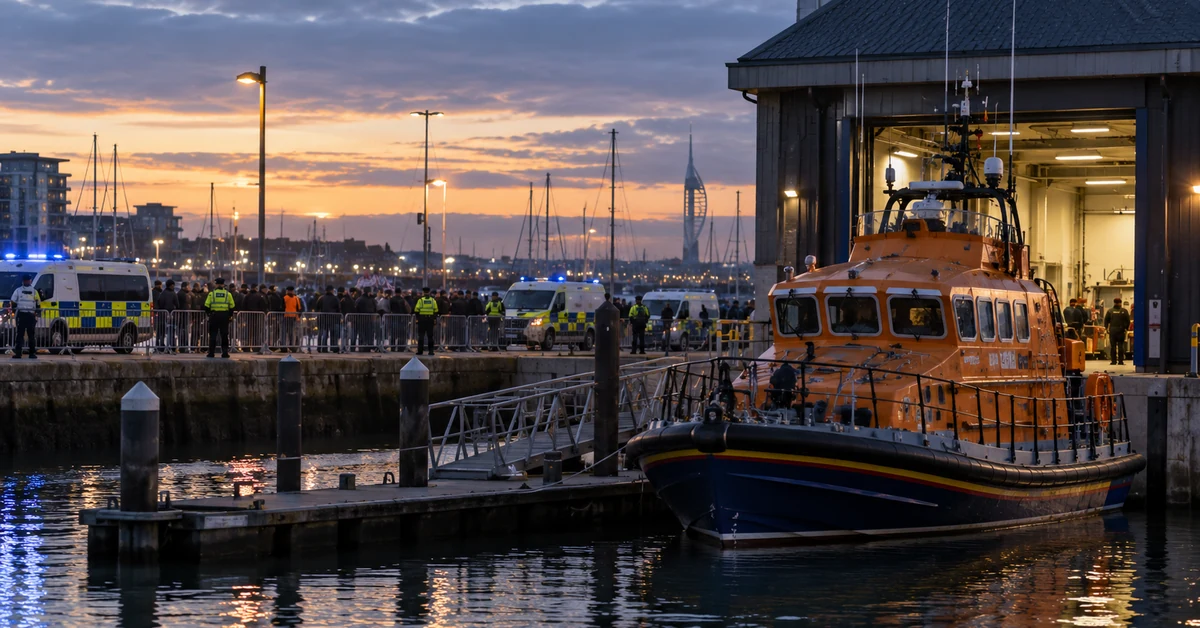
Portsmouth RNLI has suspended operations following the disorder at Eastney Marina and subsequent hostility directed towards the charity and its volunteers after they helped bring asylum seekers ashore on September 6.
Search-and-rescue coverage remains available through neighbouring stations and other emergency assets.
But the shutdown marks a significant escalation in a dispute that began with the arrival of a small boat and has since spread well beyond immigration policy.
Around 200 people gathered at Eastney Marina after a Channel crossing arrived in Portsmouth.
Police were deployed alongside Border Force, the Maritime and Coastguard Agency, the RNLI and Portsmouth City Council.
The gathering developed into violent disorder.
Hampshire & Isle of Wight Constabulary says seven police officers were injured, while police, Coastguard and Border Force vehicles were damaged.
Prosecutions are continuing.
The RNLI itself subsequently became a focus of the anger.
Volunteers involved in bringing the asylum seekers ashore were called “traitors”. The charity increased security precautions and advised volunteers to consider whether wearing RNLI-branded clothing in public could expose them to unwanted attention.
Its Poole lifeboat museum also temporarily closed following protest activity.
Portsmouth station has been temporarily off service since September 10 while the RNLI reviews security and supports its volunteers.
The development exposes how far the small-boats argument has moved beyond Westminster.
For critics of the RNLI’s involvement in Channel operations, the objection is not necessarily to maritime rescue itself.
The controversy concerns the role the charity has come to play within a system that ultimately brings people who crossed illegally into Britain.
The RNLI rejects claims that it determines immigration policy or independently decides where migrants should be taken. It says its crews respond when tasked to people in danger at sea.
The scale of its involvement is also smaller than the prominence of the controversy might suggest.
RNLI lifeboats launched 9,058 times during 2025.
Only 109 of those launches involved Channel small boats – approximately 1.2%.
Of 41,472 people recorded as crossing the Channel in small boats during 2025, 94.3% were aided by agencies other than the RNLI.
Those figures do not settle the political argument over whether charities should play any role in Channel operations.
They do establish its scale.
The more immediate consequence in Portsmouth is operational.
A station serving the eastern Solent has been taken temporarily out of service following disorder surrounding one migrant landing and the hostility that followed.
Alternative rescue coverage means Portsmouth has not simply been left without maritime emergency provision.
But something has changed nonetheless.
Britain’s small-boats dispute is no longer confined to arguments about asylum law, Border Force, hotels, deportations or government policy.
The institutions physically involved when migrants reach British waters are increasingly being drawn into the conflict themselves.
At Eastney, that conflict produced injured police officers, damaged emergency vehicles, criminal prosecutions and continuing investigations.
Now it has also produced a lifeboat station that, temporarily at least, is no longer launching.
Sources
- The Guardian – Portsmouth lifeboat station temporarily off service
- Hampshire & Isle of Wight Constabulary – Eastney Marina investigation
- RNLI – Channel rescue figures and role
Join the Dissenting Citizen Newsletter
Independent news and commentary delivered directly to your inbox.
Breaking stories, analysis and commentary throughout the day.
Follow @VoxDissent →