








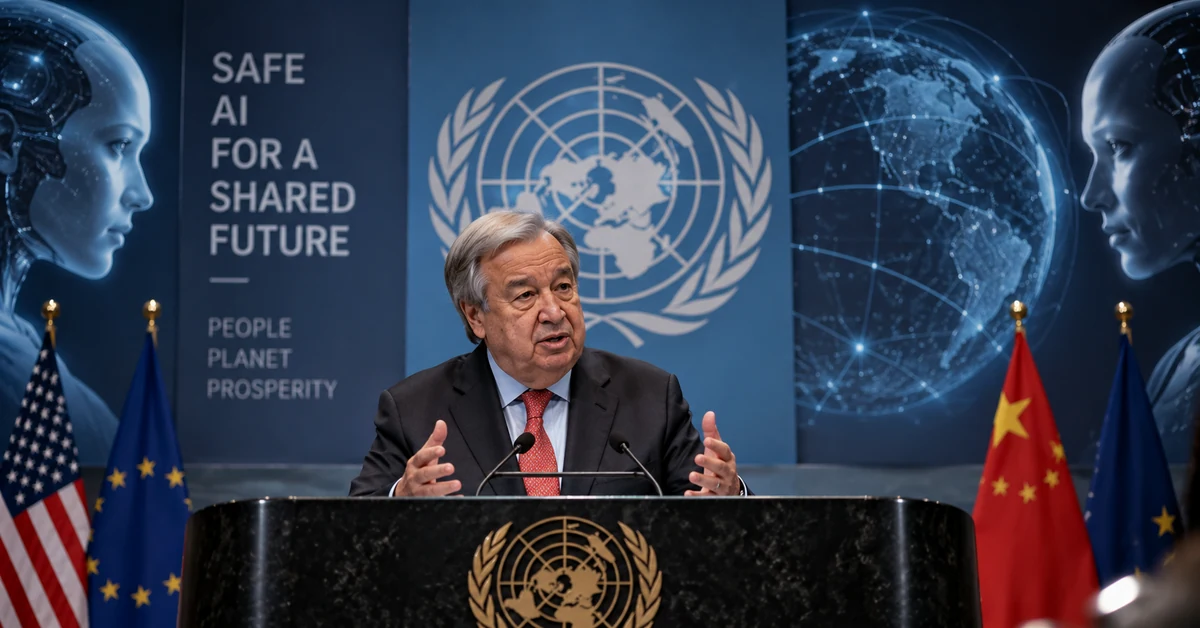
UN Secretary-General António Guterres has called for governments and leading AI companies to establish common safety guardrails, warning that the world cannot afford a “race to the bottom” as increasingly powerful systems are developed.
Guterres said AI capabilities are advancing faster than understanding of their potential risks and argued that national regulation alone will not be sufficient.
“Global coordination is indispensable,” he said.
The UN chief wants countries and companies developing frontier AI to establish contact, exchange information and work towards shared safety measures.
He also backed a properly prepared international AI summit bringing together governments, technology companies, scientists and civil society.
A race nobody wants to lose
The intervention comes as leading figures in the AI industry increasingly disagree over whether frontier development should be deliberately slowed.
Anthropic CEO Dario Amodei has argued for coordinated pacing of increasingly powerful systems.
Other technology leaders have expressed concerns about the risks of advanced AI, while Meta CEO Mark Zuckerberg argues that laboratories already have sufficient incentives to develop safely and should decide individually when their own work needs to slow.
No binding international agreement requiring countries or companies to reduce the pace of frontier AI development currently exists.
That leaves governments confronting a problem that extends beyond technical safety.
A country may conclude that increasingly capable AI creates serious risks while simultaneously believing that slowing its own development would allow a geopolitical rival to gain a decisive technological advantage.
The trust problem
That dynamic is particularly important between the United States and China, the two countries with the greatest capacity to develop frontier AI at scale.
Both can invest in safety while continuing to accelerate capability development.
The harder question is what happens if either concludes that genuinely slowing down would be safer.
Acting alone could mean surrendering technological and economic advantages to the other.
The result is a familiar strategic problem: two competitors can both regard an arms race as dangerous while neither believes it can safely stop competing first.
Guterres’s proposed international coordination is intended to address that problem by creating communication and common rules rather than relying entirely on unilateral restraint.
But agreeing that AI safety matters is considerably easier than establishing a system in which competing countries can trust each other to follow the same constraints.
Any international AI regime would therefore have to answer practical questions about verification, enforcement and which capabilities should trigger additional safeguards.
The technical challenge is making advanced AI safer.
The geopolitical challenge may be persuading competitors that they can afford to pursue that safety together.
Source
Join the Dissenting Citizen Newsletter
Independent news and commentary delivered directly to your inbox.
Breaking stories, analysis and commentary throughout the day.
Follow @VoxDissent →