



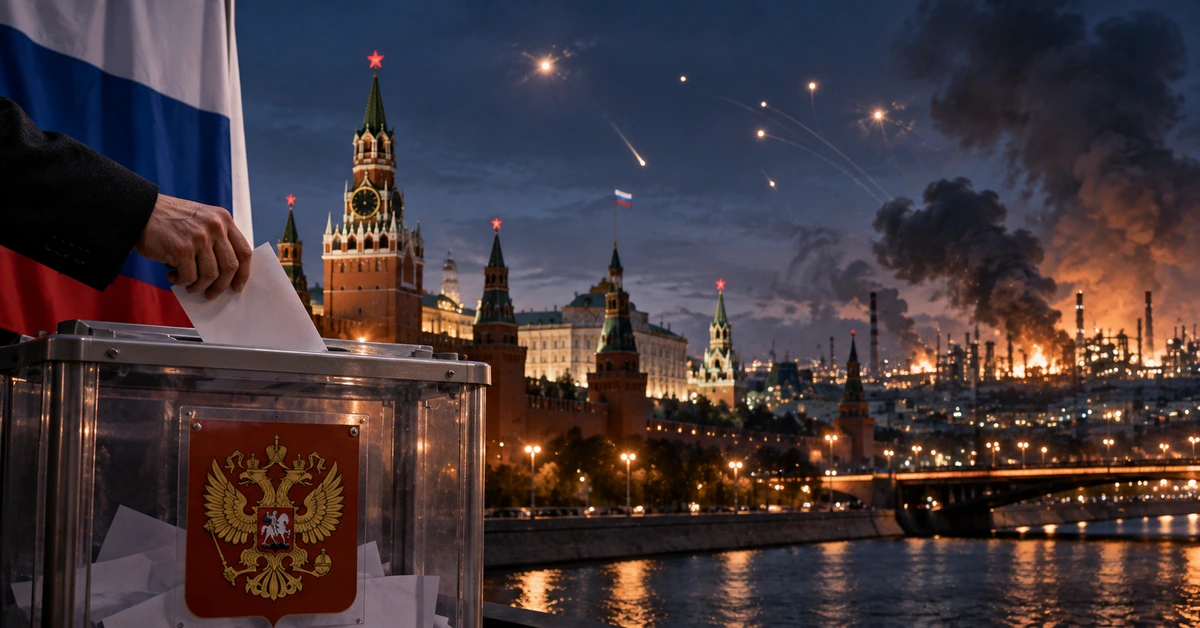
Vladimir Putin’s ruling United Russia party is heading towards another commanding parliamentary victory as Moscow and its surrounding region endure what Russian authorities describe as the largest drone attack on the capital since the war began.
Partial official results put United Russia on approximately 57.5% of the vote in Russia’s first parliamentary election since the full-scale invasion of Ukraine in February 2022.
The result comes from a political environment in which genuine anti-war opposition has been heavily constrained. Most prominent opponents of the war were excluded from the ballot, while Russian law imposes severe penalties for criticism authorities deem to discredit the military.
Putin has presented the election as a measure of domestic support for the war.
Moscow hit during final day of voting
The final day of the three-day election coincided with an extraordinary Ukrainian drone assault against Moscow and the surrounding region.
Moscow Mayor Sergei Sobyanin said Russian forces had intercepted more than 1,600 drones since Saturday, including around 450 heading towards Moscow. Those figures are Russian official claims and have not been independently verified.
Three people were killed in the Moscow region, according to Russian authorities.
The attack also damaged the Moscow oil refinery, an important facility in the capital’s energy infrastructure. Reuters journalists heard explosions and saw smoke rising from the refinery.
The facility processed more than 11 million metric tonnes of crude in 2024.
Repeated Ukrainian attacks on Russian refineries have increasingly made energy infrastructure part of the war, with previous strikes contributing to reduced refining capacity and fuel shortages.
Political control remains strong as war reaches Moscow
The Kremlin is likely to use another large United Russia majority to reinforce its argument that Putin retains domestic support during the war.
But interpreting the result as a conventional measure of public opinion is complicated by the restrictions surrounding Russian politics.
United Russia’s principal parliamentary rivals generally support the Kremlin on major issues, while anti-war politicians and activists have faced exclusion, imprisonment or exile.
The election and drone assault therefore produced a striking contrast.
The Kremlin remains firmly in control of Russia’s political system.
At the same time, a war once presented to much of the Russian public as distant from everyday life is increasingly reaching the country’s political and economic heartland.
Political control at home remains strong. The Kremlin’s ability to keep the physical consequences of the war away from Moscow increasingly does not.
Sources
- Reuters: United Russia leads wartime election after drones strike Moscow
- Reuters: Moscow-region drone attack and refinery strike
Join the Dissenting Citizen Newsletter
Independent news and commentary delivered directly to your inbox.
Breaking stories, analysis and commentary throughout the day.
Follow @VoxDissent →