








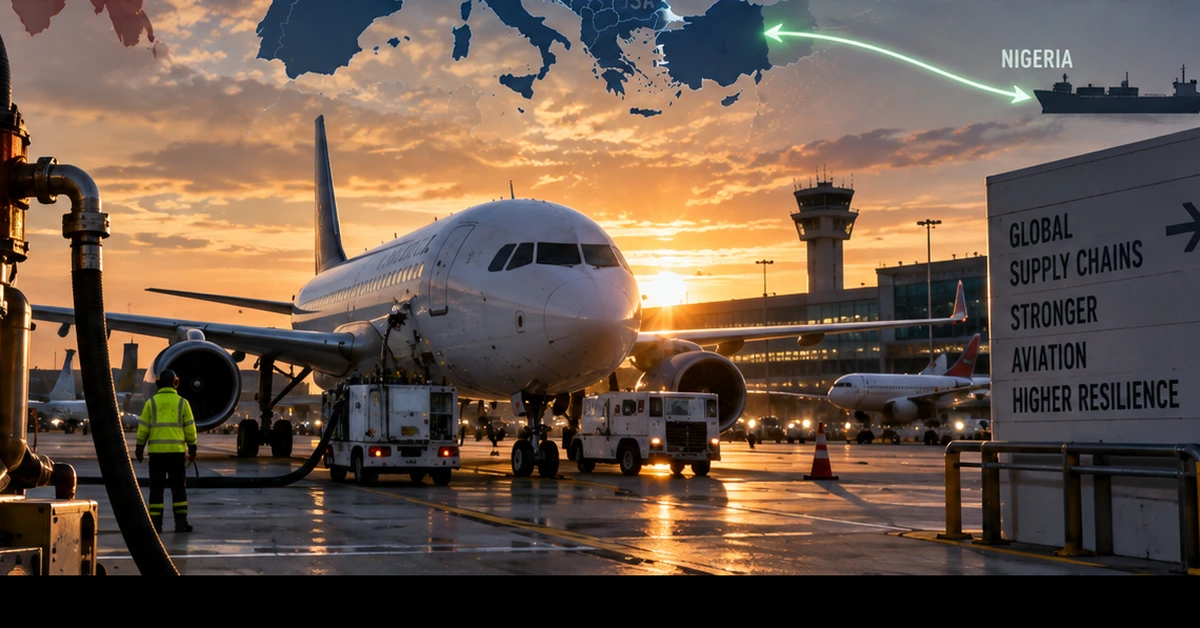
Europe is heading into the fourth quarter with a projected jet-fuel supply deficit of approximately 510,000 barrels per day, forcing buyers to source increasing quantities of aviation fuel from suppliers thousands of miles further away.
The deficit does not mean Europe is forecast to run out of jet fuel. The Energy Aspects estimate, reported by Reuters, measures the regional gap that must be covered by additional imports.
But the lengths Europe is now going to secure those imports illustrate how dramatically its aviation-fuel supply chain has been disrupted.
The Iran war earlier this year interrupted roughly half of Europe’s traditional jet-fuel imports from the Middle East, according to Reuters.
Europe is now increasingly turning to suppliers including South Korea, the United States, Canada and Nigeria to compensate.
South Korean fuel crosses the world to reach Europe
South Korean jet-fuel shipments to Europe are running at approximately 129,000 barrels per day in September, their highest level since October 2022.
That is a striking example of how global the replacement supply chain has become.
Instead of relying heavily on comparatively nearby Middle Eastern refineries, European buyers are increasingly bringing aviation fuel across much longer maritime routes.
Those supplies can close the physical deficit, but longer routes increase exposure to freight costs, shipping availability and disruption elsewhere in the global trading system.
Europe has also increased imports from North America and Africa as traders search for sufficient replacement barrels.
Stocks fall to seven-year low
The disruption is occurring while European inventories are already unusually low.
Jet-fuel stocks in the Amsterdam-Rotterdam-Antwerp trading hub recently fell to a seven-year low, according to Reuters.
That does not imply an imminent shortage at European airports.
Imports can and are being redirected to Europe when prices make those journeys commercially attractive.
But lower inventories reduce the buffer available when another disruption occurs.
A resilient energy system does not depend solely on whether enough fuel can ultimately be purchased.
It also depends on how easily alternative supplies can be found, how far they must travel and how much additional disruption the system can absorb.
A supply-chain vulnerability exposed by war
Europe’s projected 510,000-barrel-a-day deficit is therefore less a story about aviation fuel disappearing than about where that fuel now has to come from.
War disrupted a major Middle Eastern supply route.
European buyers responded by reaching across the Atlantic, into Africa and as far as East Asia.
For now, global trade can help bridge the gap.
But a system that needs fuel shipped from South Korea because a geopolitical shock removed roughly half of its traditional Middle Eastern supply is inherently more exposed to the next disruption.
Energy security is not simply having enough fuel today. It is having enough alternatives when tomorrow’s supply route suddenly disappears.
Sources
Join the Dissenting Citizen Newsletter
Independent news and commentary delivered directly to your inbox.
Breaking stories, analysis and commentary throughout the day.
Follow @VoxDissent →