








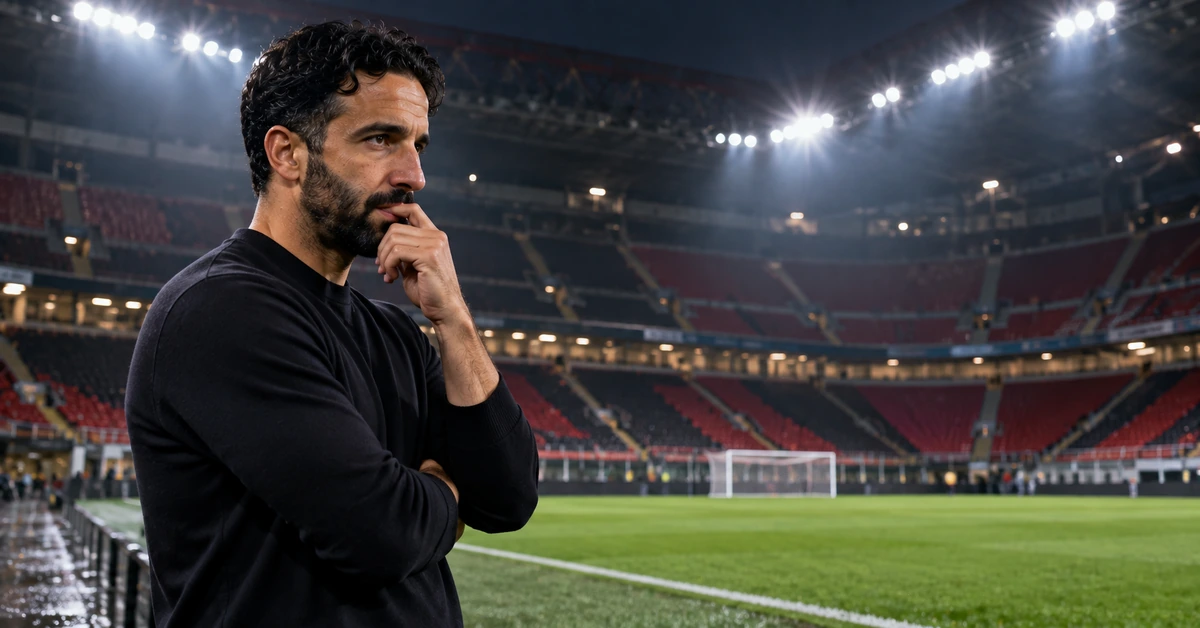
Rúben Amorim rated AC Milan’s summer transfer window “10 out of 10.”
Two weeks later, after roughly €150 million of spending, he is still talking about characteristics his squad does not have.
That sounds like a contradiction. It isn’t quite that simple.
When Amorim gave Milan’s transfer business full marks, he was already acknowledging limitations. He said another striker offering different characteristics would have helped and suggested attacking depth could become a problem.
So “10 out of 10” never meant every tactical requirement had been filled.
But five competitive matches into his reign, those limitations are already becoming part of a much larger conversation.
What did the rebuild solve?
Ahead of Wednesday’s Europa League meeting with Benfica, Amorim again discussed the fit between his players and his preferred football.
He acknowledged that Milan do not possess the ideal characteristics for everything he wants to do, while also arguing that the squad has other qualities he can exploit.
Then Milan lost 2-0 at home, extending their run without a victory to three matches.
Owner Gerry Cardinale has subsequently scheduled direct talks with Amorim. RTP reports that Cardinale wants explanations for Milan’s recent performances after the club’s substantial summer investment.
There is no indication that Amorim faces immediate dismissal. Milan remain unbeaten in Serie A and reporting in Italy says he retains the owner’s backing.
The more useful question is what Milan and Amorim believe still needs fixing.
Amorim’s preferred system demands more than arranging players into a particular formation. His football relies on players performing specific roles within that structure, and his comments suggest some of the characteristics he would ideally want remain absent.
That is familiar territory.
At Manchester United, the relationship between Amorim’s preferred system and the players available to execute it became a persistent issue. Milan knew the kind of football they were hiring and then spent heavily during his first transfer window.
That makes the distinction between adaptation and recruitment important.
If Milan’s existing players can perform the required jobs differently, Amorim has to adapt his football to extract those strengths.
If crucial characteristics genuinely remain missing, Milan have to explain why a summer rebuild costing around €150 million did not acquire them.
Both can be true.
Time – and adaptation
Amorim’s own language captures the tension.
Before the Benfica defeat, he said: “If I have to fail, it’s better if I fail big.”
He also admitted: “I don’t know if I’ll have the time.”
After the defeat, however, Amorim also indicated that he is prepared to adapt rather than simply demanding that Milan conform completely to one system.
That may prove more important than the formation itself.
Five matches cannot establish whether Milan’s recruitment has failed, whether Amorim’s system works with these players or whether the early problems are simply those of a new team learning a new manager’s football.
But €150 million and a transfer window rated “10 out of 10” create a reasonable expectation that the squad should contain most of what the manager needs.
Cardinale’s scheduled talks now give Milan an early opportunity to establish what the remaining problem actually is.
Which shortcomings can Amorim solve through coaching and adaptation?
And which, after all that spending, still require different players?
Sources
- RTP – Milan owner schedules meeting with Rúben Amorim
- la Repubblica – Amorim rates Milan’s transfer window 10 out of 10
- AC Milan – Amorim pre-Benfica press conference
- La Gazzetta dello Sport – Amorim’s comments on Milan’s squad
Join the Dissenting Citizen Newsletter
Independent news and commentary delivered directly to your inbox.
Breaking stories, analysis and commentary throughout the day.
Follow @VoxDissent →