






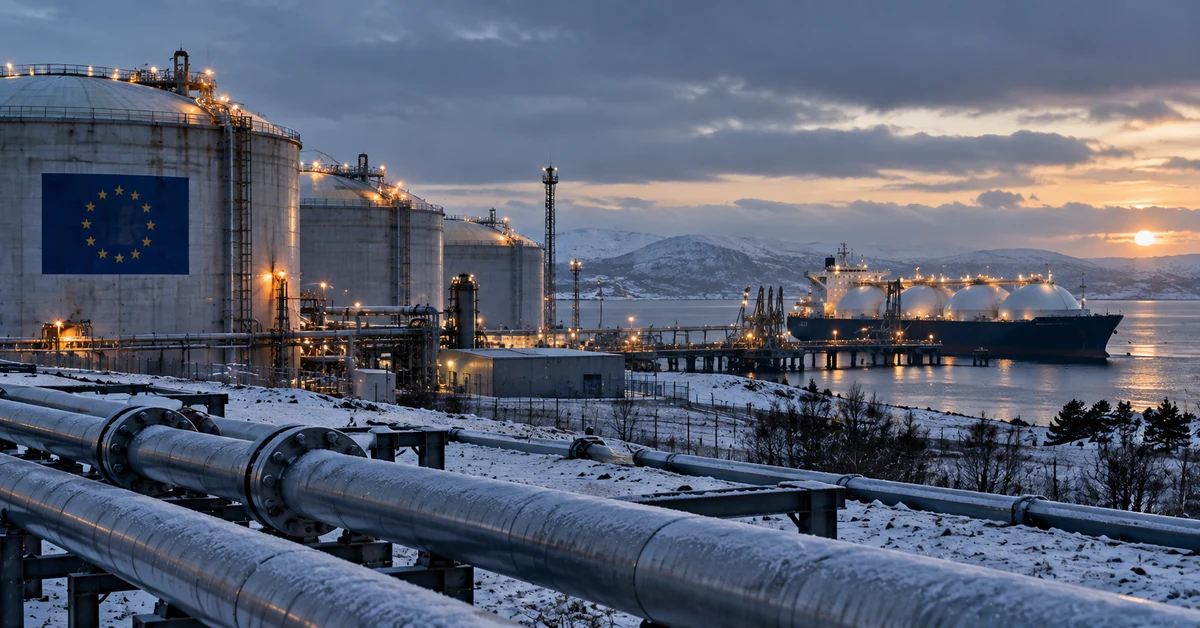
Europe spent the years after Russia’s invasion of Ukraine rebuilding an energy system designed to survive without cheap Russian pipeline gas. As another winter approaches, the continent is discovering that reducing one dependency did not remove the underlying vulnerability.
European gas-storage facilities are currently only 69% full, compared with a five-year seasonal average of 85%. Benchmark gas prices are already around 150% higher than they were a year ago, leaving households, businesses and governments exposed before the heaviest winter demand has even begun.
The storage gap is particularly significant in Germany and the Netherlands. Together they account for around 35% of the European Union’s storage capacity, making their ability to replenish stocks important far beyond their own borders.
Europe deliberately built storage as a buffer against precisely this kind of uncertainty. Gas accumulated during periods of lower demand can be released during winter, reducing the continent’s exposure to sudden shortages or price spikes. Entering the heating season with significantly less stored gas weakens that protection.
Part of the problem is that companies waited. Reuters reports that traders and utilities delayed replenishing stocks because they expected the disruption caused by the Iran war, and the resulting surge in energy prices, to ease sooner. Buying large quantities of gas while prices were elevated risked locking in expensive supplies that might rapidly lose value if the conflict subsided.
The expected relief did not arrive quickly enough. Europe now faces the possibility of having to compete for additional supplies while prices remain high, potentially buying more gas precisely when it would rather be drawing comfortably on stocks accumulated earlier in the year.
That exposes the central weakness in Europe’s post-2022 energy transformation. Before Russia’s invasion of Ukraine, much of Europe relied heavily on pipeline gas supplied directly from Russia. The arrangement provided large quantities of relatively cheap energy but left European economies dangerously exposed to Moscow when relations collapsed.
Europe responded with remarkable speed. Russian pipeline imports fell dramatically, LNG import capacity expanded, new terminals were built and suppliers including the United States, Qatar and Norway became increasingly important. That was a genuine strategic achievement: Europe demonstrated that Russia could no longer assume control of gas pipelines gave it decisive leverage over the continent.
But LNG operates differently from a dedicated pipeline. Liquefied natural gas is a globally traded commodity, and cargoes can move towards whichever market offers the best price. European consumers therefore compete more directly with buyers elsewhere in the world, allowing disruption affecting global supply or demand to reach Europe even when Russia has nothing to do with it.
The current Middle East conflict demonstrates that exposure. Europe may no longer depend upon Gazprom pipelines in the way it once did, but it still depends upon international energy markets functioning well enough to deliver enormous quantities of fuel at manageable prices. When those markets tighten, Europe pays.
The effects are already spreading beyond gas itself. Reuters reports diesel prices around 38% higher than a year ago, petrol up 24% and jet fuel more than twice its previous level.
That matters because energy shocks rarely remain confined to energy bills. Higher fuel prices increase transport and production costs across the economy. Businesses either absorb those costs or pass some of them to consumers, pushing inflation into goods and services that appear far removed from the original disruption.
Gas is particularly important because European policymakers increasingly worry that its inflationary effects can prove more persistent than movements in crude oil. Gas feeds directly into household heating, electricity generation and industrial production, making sustained price increases capable of working through large parts of the economy.
The monetary consequences are already becoming visible. The European Central Bank has raised interest rates as policymakers confront renewed inflation pressure, turning an international energy shock into higher borrowing costs for European households and businesses.
Governments then face pressure to intervene. Energy subsidies, tax reductions and other support can protect households from the immediate shock, but they transfer part of the cost onto public finances that are already stretched in many European countries.
The political consequences follow quickly. Germany provides the clearest example. Energy prices have become part of the country’s wider argument over industrial competitiveness and the consequences of abandoning Russian gas. The AfD has campaigned for restoring access to cheap Russian supplies and has benefited from public anger over energy costs.
That does not mean returning to Russian dependence would solve Europe’s strategic problem. It would simply restore the vulnerability Europe deliberately spent years reducing. But voters experiencing higher bills are unlikely to judge energy policy solely by whether it is strategically cleaner than the system it replaced. They will also judge whether it delivers affordable and reliable energy.
That is the harder test Europe now faces. Energy security does not mean eliminating every dependency. Modern industrial economies cannot produce every resource they consume, and Europe will remain reliant on imported energy under almost any realistic scenario.
The question is whether those dependencies are sufficiently diversified that disruption in one country, region or transport route cannot create another continent-wide crisis.
Europe is considerably less vulnerable to Russia than it was in 2021. That matters. But 69% storage, gas prices 150% above last year and another geopolitical shock feeding into inflation demonstrate the limit of that achievement.
Europe changed where much of its gas comes from. It has not yet escaped the consequences of depending on somebody else to supply it.
Sources
Join the Dissenting Citizen Newsletter
Independent news and commentary delivered directly to your inbox.
Breaking stories, analysis and commentary throughout the day.
Follow @VoxDissent →