









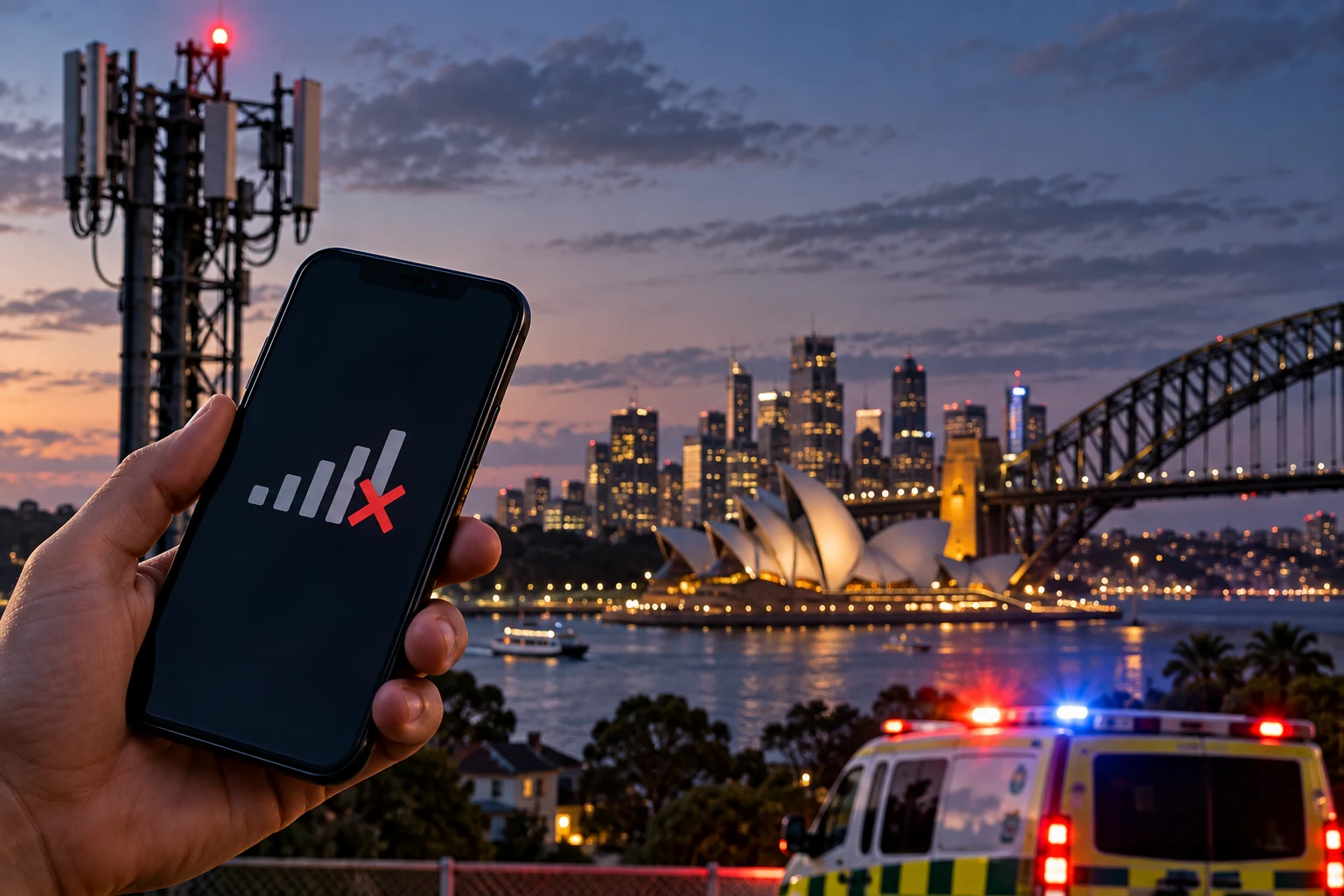
Australia has promised to strengthen the resilience of its telecommunications networks after another Optus outage disrupted emergency calls. The latest failure lasted just 76 minutes. Its significance lies in what it did not require: hackers, sabotage or a hostile foreign power.
Australia has been given another demonstration of how quickly ordinary technical failure can become a public-safety problem.
A 76-minute outage at Optus disrupted voice services across parts of Victoria, South Australia, Tasmania and the Northern Territory.
Some customers experienced intermittent call failures.
More seriously, the disruption affected access to Australia’s Triple Zero emergency service.
Victoria Police conducted around 40 welfare checks involving affected callers.
Authorities reported no adverse outcomes from the latest incident.
This time, the system recovered without reported loss of life.
Optus’s history shows why the Australian government is nevertheless treating the failure seriously.
TWO DEATHS AFTER AN EARLIER FAILURE
A previous major Optus network failure left hundreds of people unable to contact police, fire and ambulance services and was linked to two deaths.
Australia’s communications regulator had already fined Optus A$12 million in 2024 over failures to provide emergency-call services during an earlier nationwide outage.
The latest incident has therefore landed in an environment where the reliability of the country’s second-largest telecom operator is already under intense scrutiny.
Communications Minister Anika Wells said on Sunday that no infrastructure could ever be made completely resilient.
The government’s task, she said, was to make those systems as resilient as possible.
That sounds obvious.
The latest outage demonstrates why it isn’t trivial.
THIS WASN’T A CYBERATTACK
Modern discussion of critical infrastructure increasingly concentrates on deliberate attack.
Cyber warfare. Foreign interference. Ransomware. Sabotage.
Those threats are real.
Optus itself suffered a major cyberattack in 2022 affecting data belonging to around 9.5 million Australians.
But the latest outage presents a different problem.
It was reported as a technical glitch.
No hostile actor was required. No hacker needed to penetrate the network. No foreign intelligence service needed to sabotage it.
Ordinary technical failure was enough to interfere with some people’s ability to reach emergency services.
That distinction matters because the consequence experienced by the citizen can be remarkably similar.
The network they depend upon simply stops working.
WHEN TELECOMS BECOME LIFE-SAFETY INFRASTRUCTURE
A mobile network is no longer merely a convenient way of making telephone calls.
It connects citizens to ambulances, police and fire services.
It carries financial transactions and authentication codes. Businesses depend upon it. Government services depend upon it.
Families increasingly live without fixed telephone lines and rely entirely on mobile communications.
That means telecommunications resilience has become a public-safety issue.
A network can operate successfully for almost every minute of the year and still fail at precisely the moment an individual desperately needs it.
For most customers, a 76-minute outage is an inconvenience.
For somebody attempting to call an ambulance, the same 76 minutes can have an entirely different meaning.
THE RESILIENCE PROBLEM
There is a broader lesson here.
Societies increasingly depend upon highly interconnected digital systems while simultaneously concentrating attention on protecting those systems from external attack.
But security and resilience are not the same thing.
A perfectly defended system that fails because of an internal technical problem is still unavailable.
A network protected against hostile states but unable to route an emergency call during an equipment failure has still failed at the moment that matters.
That makes redundancy, failover systems, testing and recovery procedures less dramatic than cybersecurity, but no less important.
Australia’s government is now promising to improve the resilience of its telecommunications networks.
The challenge is not to build infrastructure that never fails. No government can realistically promise that.
It is to build systems in which one failure does not remove an essential service with it.
The latest Optus outage ended after 76 minutes without reported adverse outcomes.
Last time Australia was not so fortunate.
Critical infrastructure does not need to be attacked to become dangerous.
Sometimes it only needs to stop working.
Sources: Reuters, 12–13 September 2026.
Join the Dissenting Citizen Newsletter
Independent news and commentary delivered directly to your inbox.