








Members of an anti-migrant protest group have reportedly discussed taking a privately operated vessel into the English Channel to intercept migrant dinghies. It remains an early-stage idea. But even the discussion exposes a dangerous consequence when citizens cease to believe the state will enforce its own border.
Members of Patriot Platform have discussed taking a boat into the English Channel in an attempt to intercept migrant dinghies, according to an undercover investigation by the Sun on Sunday.
The newspaper says one of its reporters heard members discussing the idea during the group’s recent protest in Portsmouth.
The proposal remains at an early stage.
There is no evidence in the report that a vessel has been obtained, that an operation has been organised or that anybody has actually attempted such an interception.
The Sun also explicitly states there is no suggestion Patriot Platform leader Daniel Thomas, known as Danny Tommo, is involved in the proposal.
Those qualifications are essential.
But if activists ever attempted to turn the discussion into action, something significant would have changed.
Protesters would no longer merely be demanding that Britain’s government enforce the country’s maritime border.
Private citizens would be attempting to do it themselves.
FROM PROTEST TO INTERVENTION
Britain has experienced years of political conflict over small-boat crossings.
People opposed to current immigration policy have every right to protest peacefully, campaign for different laws and vote for politicians promising stronger border enforcement.
Taking a private vessel into the Channel to interfere physically with migrant boats is something fundamentally different.
The English Channel is one of the world’s busiest shipping corridors.
Small migrant dinghies are already inherently dangerous.
Adding privately organised vessels attempting to block or turn them around could create additional risks for migrants, activists and rescue crews.
The Sun reports that Border Force or French authorities could potentially be forced to intervene if such an operation were attempted.
THE PORTSMOUTH WARNING
The discussion reportedly occurred around the Portsmouth protest that followed the arrival of a migrant boat from Normandy.
That protest developed into a prolonged confrontation as activists attempted to prevent migrants being moved from the area.
Police officers were injured and vehicles damaged during disorder surrounding the protests, while subsequent demonstrations have prompted stronger police restrictions on face coverings.
The possibility of activists moving onto the water therefore matters because it represents another potential escalation.
Street protest pressures the state.
Private maritime interception attempts to substitute for it.
Those are not the same thing.
THE POLITICAL FAILURE UNDERNEATH IT
Condemning vigilante border enforcement does not resolve the political problem that produces discussion of it.
Successive governments have promised to stop small-boat crossings.
The crossings have continued.
French authorities have frequently monitored migrant vessels without physically preventing their passage when intervention was judged unsafe.
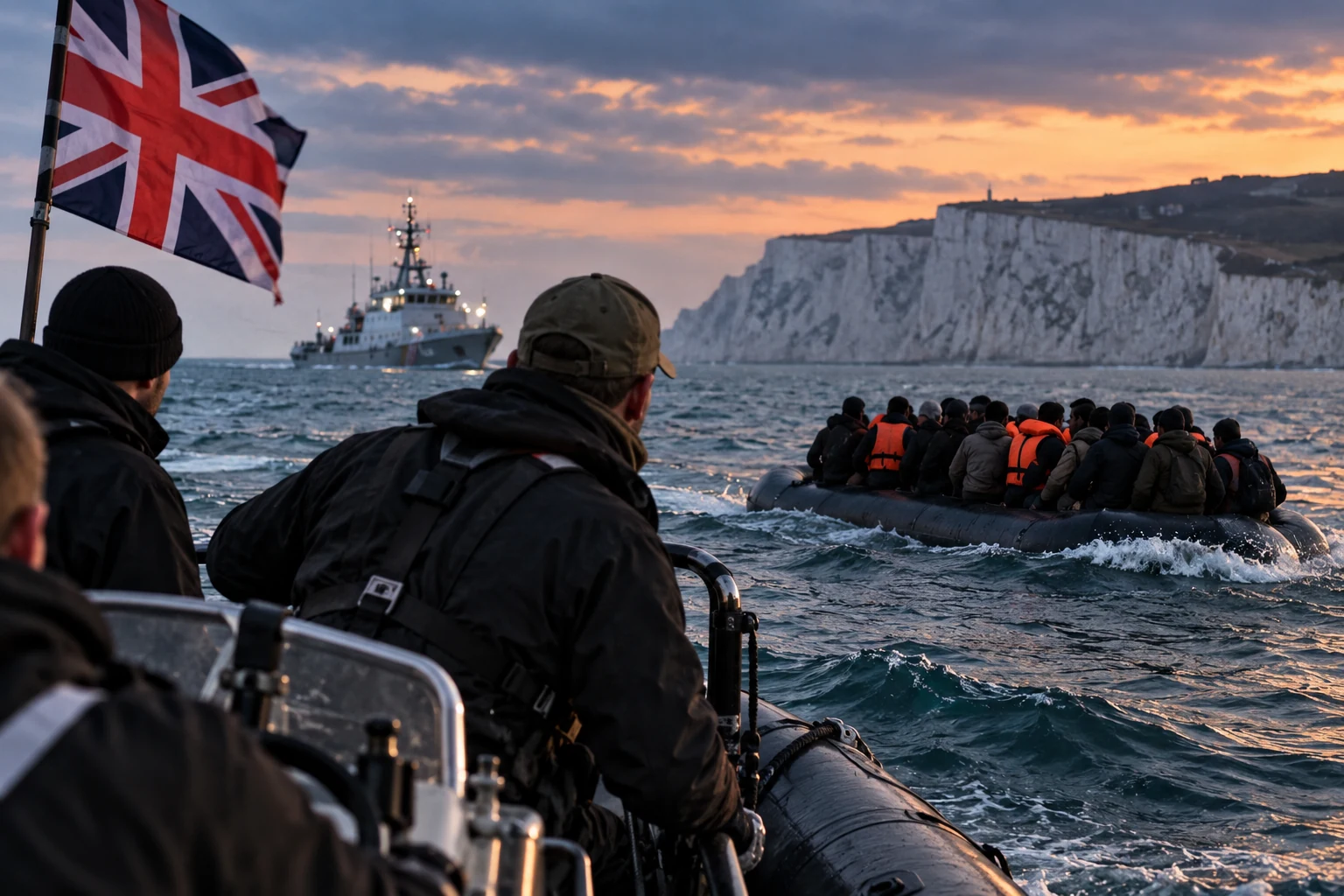
One recent boat carrying around 140 people travelled approximately 70 miles across the Channel from Normandy before reaching Portsmouth, accompanied at different stages by French rescue vessels and helicopters.
For voters who believe Britain’s border is not being enforced, scenes like those deepen the perception that normal mechanisms have failed.
That frustration does not give private citizens authority to become a substitute Border Force.
But governments should be concerned when citizens begin discussing doing precisely that.
WHEN CONFIDENCE IN THE STATE BREAKS
A functioning state claims a monopoly over certain powers for good reason.
Border enforcement is one of them.
Police powers are another.
Military force is another.
Citizens delegate those powers because enforcement requires legal authority, accountability, training and rules governing the use of force.
When people believe those institutions have stopped performing their basic functions, something dangerous can happen.
The argument moves from:
“Why isn’t the government doing this?”
to:
“Why don’t we do it ourselves?”
That transition should concern people on both sides of Britain’s immigration argument.
Those demanding stronger borders should not want maritime vigilantism replacing lawful enforcement.
Those defending the existing asylum system should not dismiss the loss of public confidence that allows such ideas to gain traction.
The Sun’s report does not establish that a private Channel operation will happen.
It establishes something more limited.
People frustrated with Britain’s failure to stop illegal crossings are reportedly discussing whether they should intervene themselves.
That is not a solution to the border crisis.
It is a warning about what happens when confidence in the state’s willingness or ability to enforce its own borders begins to disappear.
Source: The Sun on Sunday, 12 September 2026.
Join the Dissenting Citizen Newsletter
Independent news and commentary delivered directly to your inbox.