








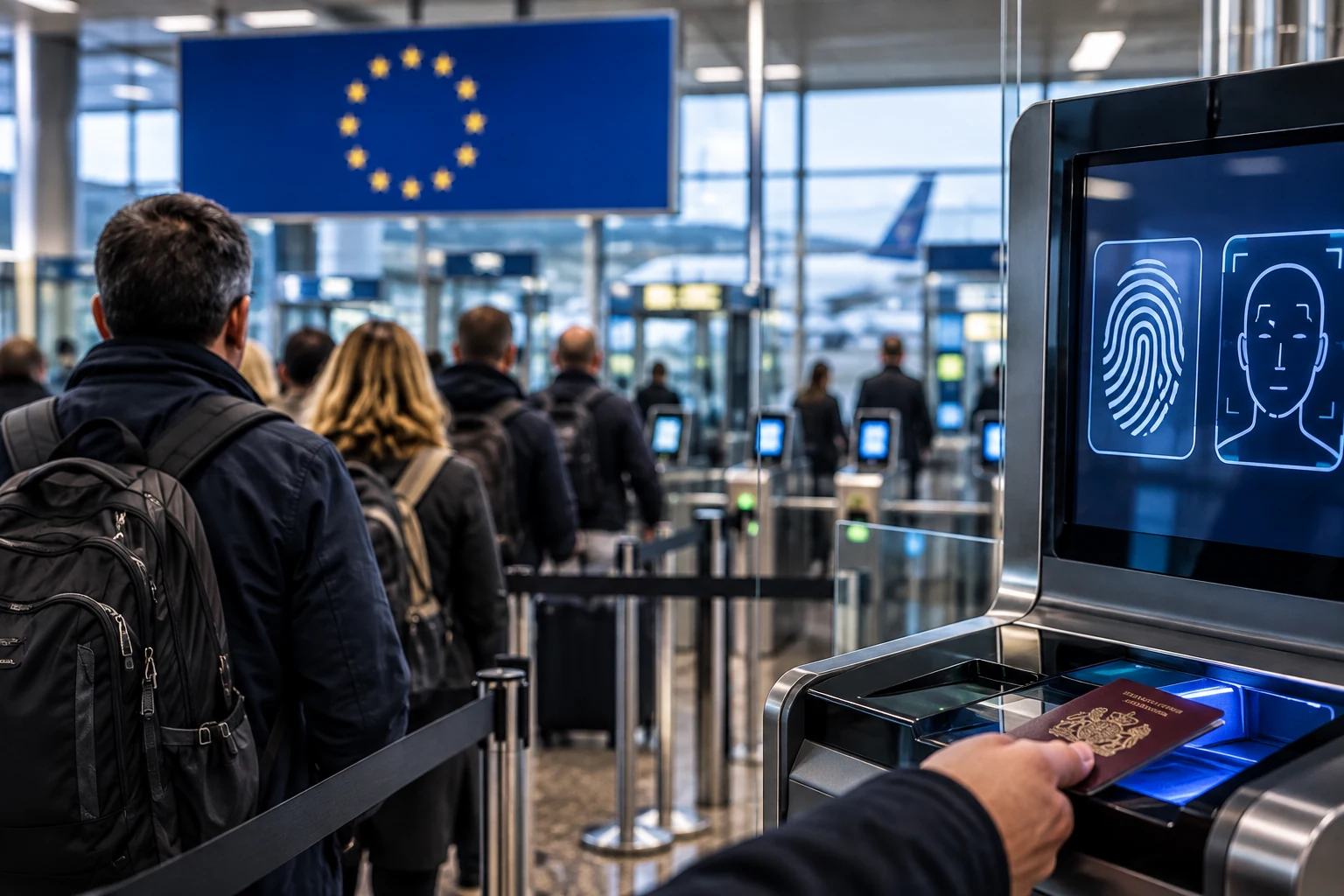
Europe’s new Entry/Exit System is officially fully operational. But nine Schengen countries have reportedly been allowed to continue relaxing parts of its biometric regime because border infrastructure is still struggling to process passengers reliably.
Nine European countries have reportedly been given additional flexibility over biometric border checks after warning that full enforcement of the EU’s new Entry/Exit System could cause serious disruption.
France, Germany, Italy, Belgium, the Netherlands, Greece, Malta, Portugal and Switzerland had asked Brussels to extend temporary arrangements allowing biometric collection to be relaxed when border crossings became overwhelmed.
Those arrangements were due to expire on September 6.
The Sunday Times now reports that the nine countries have effectively been permitted to continue delaying full implementation while technical and operational problems are resolved.
The distinction is important.
Europe has not abandoned the Entry/Exit System.
EES remains operational and continues recording travellers entering and leaving the Schengen area.
The problem concerns one of its most important features: the consistent collection and verification of biometric information.
WHAT EES WAS BUILT TO DO
The Entry/Exit System was designed to replace manual passport stamping with a digital record of non-EU travellers entering and leaving the Schengen area.
It records passport information, dates and locations of travel and biometric data including facial images and fingerprints.
The system is intended to help authorities identify people overstaying their permitted period, combat identity fraud and strengthen internal security.
For British travellers, it represents one of the most visible consequences of travelling into the Schengen area as non-EU nationals.
But biometric registration takes time.
And when thousands of passengers arrive simultaneously, those additional seconds accumulate.
THE SAFETY VALVE
Europe anticipated that problem.
During the rollout, border authorities were given temporary flexibility to suspend biometric collection in exceptional circumstances when queues became excessive.
The passport and travel record could still be processed while some biometric information was deferred.
That mechanism helped prevent border-control areas becoming overwhelmed during busy periods.
But it was temporary.
The automatic flexibility expired on September 6.
Nine countries had already warned Brussels that removing it would create significant difficulties.
The aviation industry made similar representations.
Their concern was straightforward.
If every traveller had to complete every biometric step regardless of congestion, airports and other border crossings could face severe queues.
FULLY OPERATIONAL, BUT NOT FULLY DELIVERED
Officially, EES has been fully operational since April 10.
The European Commission says the system has already processed more than 145 million entries and exits.
That is an enormous deployment.
But the experience at individual border crossings has been less straightforward.
Some European airports have experienced waits measured in hours.
Passengers have missed flights.
At the Channel Tunnel, operator Getlink warned in July that unstable EU software could delay implementation of biometric checks for motorists.
At the beginning of September, biometric kiosks installed at Dover, Eurotunnel and St Pancras were still not fully operational.
The European Commission itself acknowledged that adjustments were still required at certain border crossings after the September deadline.
That creates an uncomfortable distinction between a system being technically operational and being operationally dependable.
SECURITY VERSUS CAPACITY
There is a legitimate reason for allowing flexibility.
An airport cannot simply permit passport-control queues to expand indefinitely.
People have connecting flights.
Terminals have finite capacity.
Border officers have finite resources.
An immigration-control system therefore has to balance security against the practical requirement to keep people moving.
But that creates another question.
What happens when the security control itself becomes the thing the infrastructure cannot reliably accommodate?
The biometric component exists for a reason.
Fingerprints and facial images make it harder for individuals to travel using false identities and allow authorities to match travellers more reliably to previous entries.
They also strengthen the EU’s ability to identify overstayers.
Temporarily relaxing those checks may therefore solve an operational problem by weakening part of the mechanism designed to solve a security problem.
A BORDER HAS TO WORK WHEN IT IS BUSY
The underlying problem is not uniquely European.
Governments routinely announce sophisticated technological systems whose performance is demonstrated under normal conditions.
Critical infrastructure is tested when conditions are not normal.
Airports are busiest during holidays.
Ports experience sudden surges.
Flights arrive together.
Systems fail.
Queues grow.
Those are not exceptional circumstances in international travel.
They are predictable features of it.
Europe has built one of the world’s most ambitious biometric border systems.
Its objectives are serious: detecting overstayers, combating identity fraud and strengthening security.
But those objectives depend upon the checks actually being performed.
A border-security system cannot ultimately be judged by how sophisticated its legislation or technology appears.
It has to work when thousands of people arrive at once.
If the security checks repeatedly need to be relaxed when the border becomes busy, the problem is no longer the queue.
It is whether the system has enough capacity to deliver the security politicians promised.
Sources: The Sunday Times, 13 September 2026; European Commission; Council of the European Union; UK House of Commons Library.
Join the Dissenting Citizen Newsletter
Independent news and commentary delivered directly to your inbox.