








South Korea has expanded its espionage law beyond activities benefiting North Korea, bringing the theft of strategic technologies for any foreign state within its scope. The technologies Seoul wants protected include semiconductors, batteries and artificial intelligence.
South Korea has changed what can constitute espionage.
An amendment to the country’s Criminal Act taking effect today expands the offence beyond the law’s traditional focus on activities benefiting North Korea.
Espionage carried out for any foreign country or equivalent organisation can now fall within the offence.
Those convicted face a minimum prison sentence of three years.
But the significance of the change extends beyond which foreign countries are covered.
It also reflects what governments increasingly consider worth protecting as a matter of national security.
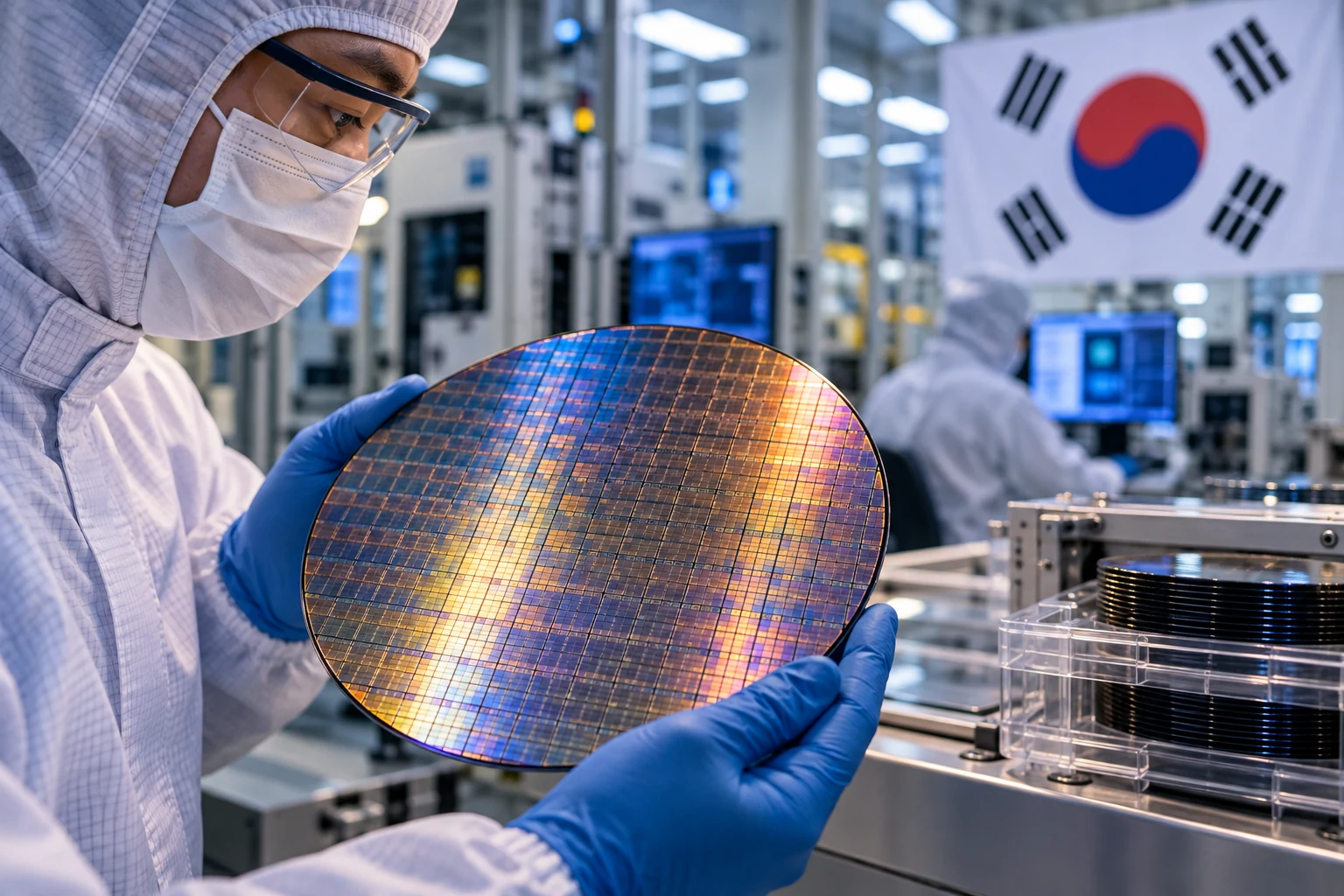
Among the strategic technologies identified by South Korea’s National Intelligence Service are semiconductors, displays, batteries and artificial intelligence.
Commercial technology is moving into territory once occupied principally by military secrets and classified intelligence.
FROM CORPORATE SECRET TO NATIONAL ASSET
For decades, industrial espionage could largely be understood as a battle between companies.
One business develops valuable technology.
A competitor attempts to obtain it.
The victim suffers a commercial loss.
That distinction is becoming harder to maintain.
Advanced semiconductors determine what computing systems a country can build.
Battery technology affects electric vehicles, energy storage and industrial competitiveness.
Artificial intelligence increasingly affects economic productivity, cyber capabilities, military systems and intelligence gathering.
The knowledge required to manufacture those technologies can therefore have value far beyond the company that owns it.
South Korea’s new law reflects that change.
The theft of strategic industrial knowledge for a foreign state can now be treated not merely as an offence against a corporation, but as espionage.
THE CHIP WAR
South Korea has particular reason to worry about technological leakage.
Its semiconductor industry includes some of the world’s most important manufacturers and sits at the centre of the global memory-chip supply chain.
Recent cases have intensified concern.
Five former Samsung Electronics employees were indicted over allegations that they transferred technology relating to advanced DRAM memory production to Chinese memory manufacturer CXMT.
Those accusations remain allegations and have not been established by a conviction.
The expanded espionage law also does not single out China. It applies to activity conducted for any foreign country or equivalent organisation.
That distinction matters.
But the broader geopolitical environment is impossible to ignore.
Advanced chips have become one of the principal arenas of technological competition between the United States and China.
Governments have imposed export controls, restricted access to manufacturing equipment and spent billions subsidising domestic semiconductor production.
South Korea sits directly inside that contest.
AI CHANGES THE VALUE OF A CHIP
Artificial intelligence makes semiconductor knowledge even more strategically important.
The largest AI systems require enormous computing resources.
That means competition over AI is inseparable from competition over the chips, manufacturing equipment, data centres and technical knowledge required to produce that computing power.
A breakthrough inside a private laboratory can therefore have implications for national power.
The same applies to the manufacturing knowledge required to turn designs into physical hardware at scale.
That creates a difficult question for governments.
When does stealing a company’s technology stop being corporate espionage and become espionage against the state?
South Korea has just moved that boundary.
THE DEFINITION OF ESPIONAGE IS CHANGING
The traditional image of espionage involves stolen military plans, classified government documents or intelligence passed secretly to another country.
Those targets have not disappeared.
But the list of information capable of affecting national power is expanding.
Chip fabrication techniques.
Battery chemistry.
Artificial-intelligence systems.
Advanced manufacturing processes.
The distinction between economic security and national security is becoming increasingly blurred.
South Korea’s legislation is one country’s response to that problem.
Others are confronting the same underlying reality through export controls, investment restrictions and technology-security regimes.
The AI race is therefore producing something larger than competition between technology companies.
Governments increasingly regard control of the underlying knowledge as a strategic interest of the state.
The most valuable secret a foreign power wants tomorrow may not come from a defence ministry.
It may come from an engineer.
Sources: Reuters, 13 September 2026; South Korean National Intelligence Service.
Join the Dissenting Citizen Newsletter
Independent news and commentary delivered directly to your inbox.