







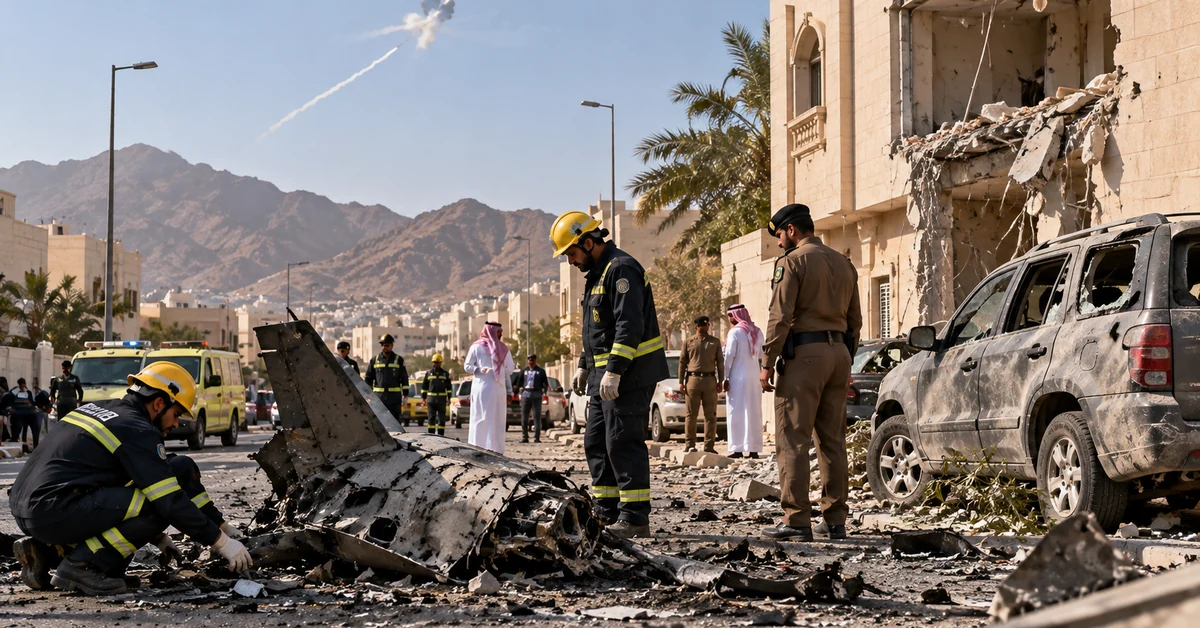
Saudi Arabia successfully intercepted a Houthi drone over Taif on Thursday. A civilian was still killed.
Saudi Civil Defence says debris from the destroyed drone fell into the western province, killing a Yemeni resident and injuring two other people. A Saudi citizen was injured, while a Pakistani resident was critically hurt. Buildings and vehicles were also damaged.
The incident is the first civilian death announced inside Saudi Arabia since the Houthis resumed attacks on the kingdom this month. It also demonstrates an uncomfortable reality of increasingly intensive drone warfare: destroying an incoming weapon does not necessarily eliminate the danger it creates.
Air defence is designed to prevent a missile or drone reaching its intended target. If an interceptor destroys the weapon in flight, the defence has performed its primary task. But neither the incoming weapon nor the interceptor simply disappears. Fragments still fall to the ground.
That matters particularly when drones and missiles approach populated areas. An interception that prevents a much larger explosion at the intended target can still send wreckage towards homes, roads and people below.
Taif provides a stark example. Saudi authorities say the Houthi drone was intercepted and destroyed, yet the resulting debris caused a death, serious injuries and material damage.
The incident comes during a sharp escalation between Saudi Arabia and Yemen’s Iran-aligned Houthi movement. The Houthis have intensified drone and missile attacks against Saudi territory while fighting Saudi-backed government forces in Yemen, increasing pressure on the kingdom as the wider Middle East conflict threatens regional energy infrastructure and shipping routes.
Saudi Arabia also said this week that its air defences intercepted another Houthi drone south of Mecca before it entered prohibited airspace around Islam’s holiest city. Riyadh described any threat to the holy sites as a red line.
The Houthis deny that they attempted to attack Mecca. Their leader Abdul Malik al-Houthi has described the Saudi accusation as false.
The Taif incident does not establish what the drone’s intended target was. What Saudi authorities have established is what happened after it was intercepted.
That distinction matters because modern air-defence reporting often reduces an attack to a simple outcome: intercepted or not intercepted. The reality is more complicated.
A successful interception can prevent catastrophic damage. If a drone carrying explosives is heading towards an airport, refinery, military base or crowded urban target, destroying it before impact may save many lives. But success is relative to what would otherwise have happened.
Intercepting a weapon over an inhabited area can leave dangerous fragments travelling at high speed towards the ground. Explosive material may survive the interception, while parts of the defending missile can fall alongside pieces of the attacking weapon.
The problem becomes more serious as the number of attacks increases. An isolated interception creates one debris event. Sustained barrages force air-defence systems to destroy repeated threats over cities, infrastructure and transport routes, increasing the opportunities for somebody on the ground to be hit.
Saudi Arabia has already experienced repeated alerts across western and southern cities during the latest escalation. Thursday’s death shows why an all-clear after interception does not mean the attack was harmless.
It also highlights the limits of even sophisticated air defence. Saudi Arabia has invested heavily in systems designed to detect and destroy incoming missiles and drones, and those systems can dramatically reduce the damage an attacker is capable of causing. They cannot turn sustained aerial warfare into a risk-free event for civilians.
The alternative is worse. Allowing an explosive drone to continue towards its target because debris might fall after interception would make little military sense. The purpose of air defence is to replace a potentially much larger impact with a smaller and less predictable residual risk.
But that residual risk is real. In Taif, it killed someone.
As the Houthis increase attacks on Saudi territory, the effectiveness of Saudi air defence will inevitably be measured by how many drones and missiles are stopped before reaching their targets. Thursday’s incident is a reminder that another number matters too: what happens after they are stopped.
Sources
- Associated Press – Saudi Arabia reports death from intercepted Houthi drone debris
- Reuters – Saudi-Houthi escalation and first reported civilian death
Join the Dissenting Citizen Newsletter
Independent news and commentary delivered directly to your inbox.
Breaking stories, analysis and commentary throughout the day.
Follow @VoxDissent →