







Artificial intelligence feels almost weightless to the person using it. Type something into a box and an answer appears seconds later. But in San Jose, residents are confronting the enormous physical infrastructure hidden behind that experience.
Silicon Valley’s largest city has actively encouraged the construction of data centres as technology companies race to secure the computing power required for increasingly capable AI systems. The financial attraction is substantial: San Jose estimates that each new facility could generate between $3 million and $6 million a year in tax revenue.
Residents and environmental groups are now asking what the city gives up in return.
Training and operating frontier AI systems requires vast amounts of computing power concentrated inside buildings packed with specialised processors. Those processors consume electricity and generate heat, which creates additional cooling requirements. The facilities need grid connections, transmission capacity, land and backup power systems capable of keeping thousands of machines operating when the electricity supply fails.
The result is that AI has a physical footprint largely invisible to the people using it. As the industry scales, that footprint is becoming much harder for the communities hosting it to ignore.
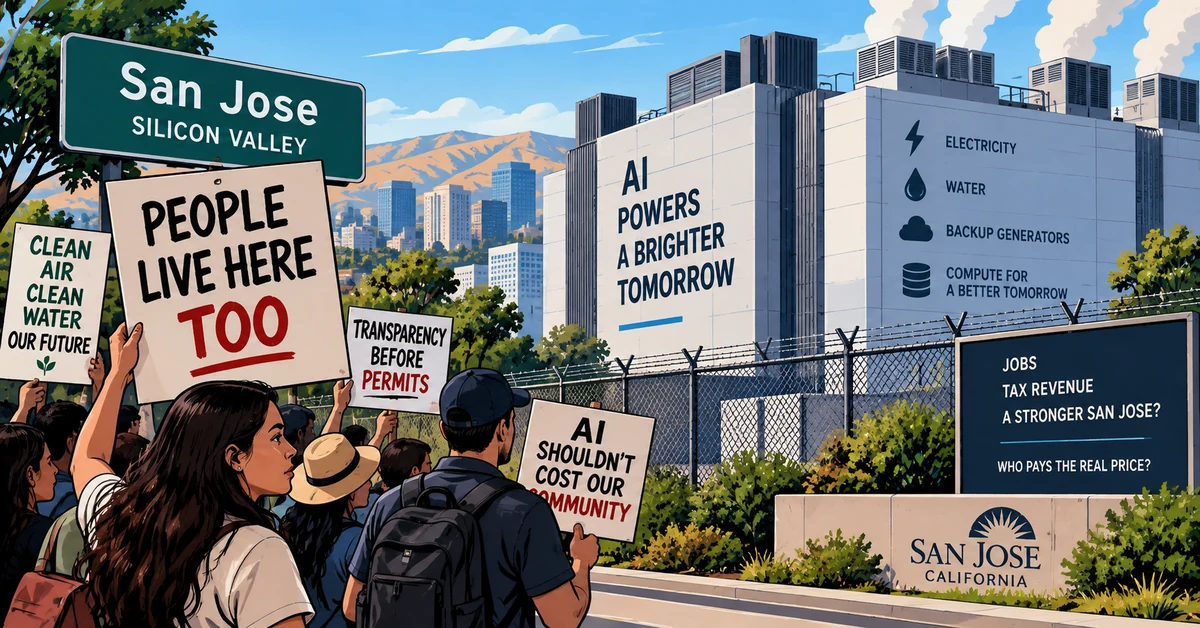
Campaigners in San Jose are demanding greater transparency and stronger public scrutiny of proposed facilities, including their electricity demand, water consumption, potential health effects and reliance on diesel backup generators. Their argument is not simply that data centres consume resources. It is that residents should know the scale of those demands before projects capable of affecting local infrastructure are approved.
San Jose officials see the same projects from another direction. The city sits at the centre of the global technology industry and wants the investment, construction activity and tax revenue generated by the next phase of computing. A single facility potentially producing millions of dollars in recurring annual revenue can help fund public services, and multiple facilities make the economic attraction considerably larger.
The data-centre industry argues that its costs are also being presented too simplistically. The Data Center Coalition, whose members include Google, Meta, OpenAI and Anthropic, says the sector is being singled out even though many other industries consume substantial amounts of electricity and water. It warns that imposing unusually restrictive requirements on data centres could simply move investment, jobs and tax revenue elsewhere.
California utility PG&E makes another important argument. Large electricity customers do not necessarily make power more expensive for everyone else. If data centres pay an appropriate share of the infrastructure required to serve them, their enormous electricity demand can spread the grid’s fixed costs across a larger customer base. Under that model, adding major industrial users could potentially reduce average costs rather than increase them.
That still leaves a series of questions that become increasingly important as the number and scale of facilities grow. If a data centre requires new transmission infrastructure, who pays for it? How much water will cooling consume, particularly during periods of scarcity? How often will diesel generators operate, and what does that mean for people living nearby? Most fundamentally, how much of this information should communities receive before local government decides that the economic benefits justify the project?
California lawmakers are already responding to those concerns. The state legislature has approved measures intended to ensure large electricity users bear an appropriate share of the grid costs associated with serving them, alongside legislation requiring greater disclosure of data-centre energy and water consumption. Governor Gavin Newsom has until the end of September to sign or veto the bills.
Whatever happens to those measures, the underlying problem is unlikely to disappear because AI companies are spending extraordinary sums on physical infrastructure. The race for better models increasingly requires a race for electricity, and that changes the geography of artificial intelligence.
The important locations are no longer only the headquarters of OpenAI, Google, Meta, Anthropic or Microsoft. They are also the communities containing the substations, transmission lines, power generation and enormous computing facilities needed to keep the models running.
Those communities can receive substantial benefits. Construction generates economic activity, facilities provide tax revenue, infrastructure investment can strengthen local grids and the wider AI industry may create considerable economic growth. But the physical costs are concentrated too. A company can sell an AI service globally while its electricity demand lands in one utility territory and its cooling requirements draw on resources available to one community.
That creates an increasingly important question about how the benefits and burdens are divided.
The AI industry has spent much of the past few years confronting shortages of advanced chips. Companies responded by ordering more processors, building larger clusters and investing billions in computing capacity. But processors cannot operate independently of everything around them. They need electricity generation, grid connections, cooling, water in some facilities, land and planning permission.
And increasingly, they need public consent.
San Jose is therefore an early example of an argument likely to spread far beyond Silicon Valley. Communities will be asked to host infrastructure serving AI users who may live hundreds or thousands of miles away. Local governments will see investment and tax revenue. Technology companies will see essential computing capacity. Residents will see the power lines, buildings, water demand and backup generators.
None of that means data centres are inherently a bad bargain. A facility generating millions of dollars in annual revenue while paying fully for the infrastructure it requires could be extremely valuable to a city. Nor does substantial electricity consumption by itself establish that residents are being made worse off.
The important question is whether the people making the decision can see enough of both sides to judge the trade properly.
AI may arrive on your screen as software, but at the scale now being built it increasingly resembles heavy infrastructure. It consumes physical resources, requires enormous capital investment and changes the places in which it is constructed.
San Jose is discovering what happens when the people supplying those resources start asking what they get in return.
Sources
Join the Dissenting Citizen Newsletter
Independent news and commentary delivered directly to your inbox.
Breaking stories, analysis and commentary throughout the day.
Follow @VoxDissent →