







The next military AI race may not simply be about who builds the most capable software.
It may be about who can still use it when political relationships change.
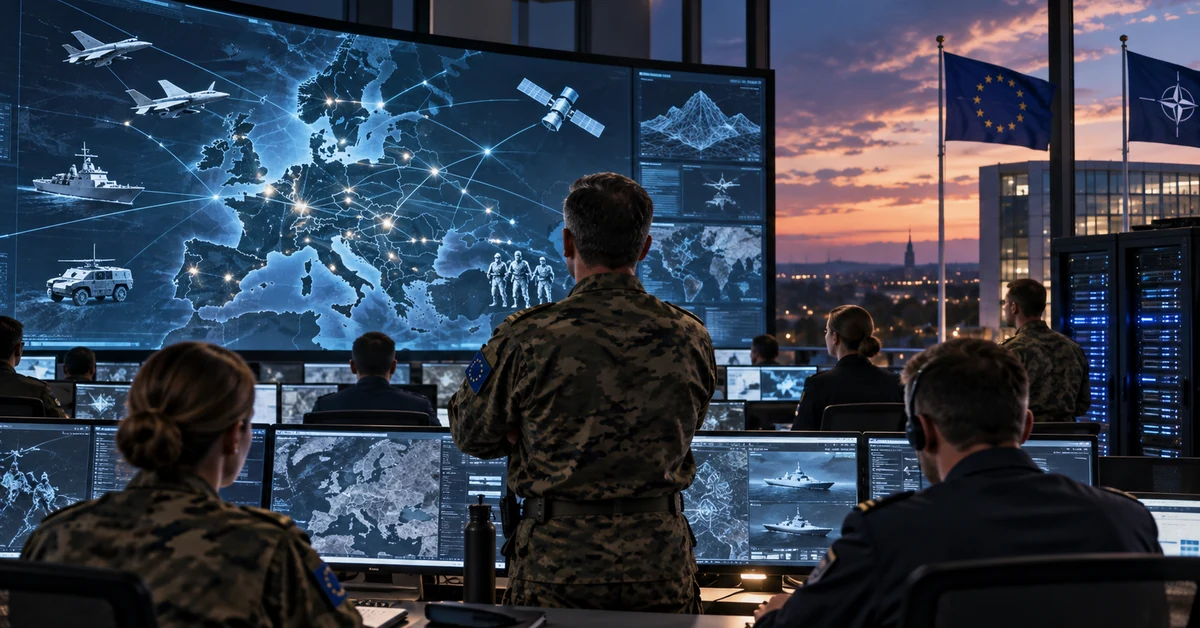
French defence group Thales has unveiled HexaForce, an AI-enhanced command-and-control platform designed to help armed forces process battlefield information and coordinate operations involving more than 100,000 personnel.
Its selling point is not just artificial intelligence.
It is sovereignty.
Thales is explicitly presenting HexaForce as a system that allows countries to retain control of their military data and technology without depending on US export restrictions.
That distinction is becoming increasingly important as artificial intelligence moves deeper into military command.
NATO has already selected US technology company Palantir’s Maven Smart System for use at its headquarters.
Reuters reports that the decision has contributed to European concerns over where sensitive military information is stored and what would happen if Washington were ever to restrict access to American technology.
HexaForce represents the European answer to that problem.
The system operates across land, air, sea, cyber, space and information operations, combining large language models and agentic AI with military command software.
Thales says AI can automatically analyse, correlate and prioritise enormous streams of information from military, civilian and open sources.
During trials, the company says the technology increased the number of targeting objectives that could be processed from 100 to 1,000 per day.
HexaForce has also been tested during NATO’s CWIX 2026 interoperability exercise, where Thales demonstrated its ability to communicate with command systems operated by other allied countries.
The company says its architecture gives national governments control over incoming and outgoing data while allowing them to integrate technology supplied by different vendors.
That is where technological sovereignty stops being an abstract European industrial policy.
If software helps a military understand the battlefield, allocate resources, process targets and coordinate forces, dependence on that software becomes a strategic question.
A country may possess its own soldiers, aircraft, missiles and intelligence.
But if the digital layer connecting them depends upon another country’s companies, export regulations or political consent, part of its military capability ultimately sits outside its own control.
That does not automatically make American technology undesirable.
There is an obvious counterargument: armed forces need the best systems available, and NATO exists precisely because allied countries deliberately depend upon one another.
Interoperability can be more valuable than technological independence.
The problem appears when dependence and interoperability become the same thing.
Europe then faces a trade-off increasingly familiar from cloud computing, semiconductors and artificial intelligence: use the strongest technology available today, or invest in domestic alternatives partly because access tomorrow cannot be guaranteed.
Thales chief executive Patrice Caine added another dimension to that argument on Thursday.
While launching a product built around sovereign control, he called for governments internationally to establish a framework governing AI development.
Technical safeguards, Caine argued, are not enough. Ultimately, decisions about how artificial intelligence develops and what constraints apply to it belong to governments.
Military AI therefore presents governments with two questions simultaneously.
What should these systems be allowed to do?
And who should ultimately control them?
HexaForce is Thales’s answer to the second.
The fact that Europe increasingly feels it needs one tells us how much the technology race has changed.
Sources
- Reuters – Thales urges international framework for AI development
- Thales – HexaForce sovereign command-and-control platform
Join the Dissenting Citizen Newsletter
Independent news and commentary delivered directly to your inbox.
Breaking stories, analysis and commentary throughout the day.
Follow @VoxDissent →