





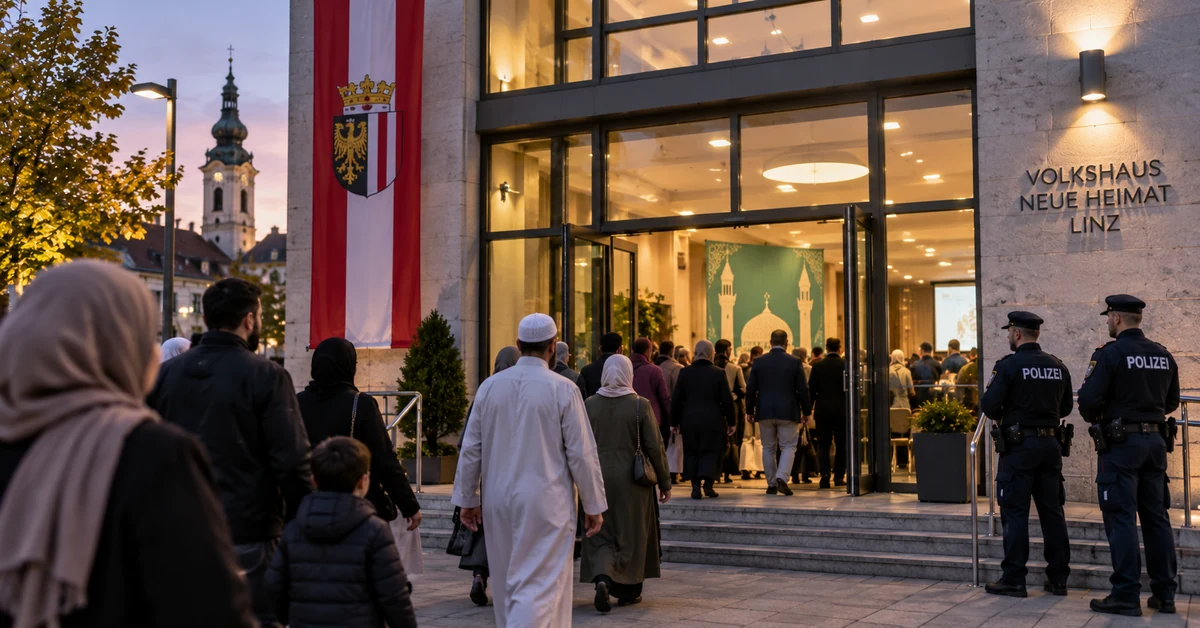
A city-owned hall in Austria is scheduled to host an Islamic religious celebration featuring Turkish speakers who have publicly praised Hamas leaders – including one who later wrote about armed people bearing hatred towards Jews and Zionists.
The event itself is legal.
That is what makes the question facing Linz more difficult.
On September 27, the Austria Linz Islamic Federation, or ALIF, plans to hold a celebration of the Prophet Mohammed at Volkshaus Neue Heimat, a municipal venue in Linz.
Its advertised guests include Turkish theologian Osman Eğin and Şükrü Asileren and Ridvan Akbaş, senior muezzins at Istanbul’s Hagia Sophia.
An investigation by Austrian newspaper Die Presse has documented political statements made by all three.
After Hamas political leader Ismail Haniyeh was killed in 2024, Eğin praised him on Turkish television, saying he had achieved what he wanted and praying that paradise would be his home.
Asileren called for a Hamas solidarity gathering outside Hagia Sophia and described Haniyeh as a martyr.
His rhetoric subsequently went considerably further.
In a later social-media post directed at Israel, Die Presse reports that Asileren referred to armed people who bore “hatred and enmity” towards Jews and Zionists and were unafraid of death or martyrdom.
Akbaş also publicly invoked religious honour for Haniyeh and other dead Hamas figures.
None of that means the September 27 event has been established as unlawful, nor that its advertised purpose – celebrating the Prophet Mohammed – is itself politically remarkable.
The issue is who has been invited to speak inside a building owned by the city.
ALIF belongs to an Austrian network associated with the wider Millî Görüş movement.
Germany’s domestic intelligence service describes Millî Görüş as the country’s largest Sunni Islamist current. Its assessment nevertheless contains an important qualification: not every member of the Islamic Community Millî Görüş pursues extremist objectives, and extremist connections within parts of the organisation have weakened over time.
That makes association alone a poor test for deciding who should have access to public facilities.
The statements of individual speakers present a more concrete problem.
Upper Austrian police told Die Presse that they regard Millî Görüş as part of political Islam and strongly fundamentalist, with elements tending towards placing Sharia above Austrian law.
Linz has so far taken a different institutional approach.
The city says ALIF has rented municipal premises several times previously without problems. Asked about the forthcoming event, officials said organisers could be checked to establish whether the security services held relevant information.
ALIF did not respond to Die Presse’s request for comment.
The disagreement exposes a problem that extends considerably beyond one Austrian hall.
Banning an organisation that commits criminal offences is comparatively straightforward.
Deciding how public institutions should treat organisations operating lawfully while maintaining ideological connections or inviting speakers whose rhetoric is regarded as extreme is much harder.
A city-owned venue is not the same thing as a government endorsement.
Nor does freedom of religion require public authorities to ignore everything said by people invited into publicly owned buildings.
Those principles can collide long before anybody commits an offence.
Austria is already debating how the state should respond to political Islam and organisations such as the Muslim Brotherhood. Those arguments often take place at the level of ideology, intelligence assessments and proposed legislation.
Linz provides something more concrete.
A religious organisation has hired a municipal hall.
The city says previous events caused no problems.
Police identify the wider movement with political Islam.
And invited speakers have publicly made statements about Hamas, martyrdom, Jews and Israel that raise questions extending well beyond religious conservatism.
The difficult question is not whether Austria should permit Muslims to celebrate Mohammed.
Of course it should.
It is what a publicly owned venue should do when the event remains lawful but the people taking its stage bring documented political baggage with them.
Sources
- Die Presse – Mohammed celebration in Linz with speakers who praised Hamas figures
- German Federal Office for the Protection of the Constitution – assessment of Millî Görüş and IGMG
Join the Dissenting Citizen Newsletter
Independent news and commentary delivered directly to your inbox.
Breaking stories, analysis and commentary throughout the day.
Follow @VoxDissent →