








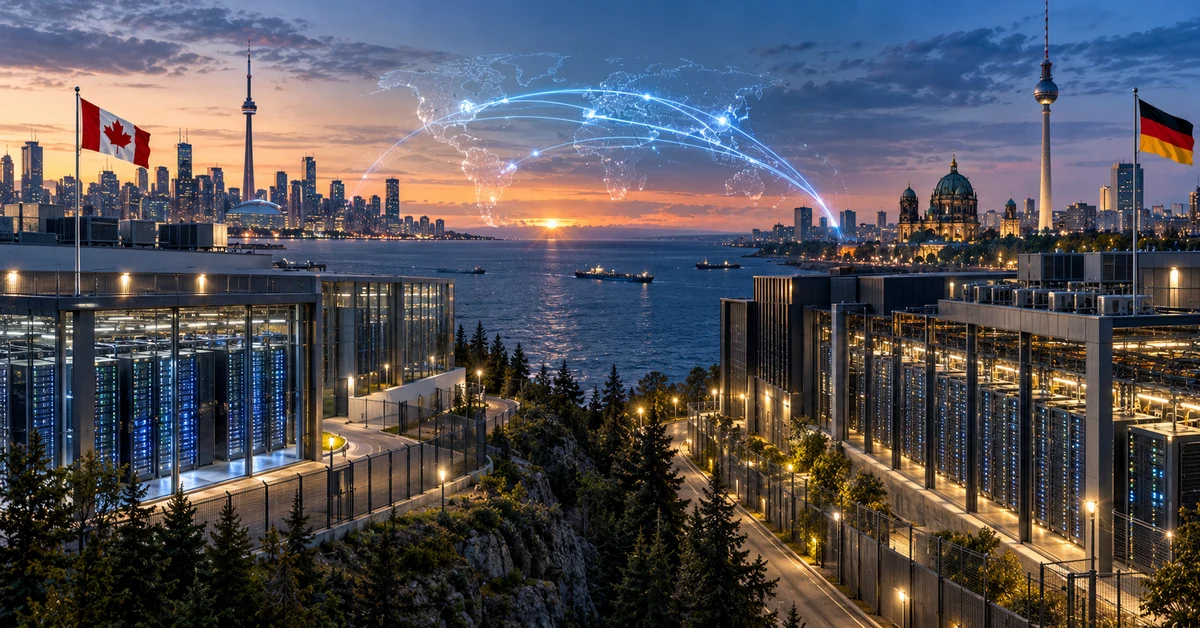
Canada’s Cohere and Germany’s Aleph Alpha have signed a definitive agreement to combine into a business valued at roughly $20 billion, built around an increasingly important idea in the global AI race: governments should not have to depend entirely on foreign-controlled AI infrastructure.
The combined company will operate under the Cohere name, with headquarters in Toronto and Berlin.
Aleph Alpha’s Heidelberg operation will remain as a research centre, while the transaction remains subject to final regulatory approval.
The companies are explicitly positioning the new group around “sovereign AI”.
That means offering governments and regulated industries AI systems capable of operating within computing infrastructure, data controls and legal jurisdictions they control rather than relying entirely on the major US cloud and AI platforms.
Up to 100,000 AI chips in Germany
The corporate combination is only part of the project.
Germany’s Schwarz Group – owner of Lidl and Kaufland – is backing the surrounding infrastructure through its StackIT cloud business.
Reuters reports that associated German computing infrastructure is ultimately expected to accommodate as many as 100,000 AI chips.
That puts physical infrastructure behind an idea Europe has discussed for years.
Technological sovereignty is relatively easy to declare as a political objective.
It becomes something more substantial when it involves data centres, cloud infrastructure, AI models and tens of thousands of advanced chips.
The AI race has another layer
Most discussion of competition in artificial intelligence concentrates on model capability.
Which company has the most intelligent system?
Which country reaches the next capability threshold first?
Sovereign AI introduces another question:
Who owns everything underneath it?
A government can use an extremely capable AI model while still depending upon somebody else for the cloud infrastructure running it, the hardware beneath it, the handling of sensitive data and potentially the legal jurisdiction governing parts of the system.
That dependence matters considerably more when AI moves from consumer chatbots into defence, government administration, healthcare, finance and critical infrastructure.
Cohere and Aleph Alpha are betting that some customers will pay specifically to reduce it.
AI becomes strategic infrastructure
The emerging divide therefore may not simply be between competing AI models.
It could increasingly be between the enormous global platforms operated principally by American technology companies and sovereign or regional AI stacks designed to keep strategically important capabilities under domestic or allied control.
That does not necessarily mean countries abandoning American AI companies.
It means governments may increasingly decide that some systems are too important to depend entirely upon infrastructure controlled elsewhere.
Energy, telecommunications and defence have all produced versions of the same argument.
Artificial intelligence is beginning to join them.
A roughly $20 billion transatlantic company and German infrastructure designed eventually to house as many as 100,000 AI chips suggest “sovereign AI” is starting to become less of a political slogan and more of an industrial strategy.
Sources
- Reuters – Cohere and Aleph Alpha sign definitive combination agreement
- Cohere – official sovereign-AI announcement
Join the Dissenting Citizen Newsletter
Independent news and commentary delivered directly to your inbox.
Breaking stories, analysis and commentary throughout the day.
Follow @VoxDissent →