







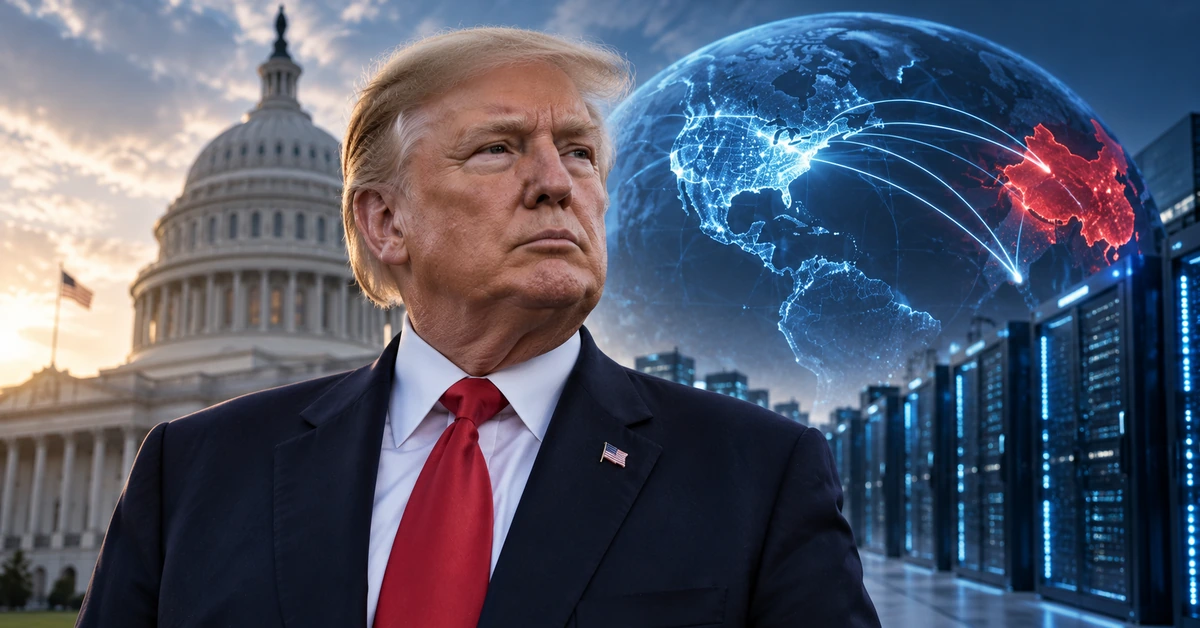
President Donald Trump says he will create a new “AI Force” and appoint an AI czar, setting out an explicitly pro-acceleration approach as Washington debates whether increasingly powerful artificial intelligence requires tighter controls.
Trump announced the initiative on Truth Social and compared the proposed AI Force with the Space Force established during his first presidency.
But the administration has yet to explain what the new organisation will actually be.
It is not clear whether the AI Force will be a civilian organisation, a military body or an inter-agency initiative. No timetable, structure or specific legal powers have been announced.
Trump rejects broad constraints on AI
What is considerably clearer is the policy direction behind it.
Trump said his administration would not “hinder or stifle” the growth of artificial intelligence and argued that America should encourage development while dealing with harmful uses through existing criminal and civil law.
The approach puts economic and technological development at the centre of US AI policy.
It also places competition with China prominently in the argument against imposing broad restrictions that could slow American companies.
Trump’s previous AI czar, venture capitalist David Sacks, stepped down from the formal role earlier this year but has continued advising the administration externally. The identity of his replacement has not been announced.
The powers remain unknown
The announcement comes during a widening argument in Washington and the technology industry over how governments should respond to increasingly capable AI systems.
Some AI executives and researchers have called for stronger safeguards as capabilities increase, while opponents of additional regulation argue that premature restrictions could weaken American companies and give China an advantage.
Trump has now placed himself firmly on the acceleration side of that debate.
His position is increasingly clear: allow American AI development to advance, use existing law against harmful applications and prioritise maintaining the US technological advantage over China.
What remains unknown may ultimately be more consequential.
An AI Force could become a coordinating body, an enforcement organisation, a national-security institution or something considerably less substantial.
Until the White House defines its powers and structure, Trump’s announcement establishes the direction of American AI policy more clearly than it establishes the institution intended to carry it out.
Sources
- The Washington Post: Trump announces AI Force and new AI czar
- Reuters: Trump says he will create AI Force and name AI czar
Join the Dissenting Citizen Newsletter
Independent news and commentary delivered directly to your inbox.
Breaking stories, analysis and commentary throughout the day.
Follow @VoxDissent →