






Saudi Arabia has spent years trying to acquire America’s most advanced fighter aircraft.
Washington has now cleared the way for it to buy 48.
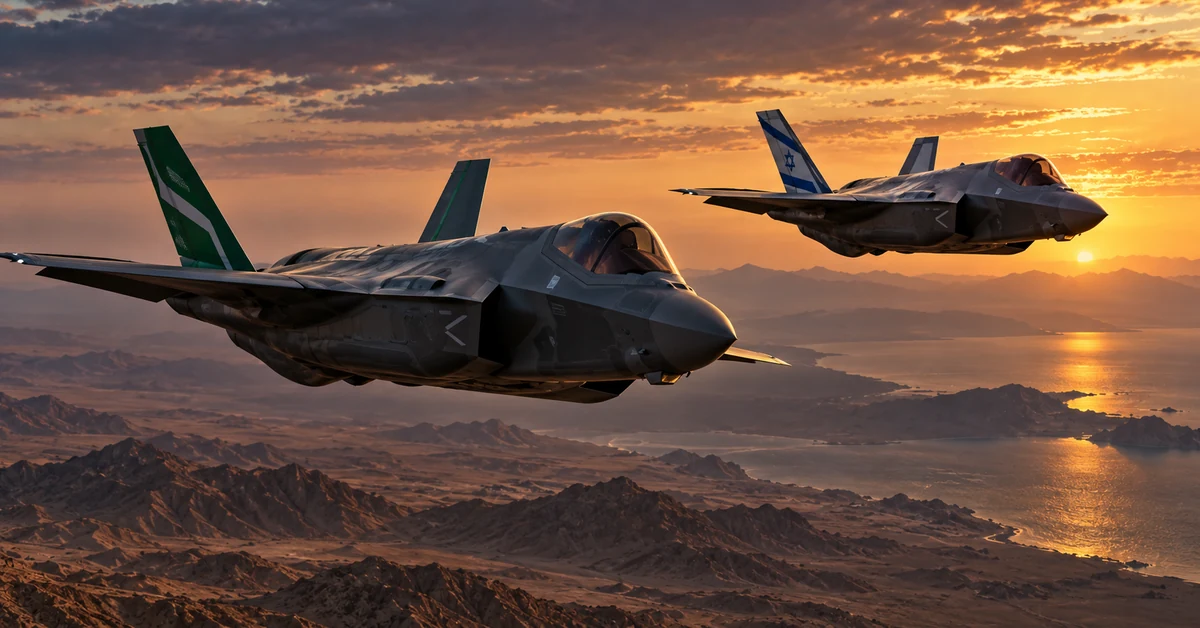
The US State Department has approved a possible $24.3 billion Foreign Military Sale covering 48 F-35 Lightning II fighters, 49 engines and associated equipment. If completed, the deal would make Saudi Arabia only the second Middle Eastern country to operate the aircraft. Israel has been the region’s sole F-35 operator for a decade.
The approval does not mean the aircraft have been sold or are about to arrive. Congress can scrutinise the proposal, negotiations can alter the final package and any eventual delivery would take years.
But it puts a longstanding American commitment under a new test.
Washington is required to consider Israel’s “qualitative military edge” when approving major arms sales in the Middle East. A Saudi F-35 fleet would end Israel’s regional exclusivity over the aircraft while the US continues to promise that Israel will retain superior military capabilities against credible regional threats.
Exclusivity and superiority are not the same thing.
That distinction is central to understanding both why Saudi Arabia wants the aircraft and how Washington could approve the sale while maintaining its commitment to Israel.
Riyadh has sought the F-35 for years as it modernises an air force currently built around American F-15s and European Tornados and Typhoons. Iran has been the principal regional threat driving that effort, and the current Middle East conflict has made Saudi security concerns more immediate.
Iran-aligned Houthi forces are again launching drones and missiles towards Saudi territory, while the wider conflict has placed Gulf states closer to a war involving Iran, Israel and the United States.
For Riyadh, the F-35 would therefore provide more than prestige. Its stealth, sensors and ability to operate as part of a wider combat network would add a capability the Saudi Air Force does not currently possess.
The harder question for Washington is what Saudi ownership would mean for Israel.
Israel’s qualitative military edge does not require every advanced American weapon to remain exclusively Israeli. It requires Israel to retain superior overall military capability against credible regional threats.
Two countries can therefore operate aircraft carrying the same F-35 designation without possessing equivalent combat capability.
Israel operates the F-35I Adir, adapted around Israeli requirements and integrated into a military system developed through years of operational experience. The aircraft sits alongside Israeli weapons, intelligence, electronic warfare, air defence and command capabilities.
A future Saudi fleet would have its own configuration, weapons package, software, support arrangements and restrictions. Saudi pilots and maintenance crews would also have to build experience around an aircraft Israel has already operated in combat for years.
That means the most important details of the proposed sale are not simply the number 48.
Congress will want to know what Riyadh would actually receive.
Which weapons would accompany the aircraft? What software and electronic-warfare capabilities would be available? Would particular systems be withheld or modified? What restrictions would apply to upgrades and support? Would Washington provide Israel with additional capabilities to maintain the required advantage?
Those questions turn QME from an abstract promise into something measurable.
The issue has arisen before.
The United Arab Emirates sought F-35s following the Abraham Accords, and the Trump administration approved a potential sale in 2020. That deal later stalled amid negotiations over US security requirements and concerns about the UAE’s relationship with China.
Saudi Arabia presents a larger strategic case because of the scale of its military relationship with Washington and its position in the regional balance against Iran.
It is already the largest customer for American weapons and has sought to deepen that relationship while also diversifying its defence partnerships. Trump made Saudi arms sales a priority after returning to office, with Washington announcing a defence package worth nearly $142 billion in 2025.
An F-35 agreement would deepen Saudi dependence on American training, maintenance, spare parts and support for decades. It would also give US defence manufacturers one of the largest potential fighter contracts in the region.
But the sale would arrive as Washington is simultaneously strengthening Israel.
The Trump administration is pursuing a separate $2.8 billion munitions package for Israel containing tens of thousands of 2,000-pound bombs, illustrating that American military support for Israel continues alongside the proposed expansion of Saudi capabilities.
That wider relationship matters because military superiority is a system, not a comparison between two aircraft inventories.
Fighter numbers matter. So do weapons, intelligence, surveillance, tankers, air defence, training, maintenance, command networks and the ability to sustain operations over time.
That is why a Saudi F-35 sale would not automatically eliminate Israel’s qualitative edge.
It would make Washington demonstrate where that edge remains.
Congressional scrutiny will provide the first opportunity to examine the answer. Saudi arms deals have faced resistance before, including over the 2018 murder of journalist Jamal Khashoggi, and the strategic implications of providing Riyadh with the F-35 will add another issue for lawmakers to examine.
The eventual configuration will matter more than the approval announced this week.
If Saudi Arabia ultimately receives the aircraft, Israel will no longer be the Middle East’s exclusive F-35 operator. That will make the differences between the two forces more important, not less.
The question is not whether both countries can possess an F-35.
It is whether they possess the same military capability.
Washington’s commitment to Israel’s qualitative military edge will ultimately be measured by the answer.
Sources
- Reuters – US clears potential $24.3 billion Saudi F-35 sale
- Reuters – Trump administration plans $2.8 billion munitions sale to Israel
Join the Dissenting Citizen Newsletter
Independent news and commentary delivered directly to your inbox.
Breaking stories, analysis and commentary throughout the day.
Follow @VoxDissent →