




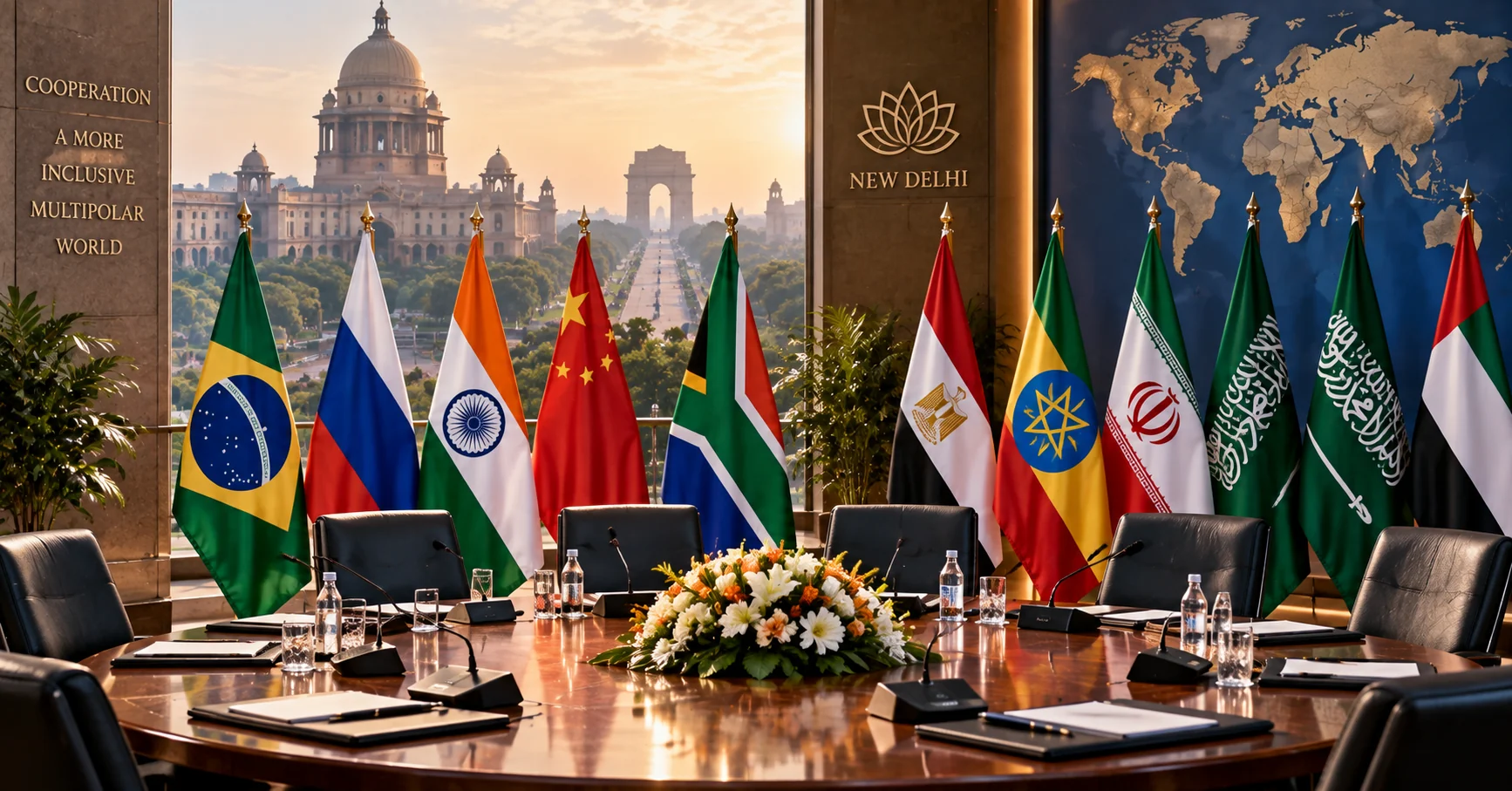
BRICS negotiators have agreed a joint declaration ahead of the group’s New Delhi leaders’ summit, overcoming internal divisions that prevented its foreign ministers from reaching agreement earlier this year.
Four sources told Reuters that negotiators had settled the text, which is expected to be approved by BRICS leaders.
The declaration is expected to condemn unilateral war by any country without identifying individual states.
That wording is significant because BRICS contains governments taking opposing positions in the current Gulf conflict.
Iran and the United Arab Emirates are both members of the grouping despite standing on different sides of the regional confrontation.
Finding language acceptable to both therefore represents a diplomatic achievement for a bloc whose expanding membership has made consensus increasingly difficult.
In May, BRICS foreign ministers failed to produce a joint statement because members could not overcome their disagreements.
The latest agreement demonstrates that those differences do not necessarily prevent collective positions from being reached.
But the wording also illustrates one of BRICS’ fundamental limitations.
The broader and more politically diverse the grouping becomes, the harder it is to adopt specific positions without alienating individual members.
BRICS nevertheless represents enormous demographic and economic weight.
Its members account for more than 40% of the world’s population and almost a quarter of global GDP.
The grouping is also pushing for reforms of institutions including the International Monetary Fund, World Bank and World Trade Organization as its members seek greater influence over the international economic system.
That makes the development of a coherent BRICS political position increasingly important.
Its scale gives the grouping the potential to become a significant alternative centre of global influence.
Its internal diversity simultaneously makes sustained political coordination difficult.
The New Delhi declaration demonstrates both realities.
BRICS can find common ground.
The harder test is whether it can turn that common ground into coordinated action when its members’ national interests diverge.
The question is whether BRICS becomes a genuine alternative centre of global power, or a coalition whose members agree most easily on what they oppose.
More to follow.
Source: Reuters, 12 September 2026
Join the Dissenting Citizen Newsletter
Independent news and commentary delivered directly to your inbox.