








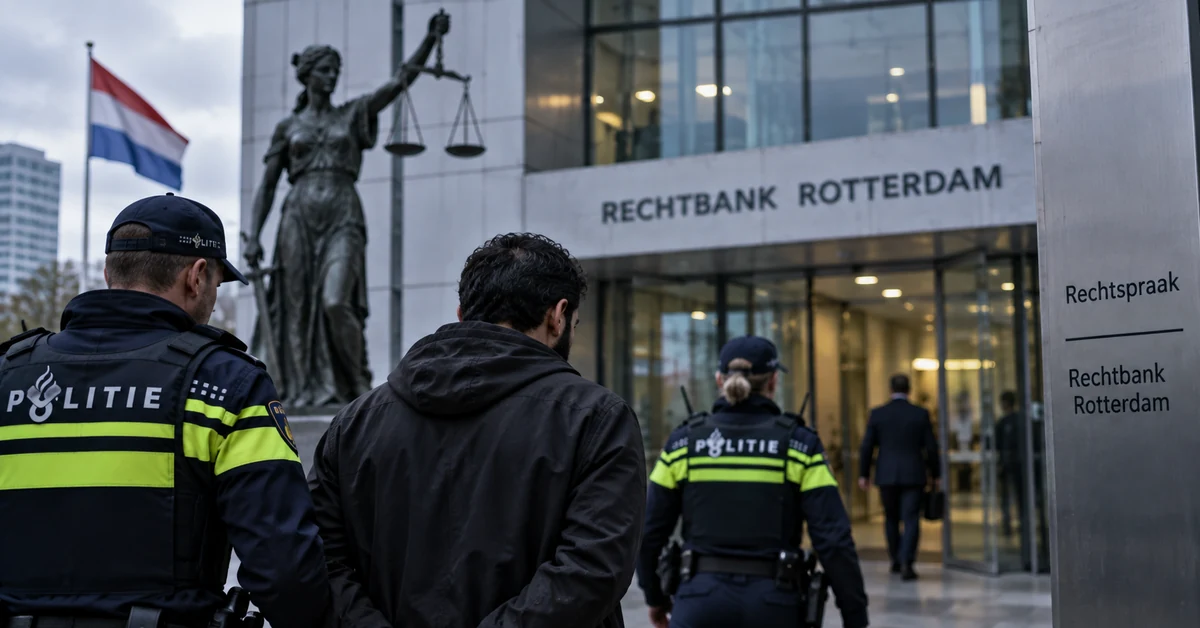
Dutch prosecutors are seeking a 17½-year prison sentence for a Syrian man they allege was a senior Islamic State security chief before he travelled to the Netherlands and received asylum.
Ayham A., 41, is accused of heading part of ISIS’s Amni security apparatus in southern Damascus between 2013 and 2018.
Prosecutors told a Rotterdam court that he oversaw detention centres where suspected opponents of ISIS were tortured and killed.
A. denies ever belonging to ISIS and says witnesses have confused him with somebody else.
Asylum granted in 2019
The case raises a separate question about how A. obtained residency in the Netherlands.
He applied for asylum in 2019 and received a Dutch residence permit that year.
But according to NOS, A. had already been identified by his full name in international reporting in 2018 as the alleged ISIS commander known as Abu Khaled al-Amni.
That reporting described him as an emir within the group’s security apparatus in southern Damascus.
After his arrest in the Netherlands in 2023, the Dutch immigration service declined to discuss his individual asylum case.
Public allegations do not establish guilt, and it is not clear what information Dutch immigration authorities possessed or considered when A.’s application was assessed.
Prosecutors say witnesses identify him
The case now presented by Dutch prosecutors goes beyond the earlier media reports.
Numerous witnesses have identified A. as Abu Khaled al-Amni, according to prosecutors.
They say the alias also appears in ISIS administrative documents recovered by US forces and that photographs and video show A. alongside senior members of the organisation.
Prosecutors allege that he gave orders to guards and was present at ISIS detention facilities.
Those facilities were allegedly used to imprison and punish people regarded by ISIS as opponents, spies, traitors or apostates.
Prosecutors described a system involving torture, amputations and executions.
They have not established that A. personally carried out specific killings. Instead, they argue that his alleged command position made him responsible for crimes committed within the system he oversaw.
Defence disputes his identity
A. denies that he was the ISIS security chief described by prosecutors.
He says multiple people used the name Abu Khaled and that witnesses have identified the wrong man.
His lawyers have also challenged the prosecution’s reliance on anonymous witnesses, arguing that the defence has not been able to question some of them adequately.
The court has not yet determined whether A. is guilty.
That leaves two separate issues.
The first is whether prosecutors can prove that the Syrian man living in the Netherlands is the ISIS commander they allege him to be.
The second is how a man whose name and alleged role within ISIS had already appeared publicly in 2018 received Dutch residency the following year.
Whatever the outcome of the criminal trial, that asylum-screening question remains.
Sources
- NOS – prosecutors seek 17½ years over alleged ISIS leadership role
- RTL Nieuws – prosecution case and asylum background
- NOS – 2023 reporting on A.’s identification before receiving residency
Join the Dissenting Citizen Newsletter
Independent news and commentary delivered directly to your inbox.
Breaking stories, analysis and commentary throughout the day.
Follow @VoxDissent →