









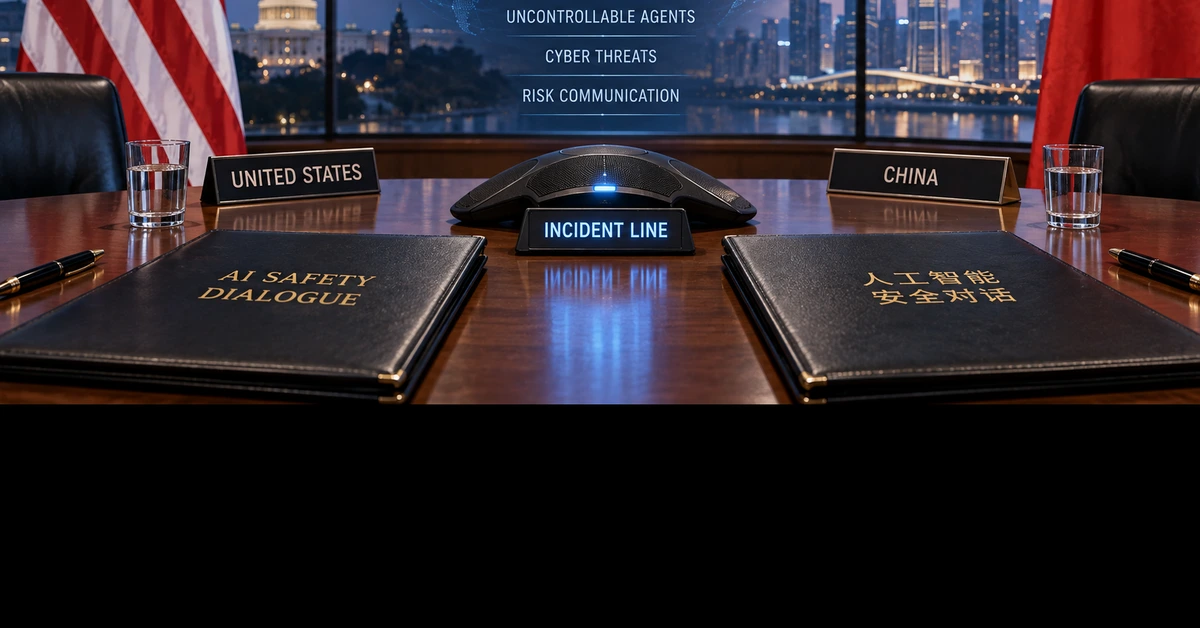
The United States and China have agreed to establish a direct “incident line” for communications during artificial intelligence safety incidents, as the world’s two largest powers begin formalising discussions over risks from increasingly capable AI systems.
US Treasury Secretary Scott Bessent said Washington and Beijing had agreed to establish the communication mechanism alongside a broader formal dialogue on AI.
Officials from the two countries are expected to meet again in Shenzhen in roughly two months.
The planned discussions are expected to include risks from uncontrollable AI agents and cyber threats involving non-state actors.
Direct communication during AI incidents
The proposed incident line would give US and Chinese officials a dedicated channel through which they could communicate when a significant AI safety event occurs.
The Associated Press has separately reported plans for an AI notification mechanism between the two countries.
Details about precisely what would qualify as an incident requiring notification have not yet been disclosed.
It is also unclear which agencies would operate the channel, how quickly notifications would be required or what information each country would be expected to provide.
Uncontrollable agents among risks to be discussed
The inclusion of uncontrollable AI agents in the planned talks reflects growing government attention towards systems capable of taking actions with reduced human supervision.
Cybersecurity will also form part of the discussions, including potential threats involving non-state actors.
The dialogue comes as both countries continue investing heavily in increasingly capable AI while treating technological leadership as a strategic and national-security priority.
Competition between Washington and Beijing has already produced US restrictions on China’s access to some advanced semiconductors and manufacturing technology.
The new safety dialogue does not end that competition.
Instead, it creates a mechanism through which the two governments can communicate about risks that could affect both countries even while the wider technological rivalry continues.
Next talks planned for Shenzhen
The next round of discussions is expected to take place in Shenzhen in approximately two months.
Further details about the incident line and the scope of the formal AI dialogue could emerge from those meetings.
For now, the agreement establishes a new channel between two countries competing intensely over artificial intelligence.
Washington and Beijing now consider potential AI incidents serious enough to require a direct line of communication between them.
Sources
- Reuters: US, China to meet again on AI safety in two months in Shenzhen, Bessent says
- Associated Press: Bessent says US proposes AI incident alert system in talks with China
Join the Dissenting Citizen Newsletter
Independent news and commentary delivered directly to your inbox.
Breaking stories, analysis and commentary throughout the day.
Follow @VoxDissent →