









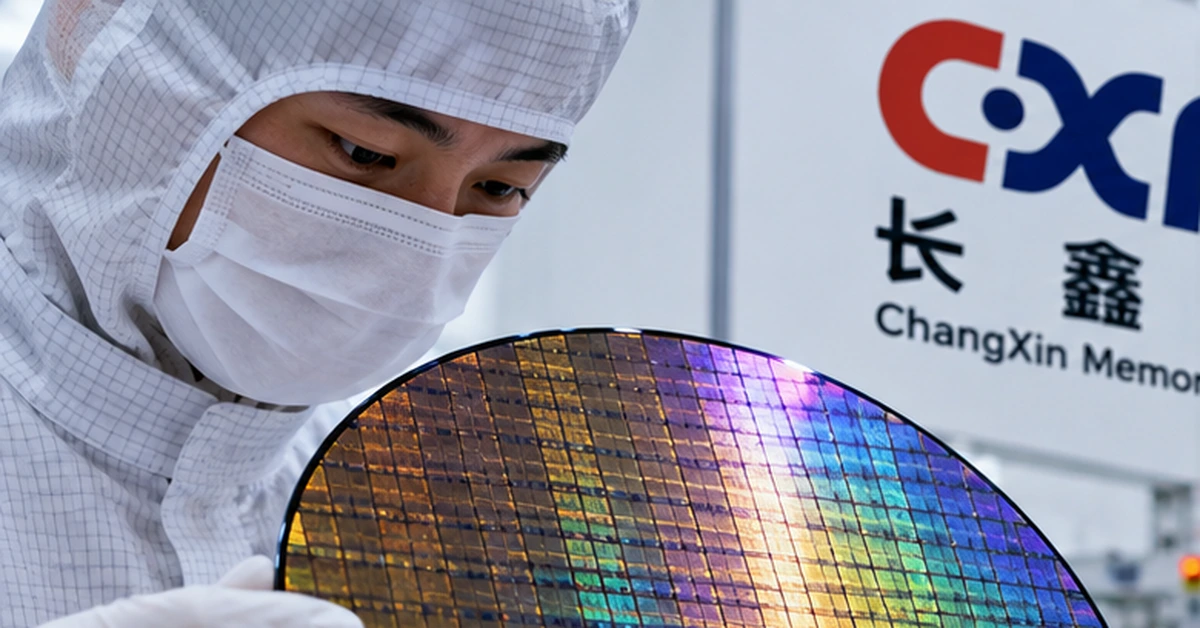
Chinese memory-chip manufacturer CXMT says its fifth-generation DRAM manufacturing platform has entered mass production, marking another step in China’s attempt to build an advanced domestic semiconductor industry despite US technology restrictions.
The company says its latest process reduces memory-cell spacing to 11.95 nanometres using quadruple patterning, a manufacturing technique that allows increasingly small features to be produced without relying solely on the most advanced lithography equipment.
CXMT says the process can increase the number of usable chip dies produced from each wafer by at least 50% compared with its previous generation.
The company has also unveiled new 24-gigabit LPDDR5X memory products manufactured using the platform.
The important phrase is ‘mass production’
Individual semiconductor breakthroughs attract attention, but demonstrating a new process is different from manufacturing it repeatedly at industrial scale.
CXMT’s announcement matters because the company says the technology has moved beyond development and into mass production.
That distinction is particularly important in the competition between China and the United States over advanced computing.
US export controls have sought to restrict China’s access to some of the equipment and technologies required to manufacture leading-edge semiconductors.
China’s response has included substantial investment in developing domestic alternatives and expanding its own semiconductor manufacturing capacity.
CXMT’s use of quadruple patterning illustrates one route manufacturers can pursue when access to more advanced lithography technology is constrained.
The technique involves additional manufacturing complexity, and CXMT’s performance and production claims have not been independently established simply by the company’s announcement.
But the strategic objective is clear.
Memory becomes part of the AI competition
Much of the semiconductor competition between China and the United States has focused on processors used for artificial intelligence.
Memory is another critical part of the same computing infrastructure.
AI servers, smartphones, computers and other advanced electronics require large quantities of increasingly fast and efficient memory.
Being able to manufacture those components domestically reduces dependence on foreign suppliers and makes technology restrictions more difficult to enforce across an entire computing supply chain.
The significance of CXMT’s announcement therefore extends beyond another new memory chip.
Export controls are intended to constrain China’s access to advanced semiconductor technology.
CXMT’s answer is to turn domestic technological progress into industrial-scale production.
That is the point at which semiconductor self-reliance begins moving from a research objective to manufacturing capacity.
Sources
Join the Dissenting Citizen Newsletter
Independent news and commentary delivered directly to your inbox.
Breaking stories, analysis and commentary throughout the day.
Follow @VoxDissent →