





Millwall and West Ham will meet for the first time in 14 years on Saturday.
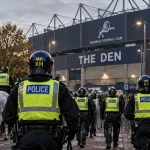
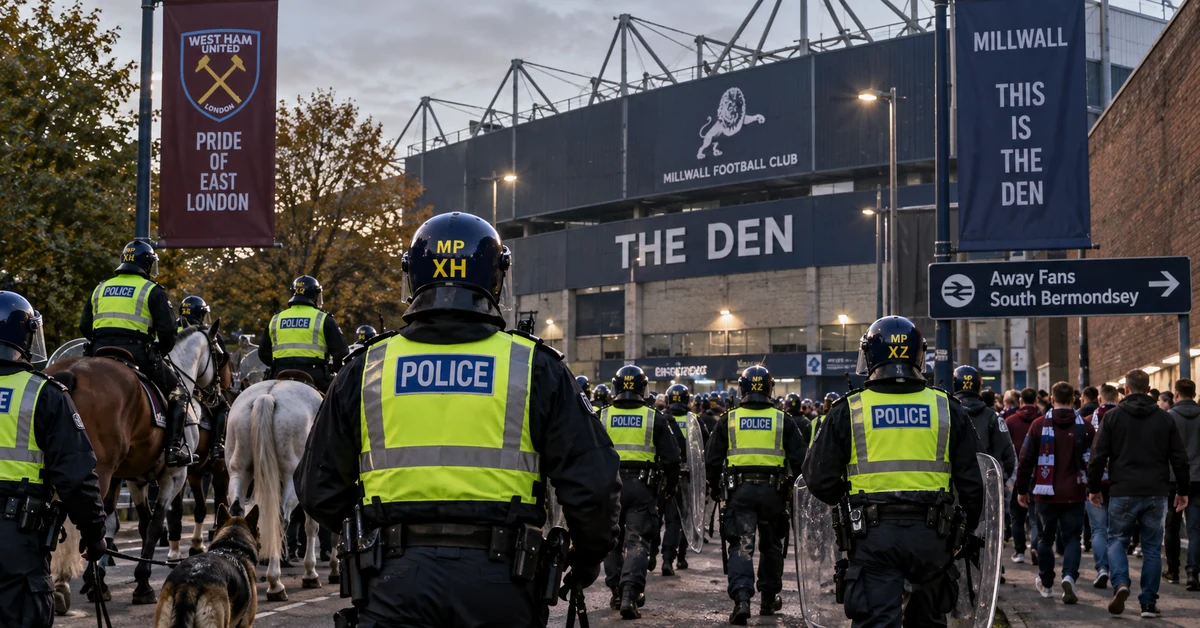
The Metropolitan Police is preparing for the occasion with around 400 public-order-trained officers, all wearing riot gear, although without shields. Mounted officers and dog units will also be deployed around The Den.
A normal Championship fixture typically requires between 60 and 150 officers.
That disparity tells its own story. Millwall and West Ham have not played competitively since 2012, yet the reputation of their rivalry remains powerful enough to shape an extraordinary policing operation before a ball has been kicked.
Saturday will test whether that reputation still reflects reality.
Police have spent months preparing with both clubs. A Section 35 dispersal order will cover the area around The Den, allowing officers to remove people involved in disorder or antisocial behaviour, while travel arrangements are designed to keep rival supporters apart.
West Ham fans are being directed through South Bermondsey station and along the dedicated walkway to the away end. Millwall supporters face restrictions on using the station at certain times, while away fans arriving elsewhere may be redirected.
The strategy is straightforward: separate supporters where possible, control their movement around the stadium and give officers powers to intervene before smaller incidents develop into larger confrontations.
The match has also been given a 12.30pm Saturday kick-off. Police have reminded supporters that entering or attempting to enter a designated football ground while drunk is prohibited under the Sporting Events Act.
None of those measures means disorder is inevitable. They reflect a risk assessment built partly around the history of a fixture that has spent more than a decade absent from English football.
Millwall and West Ham last played competitively in February 2012, when West Ham won 2-1 at Upton Park during their previous season in the Championship.
The rivalry’s reputation was cemented long before that, but its most notorious recent chapter came in the League Cup in August 2009.
A Millwall supporter was stabbed outside Upton Park during serious disorder surrounding the match, while supporters repeatedly invaded the pitch during West Ham’s 3-1 extra-time victory.
West Ham were subsequently fined £115,000 by the Football Association after being found guilty of failing to prevent supporters entering the field and of violent, threatening, obscene and provocative behaviour. Millwall were cleared of the charges brought against them.
Seventeen years have passed since that night.
That gap creates an unusual problem for Saturday’s policing operation. The Met has to prepare for the risk associated with the fixture’s history without assuming that the behaviour which created that reputation will necessarily be repeated by the supporters attending in 2026.
Football has changed during that period. Stadium surveillance is more extensive, banning orders provide authorities with tools against known troublemakers and ticketing and transport arrangements make it easier to control how rival supporters reach grounds.
The people attending have changed too. Many younger Millwall and West Ham supporters have never experienced a competitive derby between the clubs.
Yet reputations can survive long after the events that created them.
That can become self-reinforcing. A fixture associated with hooliganism receives exceptional policing because of its reputation. The exceptional policing then becomes further evidence that the fixture remains uniquely dangerous.
The Met cannot simply assume the reputation is outdated. The consequences of underestimating a high-risk fixture could be serious, and the 2009 disorder provides an obvious reason for caution.
But Saturday provides something police have not had for 14 years: current evidence.
Four hundred officers will be available to manage the return of the rivalry. Supporters will be separated through controlled travel arrangements, mounted police and dogs will be present, and officers will have additional dispersal powers around the stadium.
If serious disorder occurs despite those precautions, the fixture’s reputation will acquire a new chapter.
If the day passes peacefully, interpreting that outcome will be harder. It could mean the rivalry has changed. It could mean the policing operation worked. Most likely, nobody will be able to separate the two completely.
That uncertainty is part of preventative policing. Success often means the event everybody prepared for never happens.
What Saturday can establish is whether the first Millwall-West Ham match since 2012 resembles the fixture remembered from its past.
The reputation built around this rivalry has survived all 14 years of its absence.
Saturday is not simply a test of the policing operation. It is a test of whether one of English football’s most enduring reputations still reflects reality.
Sources
- The Standard – 400-officer deployment and public-order operation
- West Ham United – Official supporter travel guidance
Join the Dissenting Citizen Newsletter
Independent news and commentary delivered directly to your inbox.
Breaking stories, analysis and commentary throughout the day.
Follow @VoxDissent →