





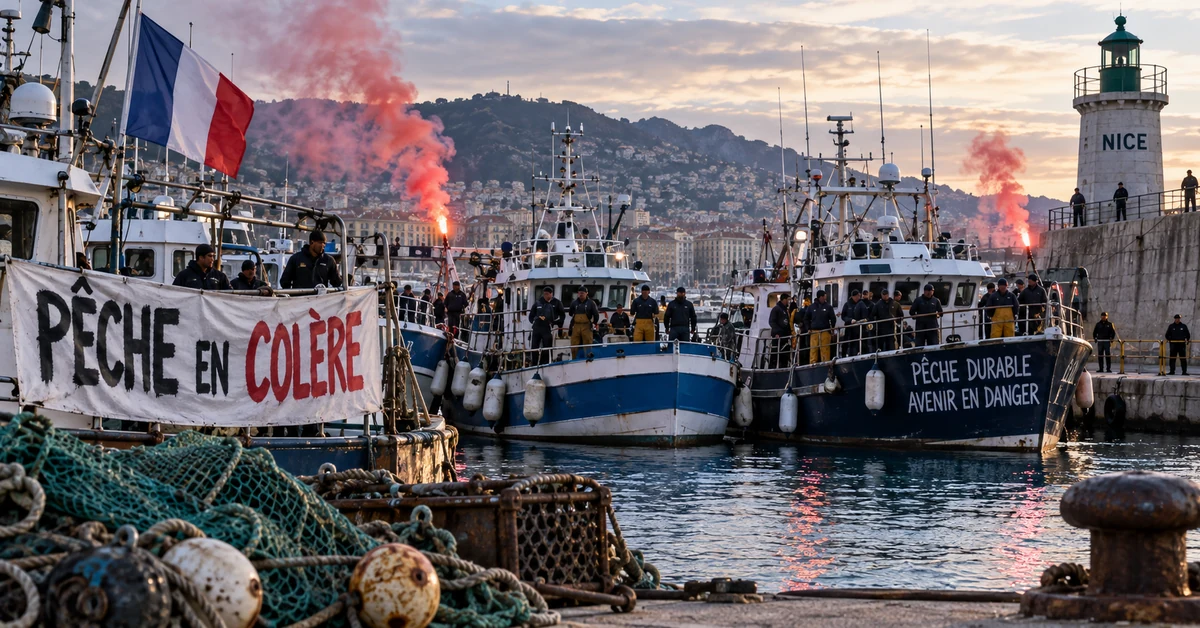
French fishermen blockaded Mediterranean ports on Thursday despite the government increasing fuel support for the industry from 25 to 35 centimes per litre.
The protests arrive at an awkward moment for Prime Minister Sébastien Lecornu. His government is proposing around €54 billion of savings against projected 2027 spending while rising energy prices are creating pressure for precisely the kind of state support it is trying to restrain.
The fishermen’s protests illustrate why individual savings become difficult once they leave a spreadsheet.
Fishing boats obstructed access at ports including Nice on September 17 as crews protested against fuel costs driven higher by the latest Middle East energy shock. The demonstrations followed Lecornu’s announcement a day earlier that emergency fuel measures covering fishing, agriculture and construction would remain in place until the end of 2026.
For fishermen, the intervention is substantial at the pump. The subsidy rises by 10 centimes to 35 centimes per litre, reducing the amount crews themselves must absorb from higher fuel prices. The total additional cost to the French state has not yet been established publicly.
France entered the latest energy shock with an existing deficit problem. Lecornu wants to bring the deficit down to 5% of GDP in 2027 and says that without his proposed savings programme it could exceed 6.5%.
This year’s finances are already weaker than planned. Finance Minister Roland Lescure has acknowledged that France will miss its previous target of holding the 2026 deficit to 5% of GDP, although Lecornu says measures already taken should keep it below 5.5%.
Higher energy prices now add pressure from another direction.
Fishing is particularly exposed because fuel represents a significant operating cost and vessels have limited ability to reduce consumption without spending less time at sea. That can leave operators facing higher costs while reducing the activity needed to generate revenue.
“Fishermen are being strangled, suffocated,” Gérard Corrodano, a fishermen’s representative in La Ciotat, told Reuters.
Temporary support can help otherwise viable businesses continue operating through a price shock. The fiscal calculation is therefore not simply the cost of the subsidy: ministers also have to consider the employment, economic activity and tax revenue that could be lost if businesses reduce operations or fail.
There is an important distinction between the current intervention and next year’s budget. The fuel measures are scheduled to expire at the end of December 2026, while Lecornu’s €54 billion savings programme concerns projected expenditure in 2027.
If the support expires as planned, it remains principally a 2026 expense. If energy prices remain high and affected industries demand another extension, the government could enter 2027 facing spending pressures that were not part of its original plan. Persistent energy costs could also weaken growth and tax receipts even if the subsidy disappears.
Whether that happens will depend partly on energy prices. The more immediate obstacle to Lecornu’s 2027 plan is parliament.
France’s National Assembly has no governing majority. The Socialists have ruled out supporting the budget in its current direction after helping the government secure the previous package, while Marine Le Pen’s National Rally has threatened to oppose measures including a possible suspension of inflation-linked pension increases.
Lecornu has promised not to use Article 49.3 to force the budget through without a vote. The government therefore needs to construct enough parliamentary support or abstentions for individual savings measures to survive.
That turns an accounting exercise into a series of political choices. A pension freeze affects pensioners. Reduced local-government funding affects councils and services. Removing business support affects employers and workers whose costs may already have risen for reasons outside their control.
The €54 billion figure can therefore describe the government’s intended fiscal adjustment without revealing how much of it will prove politically achievable.
The fishermen provide an early example. Their fuel costs rose, boats appeared at ports and the government increased support. Other proposed savings will encounter different groups with their own arguments about why they should not carry the adjustment.
Energy prices make those negotiations harder because France does not control the original shock. Ministers can influence how its costs are distributed, but they cannot determine the international price of oil or gas.
The next few months will show whether the current measures remain genuinely temporary. The fishermen’s subsidy is due to expire in December, and the total cost of the extension will show how significant the intervention has been for this year’s finances. Energy prices will help determine whether pressure builds for support to continue into 2027.
Then parliament will determine how much of Lecornu’s proposed adjustment survives.
Those outcomes provide a clearer measure of France’s fiscal position than the €54 billion headline alone: which savings are actually enacted, which temporary support measures actually end, and whether the resulting package moves the 2027 deficit towards the government’s 5% target.
France’s challenge is not simply identifying savings against projected spending. It is persuading parliament and the people affected to accept enough of them while economic conditions are making restraint harder to sell.
The government will set out the arithmetic in its budget.
Whether that arithmetic is politically achievable will be decided outside it.
Sources
- Reuters – French fishermen blockade ports as budget fight looms
- Reuters – France extends targeted fuel aid measures through year-end
Join the Dissenting Citizen Newsletter
Independent news and commentary delivered directly to your inbox.
Breaking stories, analysis and commentary throughout the day.
Follow @VoxDissent →