









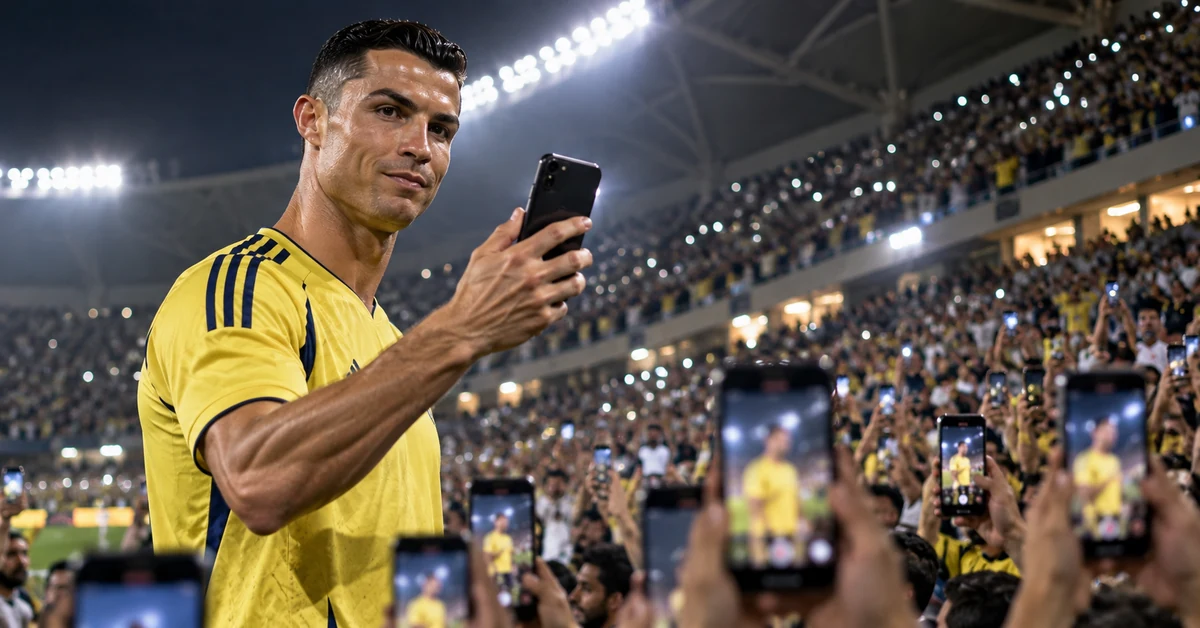
Cristiano Ronaldo can already sell shirts, tickets and sponsorships simply by attracting attention.
Now he could help sell the match itself.
The Saudi Pro League has launched a new international distribution system allowing its players and approved content creators to promote live matches directly to their followers – and receive a share of the revenue they generate.
It changes a relationship that has defined televised football for decades.
Traditionally, a league sells broadcasting rights to a television company or streaming service, which then sells access to viewers.
Under the Saudi model, the player can become part of the distribution network.
Fans in 16 countries, including the UK and Ireland, will be able to buy individual matches or bundles through Saudi Pro League-owned channels. Players, clubs and approved creators can promote those matches through their own audiences and receive a cut when they generate sales.
Cristiano Ronaldo provides the most extreme example of what that could mean.
With more than one billion followers across his social-media accounts, Ronaldo already possesses an audience comparable in scale to a global media network. If he participates, a link promoted to his followers could turn some of that audience directly into paying viewers – with Ronaldo sharing in the resulting revenue.
The player would no longer merely be the reason people buy the broadcast. He would help distribute it.
Selected third-party publishers can go further by hosting official live and on-demand Saudi Pro League content on their own platforms, subject to league approval.
The technology is being supplied by Recast, whose system handles monetisation and revenue sharing.
This is not an attempt to abolish conventional broadcasting. The Saudi Pro League says it still has 45 international broadcast partners covering more than 180 territories, and describes the new system as an additional route to viewers.
That makes the experiment more interesting.
The league does not need to prove that creators can replace broadcasters. It needs to establish whether players and online personalities can reach audiences that broadcasters either cannot reach or cannot reach as efficiently.
Football has spent years discovering that players can build audiences independently of their clubs. Some of the biggest now operate their own enormous media ecosystems across Instagram, X, YouTube and other platforms.
The Saudi experiment asks what happens when those audiences become commercially useful for distributing the actual sport.
If the model works, the valuable asset is no longer simply Ronaldo the footballer.
It is Ronaldo the footballer, Ronaldo the audience – and potentially Ronaldo the distribution channel.
Sources
- Saudi Pro League – SPL opens new route to international fans with innovative distribution model
- PA via Yahoo Sports – Cristiano Ronaldo could cash in under new Saudi Pro League streaming model
Join the Dissenting Citizen Newsletter
Independent news and commentary delivered directly to your inbox.
Breaking stories, analysis and commentary throughout the day.
Follow @VoxDissent →