








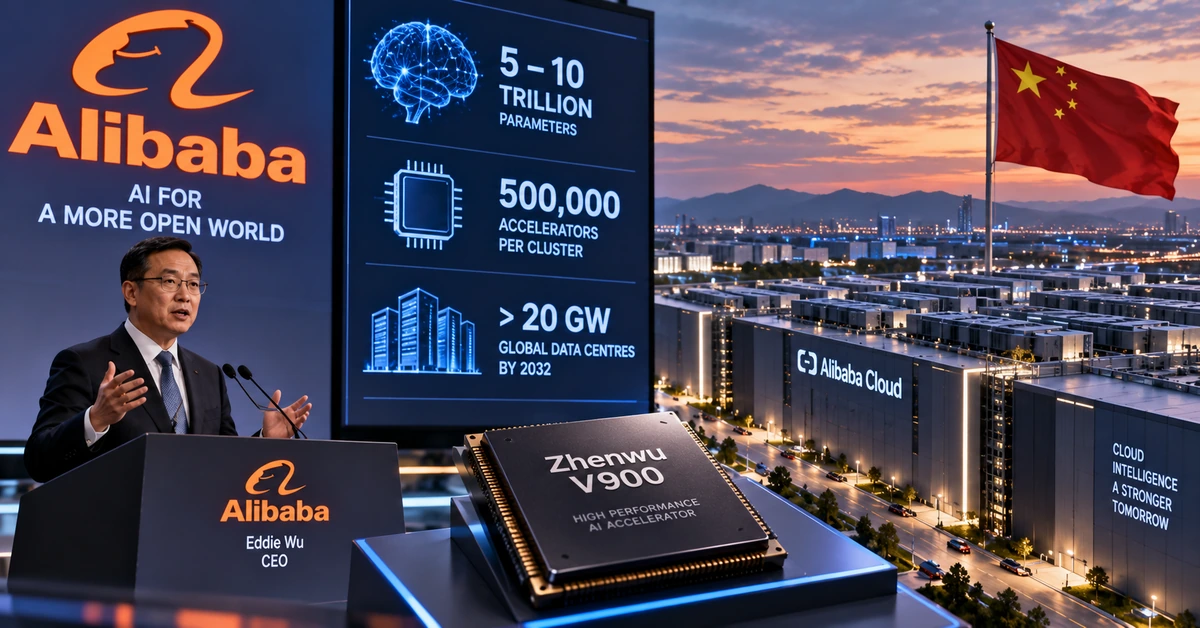
Alibaba has announced plans to develop an AI model containing between 5 trillion and 10 trillion parameters as the Chinese technology group simultaneously expands its domestic AI chips and data-centre infrastructure. The planned model would be substantially larger by parameter count than Alibaba’s current Qwen3.8-Max flagship, which has 2.4 trillion parameters. Parameter count alone, however, does not establish that a model will be more capable.
CEO Eddie Wu announced the plans on Tuesday as Alibaba laid out the next stage of its AI infrastructure expansion. Alongside the larger model, the company unveiled the Zhenwu V900, a new AI accelerator that Alibaba says delivers approximately three times the performance of its previous M890 chip. The V900 is designed to operate at enormous scale, with Alibaba saying systems could eventually combine as many as 500,000 accelerators in a single cluster.
Alibaba is also planning a major expansion of the physical infrastructure required to run increasingly large AI systems. The company intends to increase Alibaba Cloud’s global data-centre capacity to more than 20 gigawatts by 2032, building out computing infrastructure both inside China and internationally. The scale of that target illustrates how the AI competition is increasingly becoming an energy and infrastructure contest as well as a race to build better models and processors.
The strategy is unfolding as US export controls continue to restrict Chinese access to Nvidia’s most advanced AI processors. Those restrictions have increased the incentive for Chinese technology companies to develop domestic alternatives rather than remain dependent on hardware whose availability can be constrained by Washington. Alibaba’s Zhenwu programme is part of that broader effort to establish a Chinese supply of high-performance AI accelerators.
Alibaba is therefore attempting to scale several parts of the AI stack simultaneously rather than concentrating solely on model development. Its plans combine increasingly large Qwen models, domestically developed accelerators and a substantial expansion of the data centres needed to train and operate them.
The numbers give an indication of the scale being targeted: 5–10 trillion parameters, clusters containing as many as 500,000 AI accelerators, and more than 20 GW of global data-centre capacity by 2032. As restrictions continue to shape China’s access to American AI hardware, Alibaba is investing in the models, chips and physical computing capacity needed to build more of the stack itself.
Sources
Join the Dissenting Citizen Newsletter
Independent news and commentary delivered directly to your inbox.
Breaking stories, analysis and commentary throughout the day.
Follow @VoxDissent →