









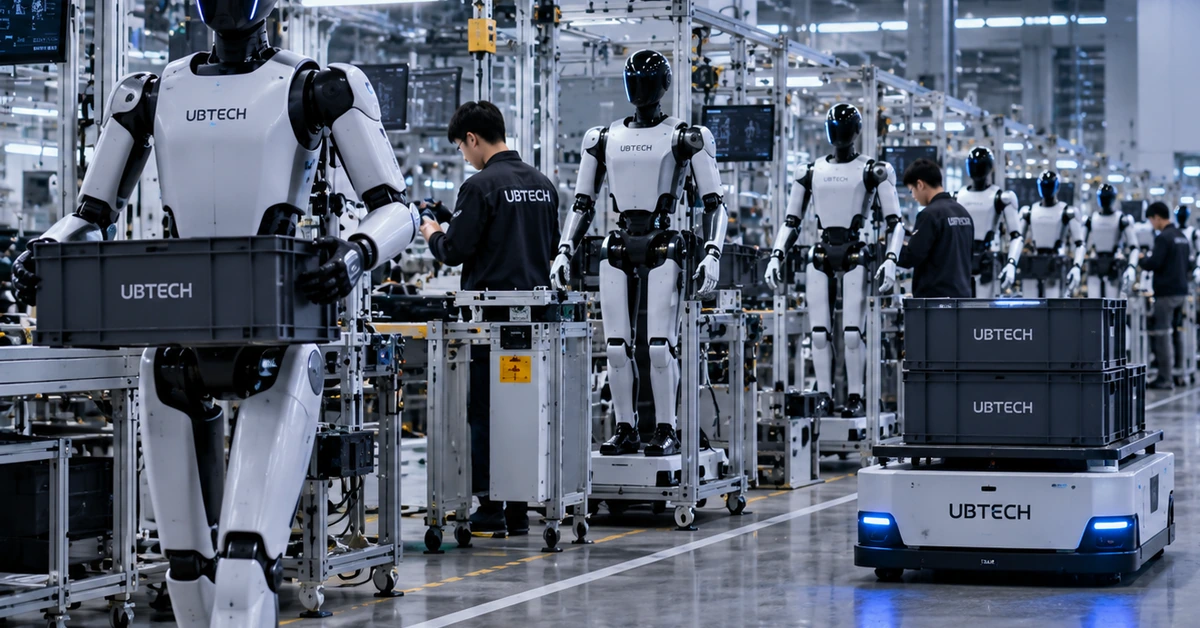
Chinese robotics company UBTECH says its new humanoid manufacturing facility has been designed to produce one completed robot every 10 minutes as it prepares to manufacture the machines at industrial scale.
The 14,000-square-metre factory in Liuzhou has annual production capacity for more than 10,000 humanoid robots, according to the company.
UBTECH says the facility combines automated logistics, collaborative robots and humanoids performing some material-handling tasks within the production process.
Each completed robot undergoes more than four hours of testing before leaving the factory.
The one-robot-every-10-minutes figure is UBTECH’s stated production capability rather than an independently audited sustained production rate.
Robots helping manufacture robots
Footage released by UBTECH shows a heavily automated production facility with humanoid robots operating alongside other industrial automation.
Humanoids can be seen moving materials around the factory as other robots progress through the manufacturing process.
That does not make the plant an autonomous factory in which humanoids independently manufacture complete robots.
Instead, the facility combines conventional automation, human workers and robots in different parts of the production process.
The significance is the scale UBTECH is now targeting.
Humanoid robotics companies have spent years demonstrating machines capable of walking, manipulating objects and performing individual industrial tasks.
Producing those machines cheaply and repeatedly is a separate challenge.
UBTECH’s Liuzhou facility is designed to move that process towards mass manufacturing, with capacity measured in thousands of humanoids per year rather than individual prototypes.
The company says the production line can turn out a completed robot every 10 minutes.
If that rate can be sustained as production expands, the humanoid race is moving beyond proving that robots can work and towards proving that they can be manufactured at industrial scale.
Sources
Join the Dissenting Citizen Newsletter
Independent news and commentary delivered directly to your inbox.
Breaking stories, analysis and commentary throughout the day.
Follow @VoxDissent →